
Girish Challa
Python Backend & AI Automation Developer
New to Contra
Girish Challa is ready for their next project!



A personal developer portfolio website showcasing my experience, technical skills, projects, and software development work across full-stack development, backend engineering, and AI/ML.
The portfolio brings together selected projects covering modern web applications, REST APIs, databases, cloud deployment, machine learning, NLP, and software engineering. Each project includes its technical overview, technologies used, and relevant links so visitors can explore the work in more detail.
I designed the portfolio to provide a clear and professional way for recruiters, clients, and potential collaborators to understand my technical capabilities and view examples of my completed work.
The portfolio highlights my experience with technologies including Python, FastAPI, React, Node.js, SQL/PostgreSQL, MongoDB, Docker, AWS, machine learning, and NLP.
0
23
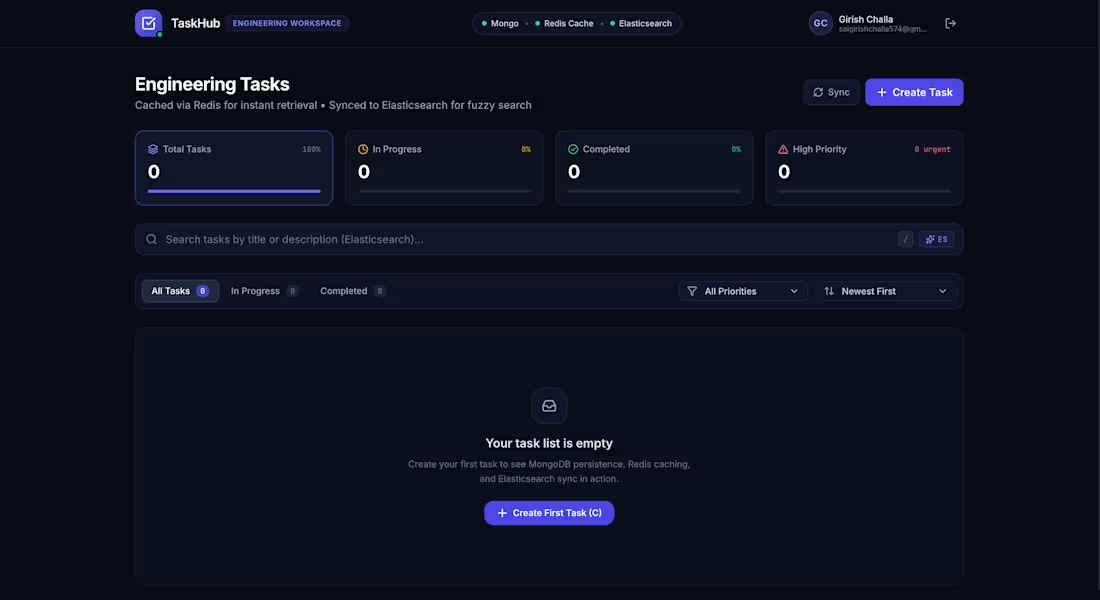
TaskHub is a full-stack task management application built for the KoderTroop Technologies Assessment. It provides secure user authentication and complete task management with create, update, delete, completion, filtering, sorting, and full-text search.
The backend uses Node.js, Express, Apollo Server, GraphQL, MongoDB with Mongoose, Redis, and Elasticsearch. MongoDB serves as the primary data store, Redis implements a cache-aside strategy for task lists, and Elasticsearch provides dedicated full-text search across task titles and descriptions.
The frontend is built with React, Vite, Tailwind CSS, and Apollo Client, with a responsive productivity-focused interface, JWT authentication, keyboard shortcuts, service health indicators, and user-specific task isolation.
I also documented the architecture, setup process, caching and search design, security considerations, and testing workflow in the project README.
0
35
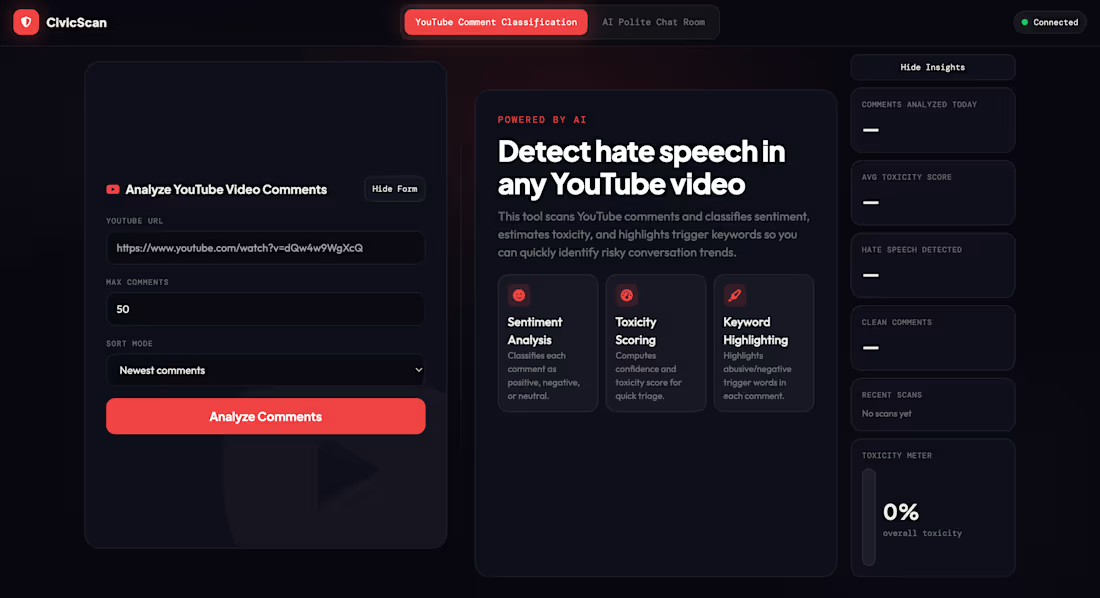
Hate Speech Detection is an NLP-based machine learning project designed to analyze text and identify potentially harmful, abusive, or hateful content. The system takes textual input from a user, processes the text, applies the trained classification model, and presents the predicted category through a simple web interface.
The project focuses on applying practical Natural Language Processing techniques to a real-world content moderation problem, where automatically identifying harmful language can help support safer online platforms.
Problem
Online platforms can receive large volumes of user-generated text, making manual moderation difficult to scale. Harmful or abusive content may also appear in different forms, making simple keyword-based filtering insufficient.
The goal of this project was to build a machine-learning-based system that could analyze textual input and automatically determine whether the content should be flagged based on the categories supported by the trained model.
Approach
The system follows an end-to-end text classification workflow:
Text input — User provides a sentence or piece of text.
Text preprocessing — The input is prepared for NLP analysis.
Feature representation — Text is converted into a representation that can be processed by the machine-learning model.
Classification — The trained model analyzes the input and predicts the corresponding category.
Result presentation — The prediction is returned through the application interface.
Web interaction — Users can submit text and view the classification result through the deployed application. Technical Implementation The project combines Python, Natural Language Processing, machine learning, and a web-based interface. The backend/application layer handles the incoming text, processes the request, runs the classification workflow, and returns the prediction to the frontend. The NLP pipeline is responsible for transforming raw user text into a format suitable for classification. This allows the model to identify linguistic patterns associated with the categories it was trained to recognize. The project was also deployed as a working web application rather than remaining only as an offline machine-learning experiment. Key Features
Text-based hate speech classification
NLP preprocessing pipeline
Machine-learning-based prediction
User-friendly text input interface
Real-time classification through the web application
Backend API/application integration
Deployable web-based architecture
Practical application of NLP for content moderation What I worked on I worked on the complete development flow, including:
Preparing and processing textual data
Implementing the NLP classification workflow
Connecting the machine-learning component with the application
Developing the backend functionality
Creating the user-facing interface
Connecting frontend input with backend prediction
Testing the classification workflow with different text inputs
Deploying the application so that it could be accessed through a web browser Outcome The project demonstrates how NLP and machine learning can be integrated into a practical application for automated content analysis. Instead of manually reviewing every piece of text, the system provides an automated prediction that can be used as an initial moderation or screening step. It also gave me practical experience in taking an NLP model beyond experimentation and integrating it into a usable application with a web interface and backend processing. Live Project Use your deployed project as the Completed work link: http://35.154.112.208/hatespeech/
0
45

GlobalSCART 360 — E-commerce & Data Platform
0
0