
FARHAN KHAN
End-to-End Academic Research & Data Analysis Solutions
- 4
- Followers



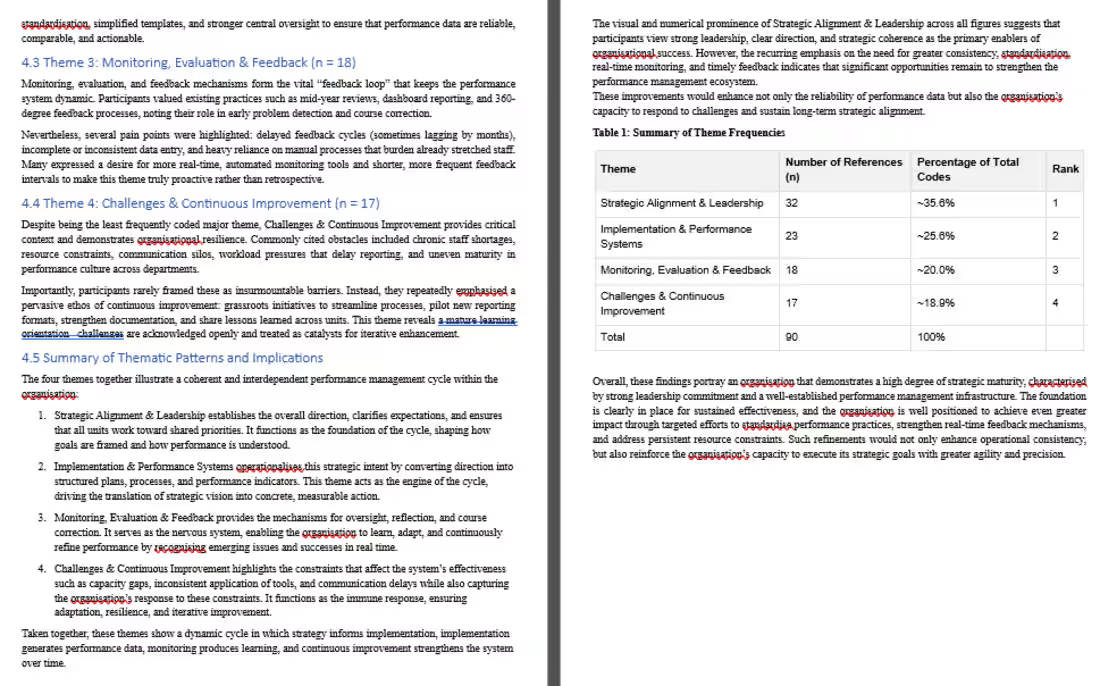
Qualitative Research & Thematic Analysis
Objective: Examine how leadership, strategy, and performance management are experienced across the organisation.
Data: Semi-structured interviews and focus-group discussions with 28 participants across leadership, management, and operational roles.
Method: NVivo-based qualitative coding and thematic analysis to identify recurring patterns, relationships, and key insights.
Key Themes:
Strategic Alignment & Leadership • Performance Systems • Monitoring & Feedback • Challenges & Continuous Improvement
Analysis & Visualisation: Coding frequencies, thematic hierarchy, sub-theme mapping, treemap, sunburst chart, and word cloud.
Outcome: Identified organisational strengths, implementation gaps, feedback challenges, and opportunities to improve performance systems and strategic execution.
Skills: Qualitative Research • Thematic Analysis • Data Interpretation
Tool: NVivo
1
65
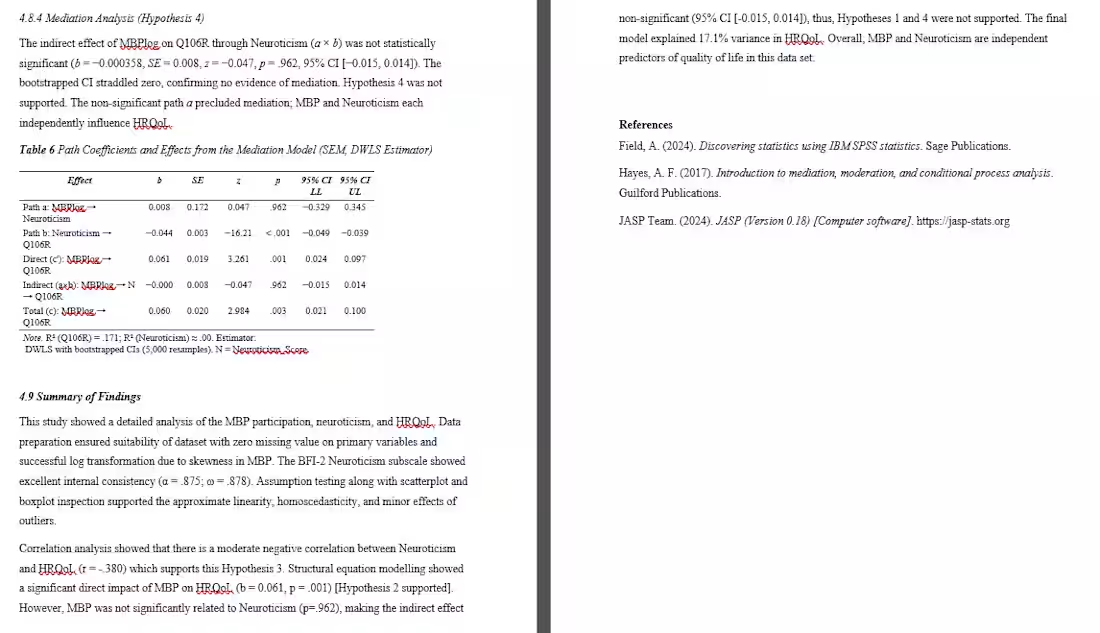
Quantitative Statistical Analysis & Mediation Study
Objective
Explore how mind-body practices relate to people's overall quality of life, and whether personality traits help explain this relationship.
Dataset
1,092 valid responses were analyzed after data screening and preparation.
Analysis Performed
Data cleaning & screening
Descriptive statistics
Reliability testing
Normality & assumption testing
Correlation analysis
Structural Equation Modeling (SEM)
Mediation analysis
Tools & Methods
JASP • Pearson & Spearman Correlation • SEM • DWLS • Bootstrap Analysis
Key Findings
Higher neuroticism was significantly associated with lower self-reported health/quality of life.
Mind-body practice showed a significant direct relationship with quality of life.
Neuroticism did not significantly explain/mediate the relationship between mind-body practice and quality of life.
The final model explained 17.1% of the variation in quality of life.
Deliverable
A complete statistical analysis report with tables, visualizations, statistical results, interpretation, and research findings.
1
71
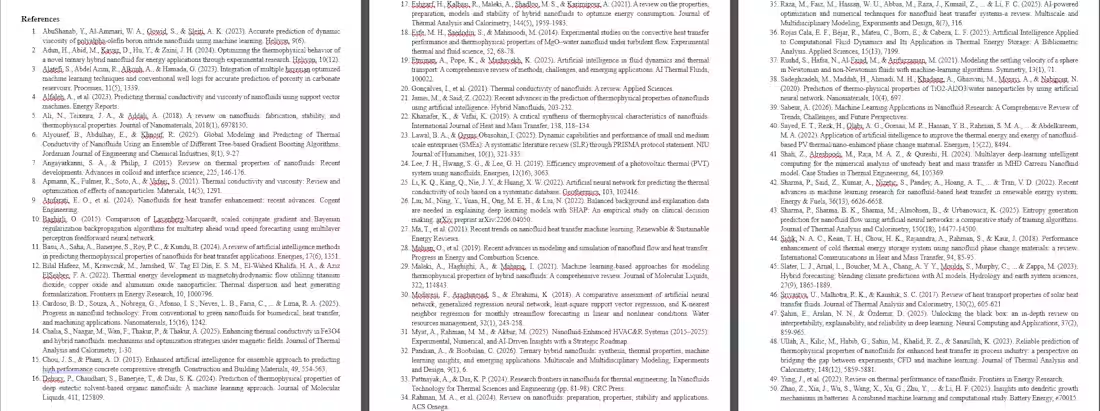
Systematic Literature Review — AI & Nanofluids
Focus: AI-driven prediction of nanofluid thermophysical properties
Method: PRISMA-based Systematic Literature Review
Scope: 2015–2026
Database Search: Scopus • Web of Science • ScienceDirect • IEEE Xplore • Google Scholar
Studies Reviewed: 100 peer-reviewed articles
Analysis: AI/ML methods • Nanofluid types • Properties • Research gaps
Outcome: Identified trends, limitations, and future research directions.
1
69
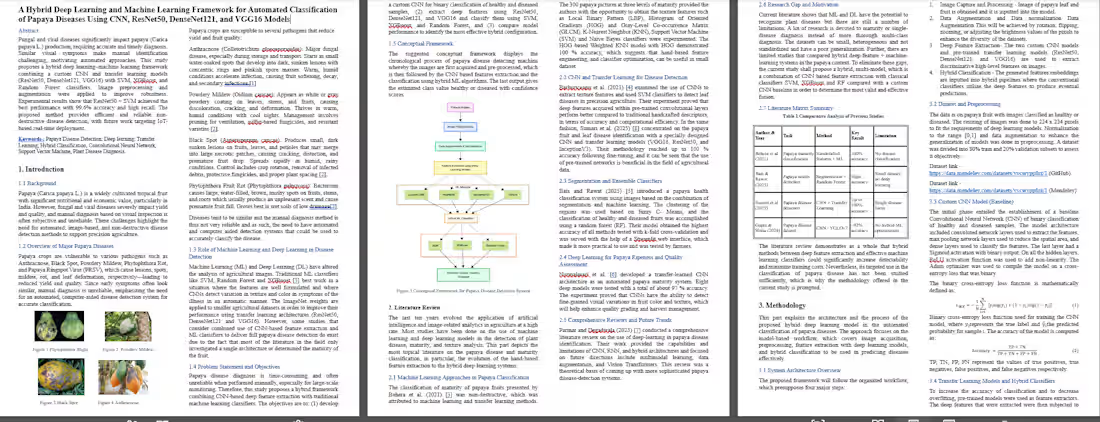
Research Focus
Developed an automated papaya disease classification study using a hybrid Deep Learning + Machine Learning framework.
Literature Review
Reviewed existing research on plant disease detection, CNNs, transfer learning, and machine learning classifiers to identify key limitations and establish the research gap.
Methodology
Designed a complete research pipeline covering image preprocessing, augmentation, deep feature extraction, model development, classification, and comparative evaluation using CNN, ResNet50, DenseNet121, VGG16, SVM, XGBoost, and Random Forest.
Results
Evaluated models using accuracy, precision, recall, F1-score, loss, and confusion matrices. ResNet50 + SVM achieved 99.6% accuracy, delivering the strongest overall performance.
Deliverables
Research paper • Literature review • Research gap analysis • Methodology • Model comparison • Data visualizations • Results & discussion
Future Scope
Proposed larger datasets, improved real-world generalization, Explainable AI, and IoT-based real-time deployment.
Full Research Paper: For further details, methodology, analysis, and results, view the published research paper: https://doi.org/10.5281/zenodo.19727283
1
76