
Disha
Content writer with a knack for making complex ideas simple
New to Contra
Disha is building their profile!


The 3 Dead Giveaways That An AI Wrote Your Landing Page (And How to De-Bot It)
The web is losing its mind over AI detection software.
Founders are paying monthly subscriptions to check if their copywriters are cheating. Editors are running essays through algorithms, trying to catch students in the act.
It is a complete waste of time. You do not need software to catch AI text.
You just need eyes.
When every single generic brand uses the exact same base model to generate their marketing, the entire internet starts to sound like a polite corporate brochure. It creates a massive wall of white noise.
If your landing page sounds like a robot, your conversion rate drops to zero. Why? Because consumers buy from brands they trust, and nobody trusts an automated script.
If you want your copy to convert, you need to ruthlessly hunt down and kill the three most obvious robotic tells.
Here are the dead giveaways, and exactly how to fix them.
Tell #1: The False Escalation (The "Not Only, But Also" Trap)
The AI Version:
"Our software not only streamlines your daily accounting processes, but it also empowers your finance team to build a brighter financial future."
Why it fails:
Humans do not talk like this. No founder sits in a boardroom and says, "Wow, this software really empowers us to build a brighter financial future!" It uses dramatic, sweeping language for a boring, everyday administrative task.
The Human Fix (The Outline Method):
Strip the fake drama. State the exact, cold utility.
"Our software automates your bookkeeping so you can close your monthly accounts in under 10 minutes."
Tell #2: The Forbidden Buzzword Checklist
There is a highly specific cluster of vocabulary that the largest language models absolutely obsess over. If more than three of these words appear on your main homepage, your readers will instantly tune out.
The primary offenders:
Delve ("Let's delve deep into your strategy...")
Testament ("This feature is a testament to our innovation...")
Landscape ("Navigating the modern digital landscape...")
Tapestry ("A rich tapestry of collaborative tools...")
The Human Fix:
If you mean look at, say look at. If you mean market, say market. Replace high-concept metaphors with direct nouns.
Tell #3: The Symmetrical Sentence Structure
AI is built on math, and math loves symmetry. When a robot writes a landing page, every paragraph follows the exact same visual weight.
Sentence 1: Short hook.
Sentence 2: Medium explanation with two adjectives.
Sentence 3: Long conclusion summarizing the benefit.
When every block of text looks the same, the reader's eye glides right past it without registering a single word. It creates visual fatigue.
The Easy Fix: Break the rhythm.
Write a sentence that is only three words long.
Then follow it up with a slightly longer paragraph that explains a complex point, before cutting the next line completely short. You have to design your text to look like a staircase, not a monolithic brick wall.
The Content Audit: De-Bot Your Brand Right Now
The hardest part about AI copy isn't that it is fundamentally broken. It is that it is aggressively average. It settles for the path of least resistance because it predicts the next most likely word instead of finding the most impactful one.
If you want to pull your copy out of the machine noise, stop overthinking the algorithms. Run this manual audit across your homepage right now:
Highlight every adjective: If it doesn’t add a hard, measurable detail, delete it.
Read it out loud: If you run out of breath before a sentence ends, split it in half.
Check the verbs: Swap out passive filler words for sharp, aggressive actions.
The internet is already full of automated white noise. The brands that stand out in the next decade won't be the ones that output the most text. They will be the ones that sound undeniably human.
1
18
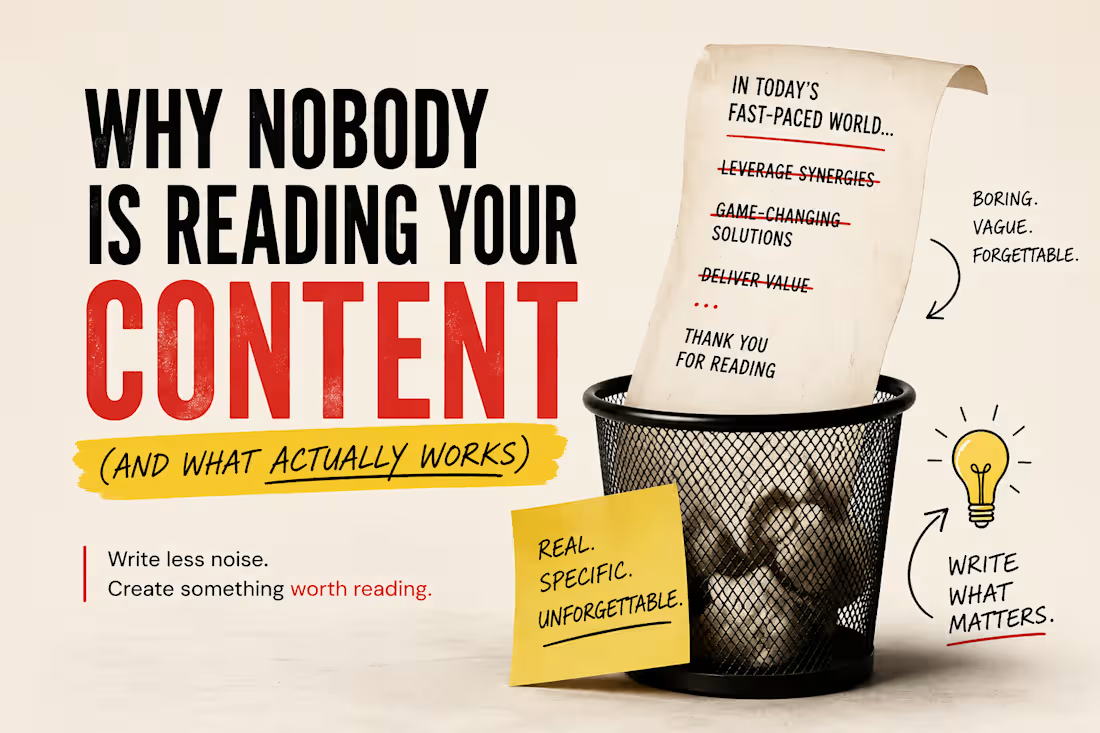
Why Nobody Is Reading Your Content (And What Actually Works)
Let's skip the part where I tell you content is king.
You've heard it. You've probably even said it yourself, with the confidence of someone who has absolutely no idea what to do next.
Here's the truth nobody in marketing wants to admit: most content isn't bad because it's poorly written. It's bad because it was written for an algorithm, a checklist, or a manager and not for an actual human being sitting somewhere, scrolling, quietly desperate to feel something.
The Mistake Everyone Makes First
In 1965, David Ogilvy, the man who essentially invented modern advertising, wrote a memo that still makes copywriters nervous.
He said, "The consumer is not a moron. She is your wife."
He meant, respect your reader's intelligence. Write like you're talking to someone real, not performing for someone imaginary.
Sixty years later, we're still ignoring him.
Browse any company blog today and you'll find the same thing: headlines stuffed with keywords, introductions that clear their throat for three paragraphs before saying anything, and conclusions that trail off like someone fell asleep mid-sentence.
Nobody reads it. Nobody shares it. And somewhere in an office, someone is asking why the "content strategy" isn't working.
What Actually Stops a Scroll
Joan Didion opened The Year of Magical Thinking with: "Life changes fast. Life changes in the instant."
That's it. No preamble. No "In today's fast-paced world." Just the truth, arriving immediately, like a hand on your shoulder.
Good content does the same thing. It earns attention in the first sentence.
Because here's what nobody tells you about the internet: your reader owes you nothing. They have seventeen other tabs open. Their attention is not waiting patiently for you to get to the point. It's already halfway out the door.
You have one sentence to make them stay.
The Paradox of "Relatable" Content...
Somewhere along the way, brands decided that being relatable meant being vague, writing things so universally agreeable that nobody could possibly object.
The result is content that says everything and means nothing.
The writers who actually build audiences, the ones whose newsletters get forwarded, whose posts get screenshotted, whose blogs get bookmarked, do the opposite. They have opinions. They take sides. They write sentences that make someone somewhere think, "Yes, exactly that, how did you know?"
Specificity is not alienating. It's magnetic.
A piece about "how to stay productive" is forgettable.
A piece about "why I deleted every productivity app and started using a ₹10 notebook" is a story. Stories spread.
Before you write anything, a blog post, a caption, an email , ask yourself one question.
If I received this, would I read past the first paragraph?
Not "is it SEO-optimized." Not "does it hit our content pillars.", would a real person, with a real life and limited time, actually want to read this?
If the answer is no, start over.
If the answer is yes, you're already ahead of 90% of what's being published today.
What Good Writing Actually Does
Raymond Carver wrote working-class stories with almost no adjectives.
Toni Morrison wrote sentences that felt like music.
Hemingway wrote about war and said almost nothing, so you felt everything.
They all understood the same thing: writing is not about showing off what you know. It's about making the reader feel something they didn't expect to feel when they sat down.
Good content marketing works exactly the same way. It doesn't interrupt people. It becomes the thing they wanted to find. It doesn't sell immediately, it builds the kind of trust that makes selling effortless later.
It respects the reader enough to be worth their time.
That's the whole secret, really.
Write something worth reading. For someone worth writing for.
Everything else is just noise.
1
112

Nobody Told Me Independence Would Feel This Good
There's a particular kind of quiet that hits at 7 PM in a paying guest room in Bangalore.
Not the lonely kind. Though I won't pretend I haven't felt that too. This is different. It's the quiet of a life that's entirely, unapologetically yours.
I moved to Bangalore for an engineering college. Like most girls from smaller cities, I came with a packed suitcase, a phone full of "be careful" texts, and a vague anxiety about what living alone would actually feel like. Nobody really prepares you for it. They just warn you about it.
What they don't tell you is that on some evenings, standing in a tiny kitchen making coffee for one, you'll feel something that takes a while to name.
The First Grocery Run!
My first solo grocery run in Bangalore was embarrassingly significant to me.
I didn't have anyone to ask "do we need this?" I just... decided. I bought the vegetables I wanted, the snacks I actually liked and a small plant because it made me happy.
I carried those bags back to my PG, put everything away, and cooked a meal that was entirely my own decision from start to finish.
It was just rajma rice. But it tasted different.
Learning the City on Your Own Terms!
Bangalore is overwhelming if you let it be. The traffic, the unfamiliar roads, the sheer size of everything. For weeks I stuck to routes I knew, scared of getting lost.
Then one Saturday I just... didn't. I took an auto to a part of the city I'd never been, walked around, found a bookshop tucked between two restaurants, ate a dosa at a random place because it smelled good, and took a different route home.
I got slightly lost. I figured it out.
There's a confidence that only comes from solving small problems alone.
Independence Isn't the Absence of People
Here's what I didn't expect: choosing independence doesn't mean choosing isolation.
It means being selective. It means your time is yours, so when you do share it, it's because you actually want to not because you're afraid of being alone. You stop collecting people out of anxiety. You start enjoying your own company enough that other people become a bonus, not a necessity.
That shift changes everything about how you relate to others.
Nobody tells you that making your own bed every morning, cooking your own meals, managing your own money, navigating your own cit, that all of this slowly builds something in you that no classroom can.
Nobody tells you that the girl who was nervous about living alone will, within months, find herself genuinely looking forward to her own company.
Nobody tells you independence isn't something that happens to you. It's something you practice. Every grocery run, every solo evening, every small decision made without asking anyone's permission, it adds up.
I'm still learning. Still figuring out Bangalore, still burning rice occasionally, still getting lost sometimes.
But I'm doing it. On my own terms. Honestly, loving it all:)
2
175