Freelancers using Web3.jsFreelancers using Web3.js
Web developer/designer

Branding, Product & Web Design that convert
$100k+
Earned
13x
Hired
5.0
Rating
1.6K
Followers
Branding, Product & Web Design that convert
Senior Web Developer for SaaS, Ecommerce & Agencies
$100k+
Earned
27x
Hired
5.0
Rating
128
Followers
Senior Web Developer for SaaS, Ecommerce & Agencies
Cover image for For ByDefaultStudio, I developed a
For ByDefaultStudio, I developed a modern, visually refined website using Webflow to reflect the studio’s creative identity and minimalist design approach. The goal was to build a clean, high-impact digital presence that highlights their work, services, and brand philosophy. I translated design concepts into responsive layouts, ensuring consistency across devices while maintaining strong visual hierarchy and typography. Key Objectives: Create a Clean & Minimal Visual Identity: Develop a modern, design-forward website that reflects the studio’s minimalist aesthetic, focusing on typography, spacing, and visual hierarchy to create a premium look and feel. Showcase Portfolio Effectively: Structure the website to highlight projects in a clear and engaging way, allowing users to easily explore work and understand the studio’s creative capabilities. Responsive Web Design: Ensure the website delivers a seamless experience across all devices (desktop, tablet, mobile) using Webflow’s responsive layout system. Smooth Interactions & Animations: Implement subtle animations and transitions to enhance user engagement while maintaining performance and not overwhelming the design. Scalable Webflow Structure: Build reusable components and a flexible layout system so the client can easily update and expand content without technical dependency. Webflow CMS Integration: Set up CMS collections for projects and content, enabling easy management and regular updates by the internal team. Performance Optimization: Optimize images, structure, and interactions to ensure fast loading speed and smooth browsing experience. SEO Best Practices: Implement proper heading structure, meta tags, and clean code to improve search engine visibility and organic reach. User Experience (UX) Focus: Design intuitive navigation and clear user flow to guide visitors toward key sections like portfolio, services, and contact. Brand Consistency: Maintain consistency in colors, typography, and layout to align with the studio’s brand identity across all pages. Expected Outcomes: The ByDefaultStudio Webflow project resulted in a clean, modern website that strengthened the brand’s digital presence and improved overall user engagement. The responsive design and smooth interactions ensured a seamless experience across all devices, while CMS integration made content management simple and scalable. Performance and SEO optimizations contributed to faster load times and better visibility, helping attract and retain more visitors.
1
340
Cover image for ArtsDAO – Web3 Community Platform
Overview
ArtsDAO
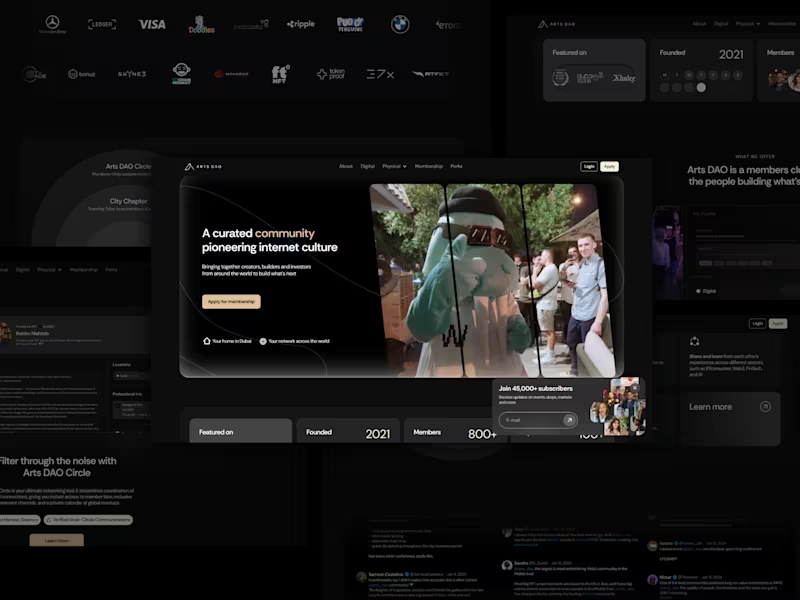
ArtsDAO – Web3 Community Platform Overview ArtsDAO is a leading Web3 community that brings together entrepreneurs, investors, creators, and innovators through exclusive events, networking opportunities, and educational initiatives. The objective was to build a modern digital experience that reflects the community’s premium brand while increasing membership applications and event engagement. Challenge The platform needed to communicate a broad ecosystem of events, memberships, partnerships, and community initiatives without overwhelming visitors. It also required a highly interactive experience that aligned with the expectations of a Web3 audience while maintaining excellent performance. Solution I designed and developed a custom Webflow website featuring a scalable component system, responsive layouts, engaging animations, and a clear content hierarchy. The site was optimized for speed, SEO, and accessibility while making it easy for the client to manage content through Webflow CMS. Key Features Custom Webflow development Responsive design for all devices CMS-powered content management Interactive animations and micro-interactions Conversion-focused landing pages SEO and performance optimization Reusable component-based design system Fast, scalable, and easy to maintain Results The finished website delivers a premium user experience that strengthens the ArtsDAO brand, simplifies community discovery, promotes events and memberships, and provides a scalable foundation for future growth while maintaining high performance across all devices.
0
256
Full stack developer, Top 1% at Contra
13x
Hired
5.0
Rating
245
Followers
Full stack developer, Top 1% at Contra

30+ Apps Shipped | Flutter, Angular & ASP.NET
$100k+
Earned
7x
Hired
5.0
Rating
60
Followers
30+ Apps Shipped | Flutter, Angular & ASP.NET

Cover image for 📌 Case Study: PolySwap (PoliexSwap)
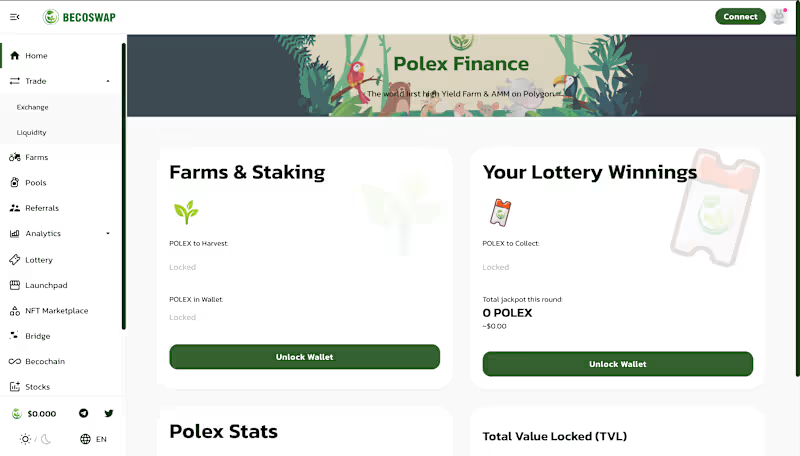
📌 Case Study: PolySwap (PoliexSwap) — Decentralized AMM & Yield Farming on Polygon Category: DeFi · Decentralized Exchange · Web3 Platform: Web (Polygon Network) Project Type: Automated Market Maker (AMM) & Yield Farming Protocol Live: polyswap.netlify.app (http://polyswap.netlify.app) Project Overview PolySwap (https://polyswap.netlify.app) — built as PoliexSwap — is a decentralized exchange and high-yield farming protocol deployed on the Polygon network. It gives users the ability to swap tokens, provide liquidity, and earn yield on their assets directly from a non-custodial Web3 interface, without intermediaries and without leaving their wallets. Built by Cuboid, it sits in the same product category as PancakeSwap on BSC — but positioned specifically for Polygon's faster, lower-cost infrastructure. The Problem Ethereum's gas fees made DeFi participation prohibitively expensive for smaller investors. Binance Smart Chain addressed the cost problem but introduced centralization trade-offs many users weren't comfortable with. Polygon emerged as a legitimate Layer 2 alternative — fast, cheap, and EVM-compatible — but lacked a native, fully-featured AMM and yield farming platform at the time. The opportunity was clear: a first-mover DEX on Polygon that combined token swapping, liquidity provision, and high-yield farming in a single, clean interface built for the Polygon-native user. Our Solution Cuboid designed and developed the full PolySwap platform — smart contract integration, liquidity pool architecture, yield farming interface, and wallet connectivity — on Polygon's EVM-compatible chain. The interface was modeled on the established DEX UX patterns users already knew from Uniswap and PancakeSwap, lowering the barrier to entry while delivering Polygon's speed and cost advantages underneath. The platform was built to be genuinely non-custodial throughout — users connect their own wallets, execute swaps and deposits directly on-chain, and retain full control of their assets at every step. Key Features & Capabilities Token Swapping (AMM) — An automated market maker enabling direct token-to-token swaps on Polygon without order books, central servers, or custodial risk. Pricing is determined algorithmically by liquidity pool ratios, ensuring continuous liquidity at all times. Liquidity Provision — Users deposit token pairs into liquidity pools and earn a share of all swap fees generated by that pool — passive yield tied directly to platform trading volume rather than speculative token price. High-Yield Farming — Liquidity providers receive LP tokens representing their pool share, which can be staked in farming contracts to earn additional protocol rewards on top of swap fees. The dual-layer yield model — fees plus farming rewards — was positioned as the platform's primary value proposition for capital deployment on Polygon. Non-Custodial & Permissionless — No sign-up, no KYC, no custody. Users connect a compatible Web3 wallet and interact with smart contracts directly. Any Polygon-compatible token pair can be added as a liquidity pool without platform approval. Polygon-Native Performance — Transactions settle in seconds at a fraction of Ethereum mainnet gas costs, making frequent farming interactions and compounding strategies economically viable for users of any portfolio size. Why Polygon The decision to build on Polygon rather than Ethereum mainnet or BSC was deliberate. Polygon's EVM compatibility meant existing Ethereum tooling, wallets, and token standards worked without modification. Its transaction costs and speed made high-frequency DeFi interactions — swaps, deposits, harvest cycles — practical for retail users, not just whales. Positioning PolySwap as the first high-yield AMM on Polygon was a first-mover bet on a network that has since grown into one of the most active EVM chains in DeFi. Final Outcome PolySwap demonstrates Cuboid's capability across the full DeFi product stack — AMM smart contract integration, liquidity pool architecture, yield farming mechanics, and a consumer-grade Web3 interface built for a specific chain's competitive advantage. It's a project that required both technical precision and an understanding of how DeFi users think about capital, risk, and yield.
0
436
Cover image for 📌 Case Study: NFT Gaming
📌 Case Study: NFT Gaming Stars — Play-to-Earn Blockchain Gaming Platform Category: Web3 · GameFi · NFT & Metaverse Platform: Web (Binance Smart Chain) · iOS & Android (in development) Project Type: Decentralized Play-to-Earn Gaming Ecosystem Live: nftgamingstars.com (http://nftgamingstars.com) Project Overview NFT Gaming Stars (https://nftgamingstars.com) is a Binance Smart Chain-based Play-to-Earn gaming ecosystem that unites NFTs, decentralized gaming, staking, and a metaverse layer under a single platform. Its native token — GS1 — serves as the currency of the entire ecosystem, powering in-game earnings, NFT purchases, staking rewards, and wallet-to-wallet trading. Built by Cuboid, the platform was designed to sit at the intersection of GameFi and the broader Web3 movement at a time when that space was defining its own rules. The Problem The convergence of blockchain and gaming presented a genuine opportunity — but most early Play-to-Earn platforms prioritized tokenomics over user experience, producing platforms that felt transactional and inaccessible to anyone who wasn't already deep in crypto. The result was an ecosystem that talked about fun but delivered a spreadsheet. NFT Gaming Stars needed a platform that could attract both crypto-native users and mainstream gamers — one that delivered real earning mechanics without sacrificing the experience quality that keeps people playing. Our Solution Cuboid built the full web platform and DApp infrastructure for NFT Gaming Stars on Binance Smart Chain — handling smart contract integration, the marketplace UI, staking interface, wallet connectivity, and the P2E game environment. The platform went live with a complete ecosystem from day one: token purchase, NFT minting, staking at up to 60% APY, and an operational Play-to-Earn game accessible directly from the browser. The architecture was built around a customizable API layer to support transaction handling at scale, with decentralization and cryptographic security embedded at the infrastructure level — not bolted on as an afterthought. Key Features & Capabilities GS1 Token Ecosystem — A fixed supply of 250 million GS1 tokens with liquidity locked until 2033. GS1 functions as the platform's medium of exchange across games, NFT purchases, staking, and wallet-to-wallet trading — designed for multi-utility across the entire Stars Network rather than single-game use. Play-to-Earn Games — Browser-based P2E games where players earn GS1 by playing, with NFT holders earning passive GS1 as the ecosystem expands into metaverse interactions. The first game, Battle Leet, launched as a proof-of-concept with a mobile app roadmap following behind. NFT Marketplace — A limited edition of 1,000 NFTs available for purchase on-platform, covering in-game assets including skins, weapons, land, and aesthetic upgrades. Every asset is verifiable, traceable, and immutable on-chain. Staking — Users stake GS1 directly on the platform for APY rewards, creating a holding incentive beyond active gameplay and supporting long-term token stability. Walk-to-Earn Integration — A Walk2Earn application concept integrating AR and AI — rewarding physical activity with GS1 earnings, extending the platform's utility beyond screen-based gaming entirely. Decentralized Exchange Layer — Direct crypto wallet trading with support for GS1, BNB, and other BSC assets. No central authority, no custody risk — users trade directly from their own wallets throughout. MetaStars — Metaverse Expansion — The platform roadmap includes MetaStars, a full metaverse environment where NFT holders interact with assets in an immersive virtual world, with multiplayer game development including a chess variant running in parallel. Community & Traction NFT Gaming Stars launched with a 34,000-follower Twitter community, airdrop campaigns distributing over $20,000 in GS1 and 32 NFTs, and listings across major crypto data platforms including CoinMarketCap and Bitget. The project's audit was handled by SolidProof, and KYC verification was processed through the same trust infrastructure used by established BSC projects. Final Outcome NFT Gaming Stars demonstrates Cuboid's capability in full-stack Web3 product development — smart contract integration, decentralized exchange infrastructure, NFT marketplace architecture, and P2E game environments — delivered for a live, token-listed, community-backed project operating on Binance Smart Chain.
0
428
Design and Development Partner For Startups (A.I Powered)
2x
Hired
5.0
Rating
121
Followers
Design and Development Partner For Startups (A.I Powered)