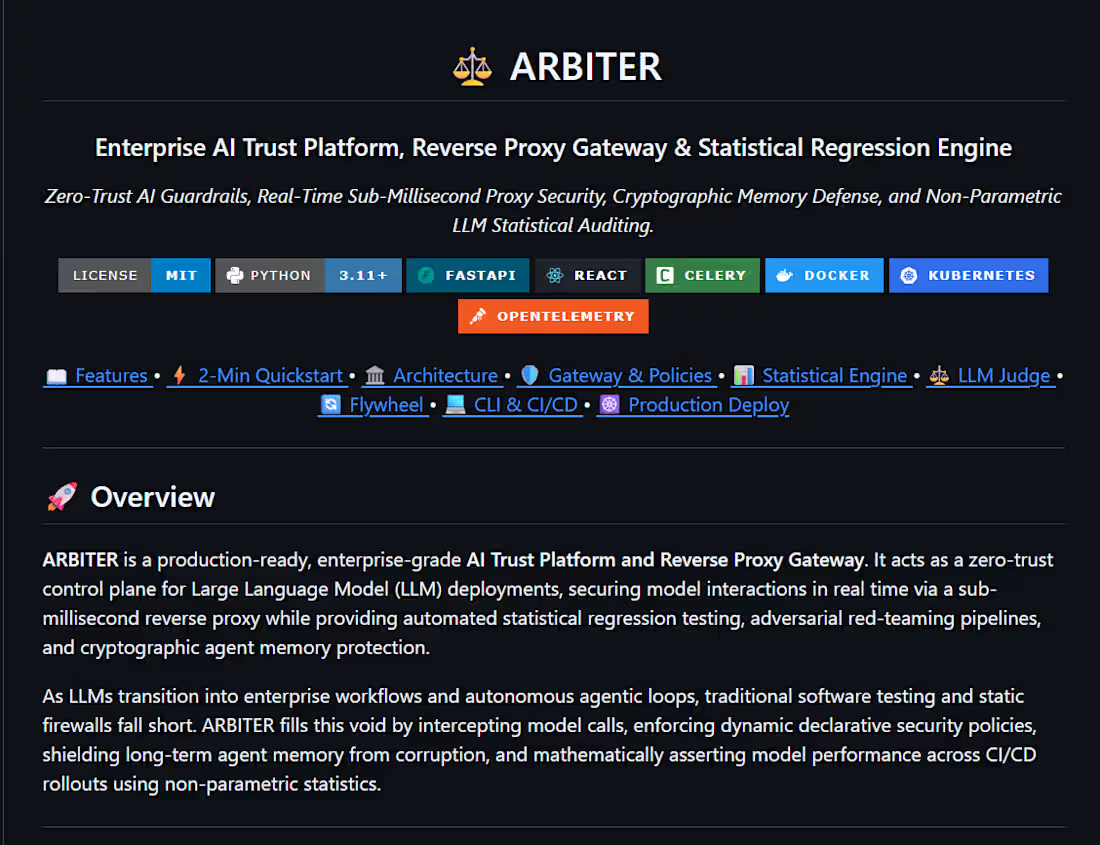
Freelance Heuristic EvaluationsFreelance Heuristic EvaluationsArbiter — AI Trust & Evaluation Platform
Arbiter is an enterprise-grade AI trust and evaluation platform built to help teams test, secure, monitor, and govern LLM-powered applications before and after they reach production.
Modern AI applications can fail in ways that traditional software testing does not easily catch. A prompt change can reduce answer quality, a model upgrade can introduce regressions, an agent can expose sensitive information, or a jailbreak can bypass application-level safeguards. Arbiter provides an infrastructure layer for continuously evaluating and controlling these systems.
Core Capabilities
LLM Evaluation
Automated evaluation of LLM responses against configurable criteria.
Support for deterministic and statistical evaluation workflows.
Compare different models, prompts, and configurations.
Track quality changes across evaluation runs.
Statistical analysis using techniques such as the Mann–Whitney U test and bootstrap confidence intervals.
Adversarial Testing
Test LLM applications against jailbreaks, prompt injection, adversarial prompts, and other failure scenarios.
Create repeatable attack suites for regression testing.
Run security and reliability checks before deployment.
AI Firewall & Policy Engine
Acts as a control layer between applications and LLM providers.
Inspect prompts and model responses.
Apply configurable policies to block, modify, or flag potentially unsafe requests and responses.
Provide centralized enforcement rather than implementing safety logic independently in every application.
Memory Protection
Analyze information being written to or retrieved from AI memory.
Apply policies around sensitive information and potentially unsafe memory operations.
Reduce the risk of unintended persistence of confidential information.
CI/CD Quality Gates
Integrate AI evaluation into the software delivery pipeline.
Automatically evaluate model or prompt changes before deployment.
Fail a deployment when configurable quality, safety, or regression thresholds are not met.
Treat AI behavior as something that can be tested continuously rather than manually reviewed after deployment.
Observability
Track AI requests, responses, evaluation results, policy decisions, and failures.
Designed around OpenTelemetry for integration with existing observability infrastructure.
Provides visibility into how AI systems behave in real-world usage.
Architecture
Arbiter is designed as an infrastructure layer around existing AI applications rather than requiring teams to rebuild their applications from scratch.
Application → Arbiter Gateway → Policy & Security Layer → LLM Provider
Requests can pass through evaluation, policy enforcement, security checks, and observability before reaching the underlying model. Responses can then be evaluated and monitored before being returned to the application.
This architecture allows teams to introduce AI governance without tightly coupling their application to a specific model provider.
Engineering Focus
The project combines:
LLM evaluation
Statistical testing
Adversarial AI security
AI governance
API gateways
Policy engines
Memory security
CI/CD automation
Observability
Production AI infrastructure
The goal is to move LLM applications from “it works in a demo” toward systems that can be continuously tested, monitored, and controlled in production.