







Most designers have solid reasons behind every decision they make. But when it's time to explain the work to a client, or turn it into a case study, those reasons are rarely written down anywhere.
We felt that too sometime, so we decided to built "Check" with the team. Answer a few questions about your project, and "Check" will turn your answers into a one-page case study that's ready to share.
Pick the "Focused fix" if you improved something that already existed, or "Build from nothing" if you started it yourself. Early access is open starting today & the full access should follow in about two weeks. Stay tuned! 👀
We'd love your feedback while it's still taking shape. "Check" us out on jet.studio/product/check (http://jet.studio/product/check)
2
0
123
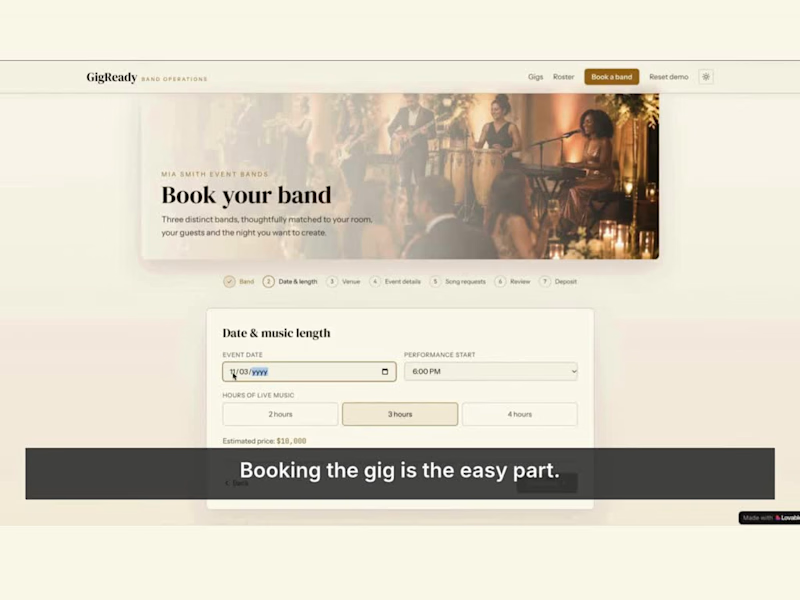
Maybe it was the "love" in Lovable that made me think of wedding bands the second I saw the challenge. The music, not the rings. 😂
I played a few weddings as a musician in Los Angeles, and I've been a music director and bandleader from time to time. I never ran several event bands at once - that’s really a whole thing. The people who do usually have an assistant, because the job may include most of the logistics: gigs coming in from managers, coordinators and websites, venue and load-in details for everyone, rehearsal space, new music when a client requests a song outside the standard set, travel, and finding a substitute when a regular player is booked.
Honestly, that would have been too much bandwidth for me, though being the key player in a couple of bands of different genres is a lot of fun. Leading one’s own bands can be one of the annoying consequences of just wanting to play music you like at a professional level.
The client-facing side (website, availability, booking, payment) is already well covered. The hidden work after the booking is the painful part, so I built for that.
For the challenge, I created a bandleader named Mia Smith. She runs three premium event bands: Jazz, Afro-Cuban/Salsa and Soul/R&B. Each band has first-call musicians, but musicians take gigs when they come up. When a first-call player is out, Mia moves to her substitute list, waits for answers and tracks which chairs are filled. Substitutes and special requests also need charts and recordings. Then everyone needs the venue, call time, dress code, parking and load-in notes.
That's GigReady. It answers one question: what happens after the event is booked but before the band is ready to play?
Mia sees which gigs are staffed, who has confirmed and which positions still need attention. If a first-call player is unavailable, she goes straight to a substitute for that instrument. Once every chair is covered, she locks the lineup. GigReady builds the Call Sheet with what the musicians need and sends it to the band.
What surprised me was my own reaction to the first working version. I'm not gigging or managing musicians right now, and I still felt immediate relief. The gig was all in one place: who answered, which chair was open, and the logistics message already written.
That's when I knew GigReady was a real tool. It could have changed what kind of gigs I was willing to take.
1
1
394