



Concordium — Supply Chain & Testnet Infrastructure
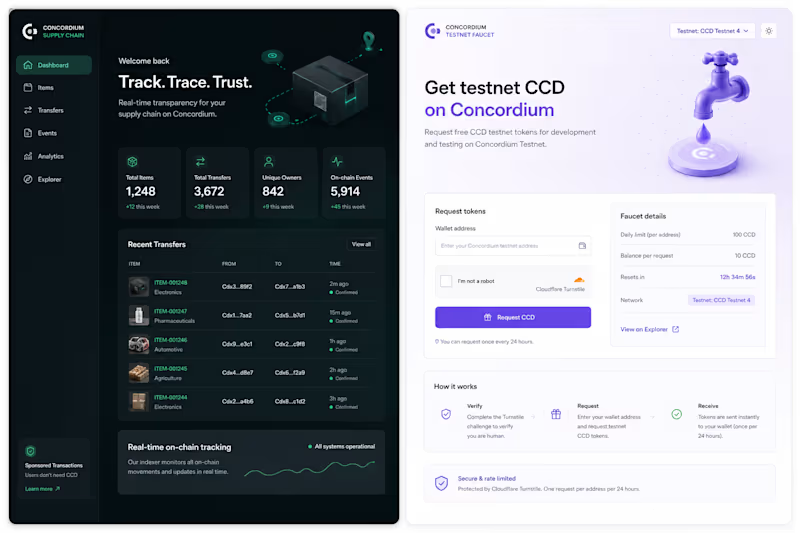
We delivered two blockchain projects for Concordium: a supply chain track-and-trace system and a testnet faucet.
Track-and-trace:
- Built a CIS-3 NFT smart contract (Rust) for product tracking.
- Added sponsored transactions so users don’t need to hold tokens.
- Implemented an indexer to track all on-chain movements in real time.
- Shipped a full frontend and Docker-based infrastructure.
Testnet faucet:
- Developed a Next.js faucet with Cloudflare Turnstile bot protection.
- Added per-address daily limits and balance checks via the explorer API.
- Provided complete documentation for deployment and maintenance.
Outcome:
- Both systems production-ready and actively used.
- 92 combined commits, clean architecture, ready-to-reuse patterns.
This case shows our ability to ship end-to-end blockchain solutions—smart contracts, infrastructure, and UX—in one go.
1
132

https://dealy.figma.site/
Latest Updates 🚀
📍 Improved User Location Accuracy
The map now centers precisely on the user's current location.
Increased zoom levels make it much easier to identify the exact position and nearby points of interest.
🌐 Domain Update
Renamed the domain to better reflect the application's purpose and branding.
Tech Stack
Supabase
Next.js
Skills & Focus Areas
UI/UX Design
Next.js Best Practices
Geolocation & Mapping
Frontend Performance Optimization
Small improvements like these can make a significant difference in usability and overall user experience.
1
2
236


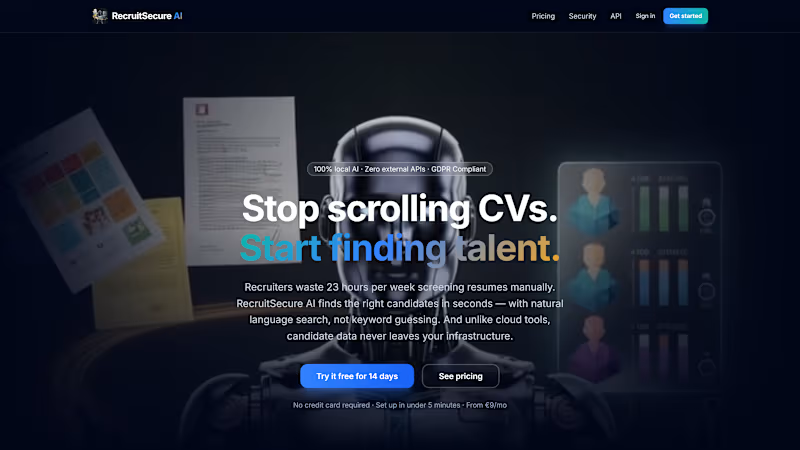
Recruiters sit on hundreds of CVs they can't search. Keyword search misses the obvious — the candidate wrote "React", you searched "frontend", they never surface — and every AI tool that fixes that ships candidate data to a third-party API.
I built RecruitSecure AI to do the semantic search without the API call. The embedding model runs server-side through Transformers.js (quantized multilingual-e5-small, 384 dimensions, 100+ languages), so you can ask in Spanish and it finds CVs written in English — and nothing ever leaves the deployment.
Drop in PDFs or DOCX and it extracts name, email, skills and experience, indexes each CV as a vector, and answers plain-language queries like "frontend lead who has built a design system": ranked by relevance, each result showing the exact CV fragments behind the match, so the recruiter sees the reason and not just a score. Retrieval is hybrid — pgvector HNSW cosine fused with BM25 full-text through Reciprocal Rank Fusion, then re-ranked from the recruiter's own thumbs up/down.
Next.js 16, React 19, strict TypeScript, PostgreSQL + pgvector through Drizzle ORM, Auth.js, Stripe subscriptions, multi-tenant with AES-256-GCM encryption at rest and GDPR export and deletion. Built solo, end to end.
The video is the real application: ten synthetic CVs uploaded through the actual pipeline, extracted, embedded and searched. Nothing staged.
3
437