Freelance Mobile Engineers in SindhFreelance Mobile Engineers in Sindh
AI SaaS Engineer | Next.js + Node.js | MVPs to Production

1x
Hired
5.0
Rating
12
Followers
AI SaaS Engineer | Next.js + Node.js | MVPs to Production
Product Design, Growth and Developer | E-Books and Software
5.0
Rating
11
Followers
Product Design, Growth and Developer | E-Books and Software
Cover image for GPUStore: A Modern GPU Shopping
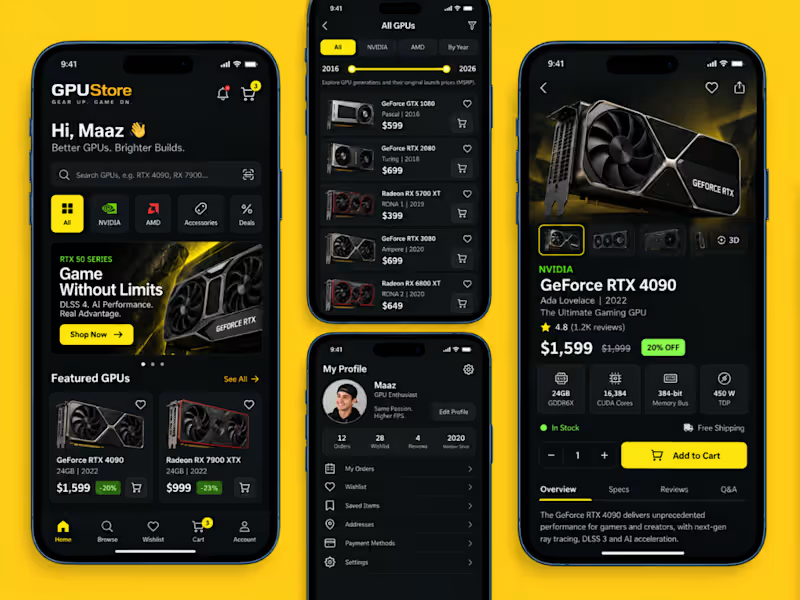
GPUStore: A Modern GPU Shopping and Discovery App I designed GPUStore to make buying graphics cards feel less like decoding a spec sheet and more like exploring a well-organized catalog. Instead of overwhelming users with dense tables and inflated resale listings, I structured the product around what PC builders actually ask: which generation is this, what did it originally cost, and what will it do for me? The visual identity pairs a dark charcoal interface with electric lime green accents. The green guides interaction. It marks active filter tabs, the Shop Now and Add to Cart buttons, the cart badge, saved hearts, and the NVIDIA brand label. Dark cards and high-contrast product renders give each card a premium, showroom feel while keeping specs and prices easy to read. The home screen opens with a personal greeting, a search bar with a real example query ("RTX 4090"), and quick category chips for All, NVIDIA, AMD, Accessories, and Builds. A bold RTX 50 Series banner promotes new releases, followed by a "Featured GPUs" section. Each card shows the architecture, release year, launch price, and a one-tap cart button. The All GPUs screen turns browsing into a timeline. Segmented filters (All, GTX, RTX, By Year) sit above a 2016 to 2026 range slider, so users can explore generations and their original launch prices (MSRP). Seeing the GTX 1080 at $599 next to the RTX 4090 at $1,599 makes a decade of pricing history readable at a glance. The product detail screen prioritizes clarity. An image carousel with wishlist and share actions leads into the architecture and release date, then a dedicated MSRP panel. A compact Key Specifications table follows (Ampere architecture, 8,704 CUDA cores, 10 GB GDDR6X, 320-bit memory bus, 320 W TDP). A sticky quantity stepper and Add to Cart button stay within thumb reach. A short note clarifies that launch price shows original MSRP and actual market prices may vary. The profile screen gives users a personal hub with their saved items, orders, builds, and member-since year. Wishlist, Orders, and Settings tabs keep everything in one place, and saved cards show the date each item was added. Across the app, a five-tab bottom navigation (Home, Browse, Wishlist, Orders, Account) keeps the structure predictable. Frontend I built the client as a cross-platform mobile app using React Native with TypeScript. React Navigation handles the bottom tabs and the stack flows between listing, detail, and cart. TanStack Query manages server data, caching, and loading states, while Zustand holds lightweight local state such as cart count, wishlist toggles, and active filters. The year-range slider and category filters update query parameters, so results refresh without a full reload. Reusable components (GPU card, spec row, filter chip, quantity stepper) are driven by a shared design-token file for the dark theme and green accent, keeping the UI consistent across screens. Backend The backend is a Node.js REST API (Express or NestJS) backed by PostgreSQL through Prisma. The core schema covers users, GPUs, wishlists, carts, cart items, orders, order items, and builds. Each GPU record stores brand, series (GTX or RTX), architecture, release date, MSRP, CUDA cores, memory size and type, bus width, and TDP. MSRP is stored separately from the live selling price, which matches the app's "launch price vs. market price" approach, and all money values are stored as integer cents to avoid rounding errors. Endpoints support search, brand, series, and year-range filtering (GET /gpus?series=RTX&yearFrom=2016&yearTo=2026), product details, cart and wishlist actions, and order history. Authentication uses JWT with refresh tokens, images are served through a CDN, and Stripe handles checkout. The result is a GPU shopping experience that feels premium, informative, and easy to navigate, built for gamers and creators.
1
155
Cover image for I created Orbit as a
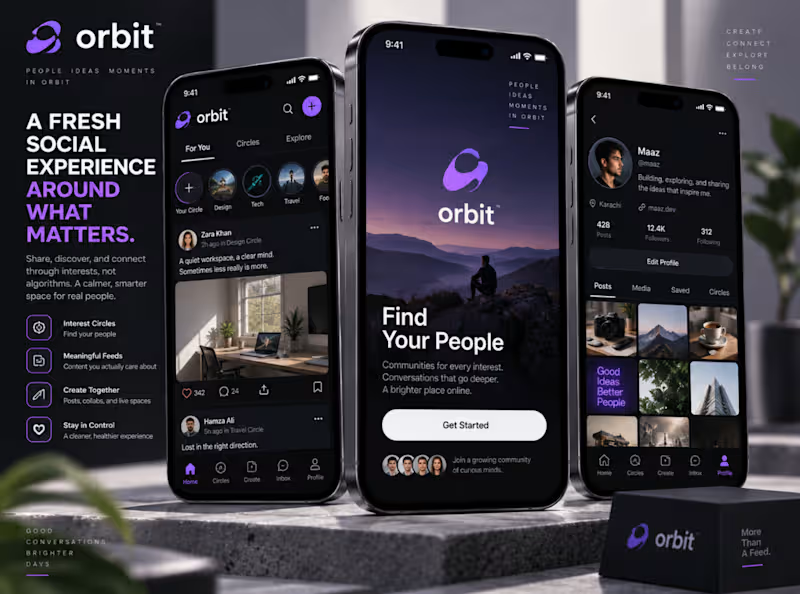
I created Orbit as a mindful social platform designed to bring intention back to how we connect online. Rather than optimizing for endless dopamine loops, vanity metrics, and noisy algorithmic feeds, I shaped the product around what truly matters: shared interests, meaningful conversations, and smaller, focused communities called Circles. The visual direction pairs a deep, cinematic dark theme with soft violet and indigo gradients, giving Orbit a sleek, modern identity while keeping the browsing experience serene and focused. Vibrant purple accents highlight primary actions, active navigation states, and identity elements, while clean typography and dark neutral cards ensure that member content and photography remain the hero. The onboarding screen sets an intentional, welcoming tone with the prompt "Find Your People." Instead of aggressive sign-up walls, it pairs moody outdoor imagery with clear social proof, grounding the experience in human connection and inviting users to step into a calmer corner of the internet. The home feed rethinks traditional social timelines. At the top, persistent "Circles" pills (such as Design, Tech, and Travel) let users pivot their feed by topic rather than enduring an arbitrary algorithm. Posts are presented with generous white space, subtle metadata, and clean engagement triggers, fostering high-signal discussions and genuine visual storytelling. The profile screen balances personal identity with creative curation. Beyond follower counts and bio links, the profile serves as a visual portfolio and hub for individual contributions, dividing posts, media, saved items, and joined Circles into a scannable grid that reflects a user’s genuine passions. Across the interface, I prioritized visual breathing room, crisp iconography, and restrained navigation tabs (Home, Circles, Create, Inbox, Profile). The result is a social product that feels human, grounded, and premium, giving people a healthier, quieter space to find their orbit.
0
140
Cover image for PRESTORATIVE™ (Pacific Plant Nutrients)
I designed
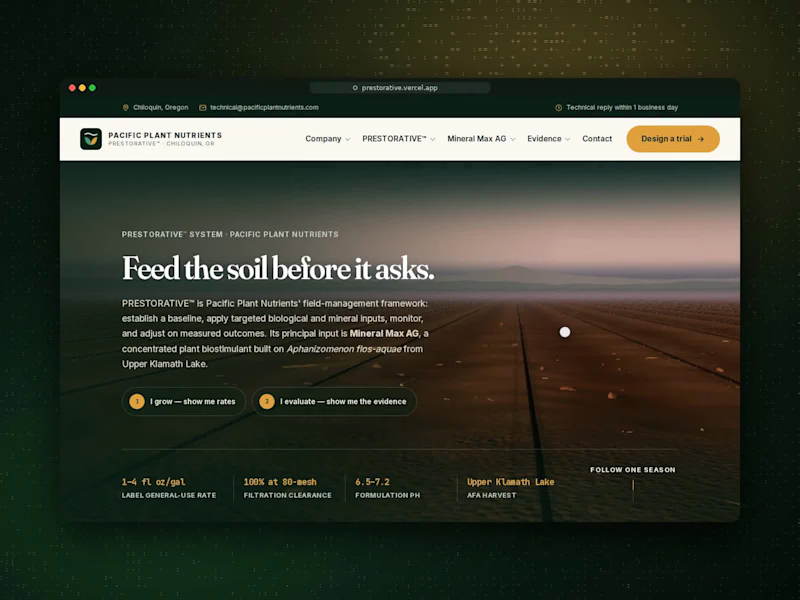
PRESTORATIVE™ (Pacific Plant Nutrients) I designed this website for an agricultural biostimulant brand whose buyers are practical and sceptical: growers who want application rates, and agronomists and distributors who want proof. The challenge was to make a biological product feel credible and easy to understand without relying on big marketing claims. The hero opens on a 3D farm field at dusk under the headline "Feed the soil before it asks." Two buttons split visitors by what they need: "I grow — show me rates" and "I evaluate — show me the evidence." Key product facts sit below in amber monospace type, like readings on a field instrument. I paired an editorial serif with that data typeface, on a palette of deep forest green, warm cream and amber. The centrepiece is "One season," a scroll-driven 3D story. As visitors scroll, a single seed sits in the soil, puts down roots and grows into a full field of crops under a setting sun. Along the way the five stages of the program appear: Assess, Plan, Apply, Measure and Adapt. Floating labels mark the water, root zone, biological activity and mineral environment, and a stage tracker at the bottom shows where you are in the season. It turns an abstract field-management method into something visitors can watch happen. The rest of the page is built around proof rather than promises: Three names, one job each: clear cards separate the company, the system and the product. Product specification: laid out like a technical data sheet. Crop rate engine: choose one of six crops, a growth stage and your acreage, and it calculates the dose and carrier volume. Technical assistant: answers questions from the product documentation. Evidence library: a record carousel with a grading system, "Read the grade before you read the number," so every result shows how strong its evidence is. Toxicology section: tackles the toughest objection head-on: "Isn't this the toxic Klamath algae?" After grower testimonials, the page closes with a confident invitation: "Don't take our word for it. Test it against your current program."
0
8
Cover image for I designed this website for
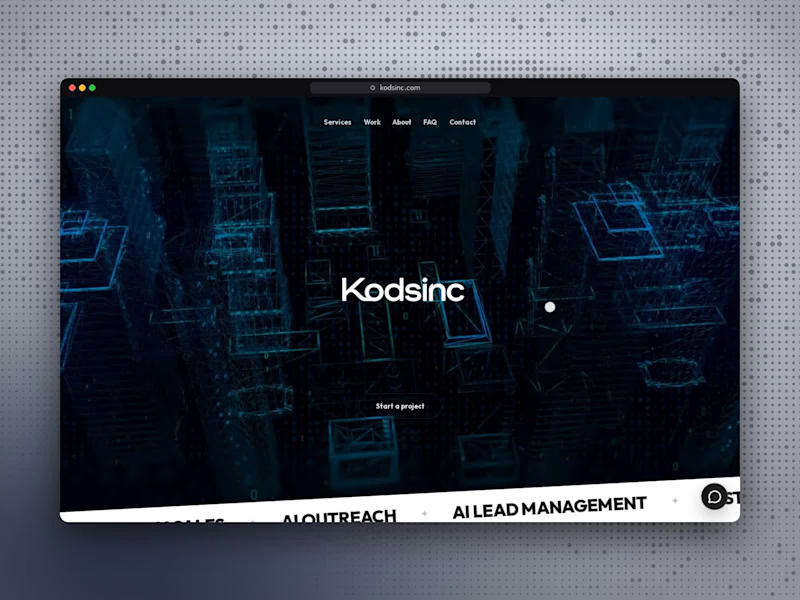
I designed this website for Kodsinc, a digital product and AI studio. The goal was to feel cinematic and ambitious from the first second, while explaining clearly what the studio builds and how it works with clients. The hero opens on a full-screen video of a glowing wireframe city with the Kodsinc wordmark at its centre. Beneath it, a tilted band scrolls through the studio's capabilities: AI voice agents, chat bots, automation, data and analytics, SaaS platforms and custom CRMs. As visitors scroll, the header condenses into a compact "Start a project" pill that expands into a numbered navigation menu. An AI assistant called Aria greets visitors, asks their name and offers suggested questions, so the site demonstrates the studio's own product from the start. For services, I designed a 3D card carousel. Seven vertical cards fan out side by side, and the selected one expands to reveal an illustration and the tools behind that service. The work section, "Work built to move," presents five products (Northstar, Flow CRM, AriaFin, WhatsApp SDR and Aria Assistant) as large stacked cards with device mockups. The page then builds trust. An interactive world map shows offices across five countries, and "Remote by location. Onsite in how we deliver" explains how the team stays close to clients. Security and compliance badges appear before the FAQ. The contact form sits beside the FAQ as a fill-in-the-blank sentence with a dropdown for the type of help needed. The page closes with the line "From Code to Intelligence," which sums up the studio in four words.
1
141
Full-Stack Developer & Digital Consultant
5.0
Rating
4
Followers
Full-Stack Developer & Digital Consultant
🏆 iOS SwiftUI|RxSwift Expert: Apps with 50M+ Installs 🚀
💻Full-stack Developer | Flutter-Laravel-React 🚀
Expert in crafting high-quality, cross-platform Mobile Apps
AI native apps
2x
Hired
5.0
Rating
17
Followers
AI native apps