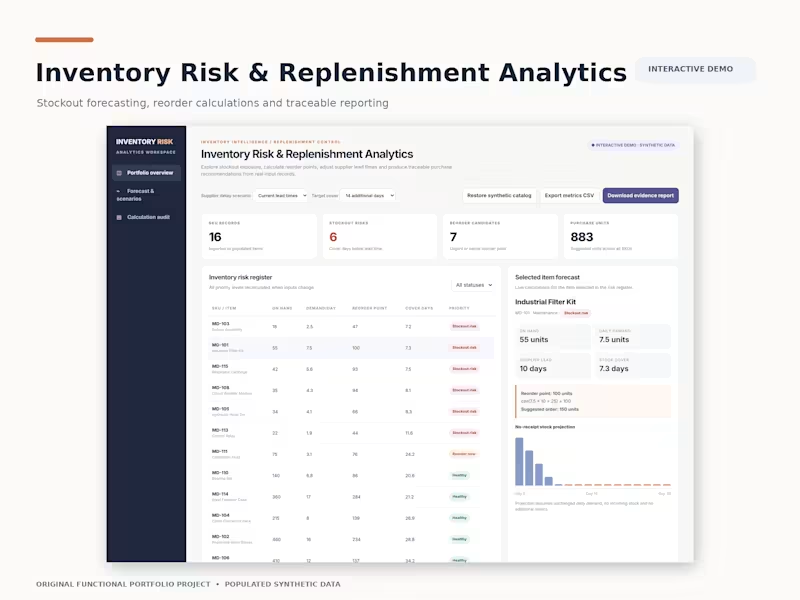
This video demonstrates an interactive inventory analytics application designed to help operations teams monitor stock availability, identify supply shortages, and make informed replenishment decisions.
Using 16 populated synthetic inventory records, the walkthrough demonstrates how changes in stock quantities and supplier lead times automatically update inventory risk calculations.
What the Video Demonstrates
Inventory Dashboard: Displays stock availability, six stockout-risk items, and seven replenishment candidates.
Stockout Risk Detection: Identifies products that may run out before replacement inventory arrives.
Supplier Delay Simulation: Demonstrates how changing lead times affects replenishment calculations and risk exposure.
Interactive Inventory Management: Shows how stock adjustments immediately update dashboard metrics.
Replenishment Analytics: Calculates reorder points using demand, lead time, and safety stock.
Reporting: Provides calculated inventory results and export capabilities.
Technical Implementation
Developed the interactive dashboard, inventory calculation logic, scenario controls, risk filtering, and data import/export functionality using JavaScript, HTML5, and CSS3.
The demonstration showcases a functional inventory management analytics application with reproducible calculations and clearly identified synthetic data.
2
0
155
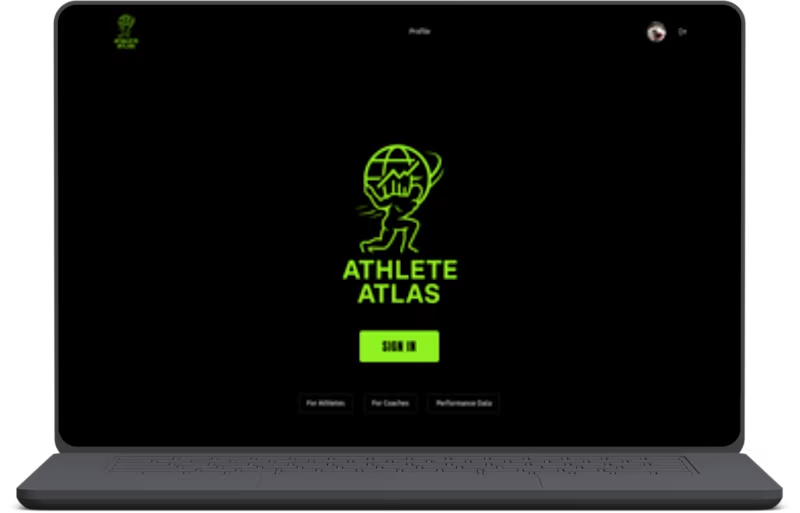
Athlete Atlas – Athlete Management Platform
What it is:
A web application that helps athletes and coaches track performance, training progress, and athlete profiles in one centralized system.
What I built:
Athlete profile and data management
Training and performance tracking features
Coach-facing dashboard for monitoring athletes
Secure authentication and role-based access
0
79





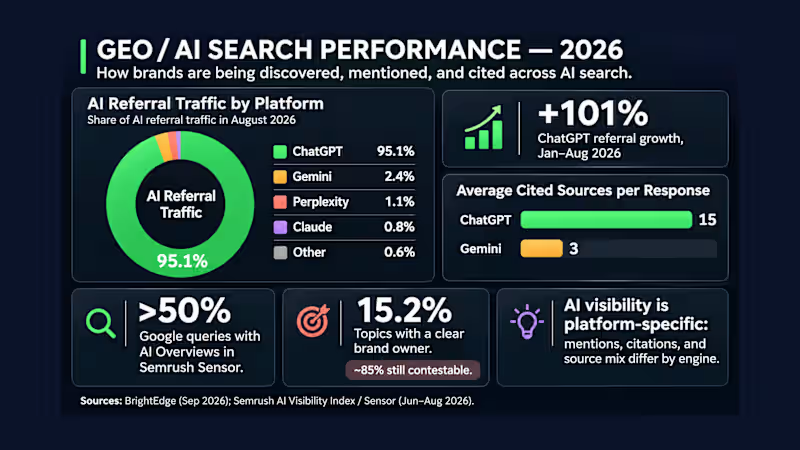
This project analyzes how brands are being discovered, mentioned, and cited across the generative AI search landscape (GEO).
Industry benchmarks highlight a critical consolidation in AI discovery: ChatGPT drives an overwhelming 95.1% of all AI-referred traffic to business sites, experiencing a +101% referral growth rate from January to August 2026. While alternative engines like Gemini, Perplexity, and Claude divide the remaining market share, visibility models show that AI citations are highly platform-specific. For instance, ChatGPT averages 15 distinct cited sources per informational response, showing how strongly visibility depends on structured presence across trusted third-party sources.
The dashboard was designed to map out this ecosystem and track multi-engine visibility index scores. It enables brands to look past traditional SEO and engineer their digital footprints to feed directly into the primary sources LLM engines crawl.
The central takeaway is clear: Dominating AI search is not a broad guessing game. Winning requires a highly targeted focus on the citation channels and indexing parameters shaping visibility on ChatGPT, which accounted for 95.1% of AI-referred traffic in the benchmark.
#GEO #GenerativeEngineOptimization #AISearch #ChatGPT #ContentStrategy
1
140

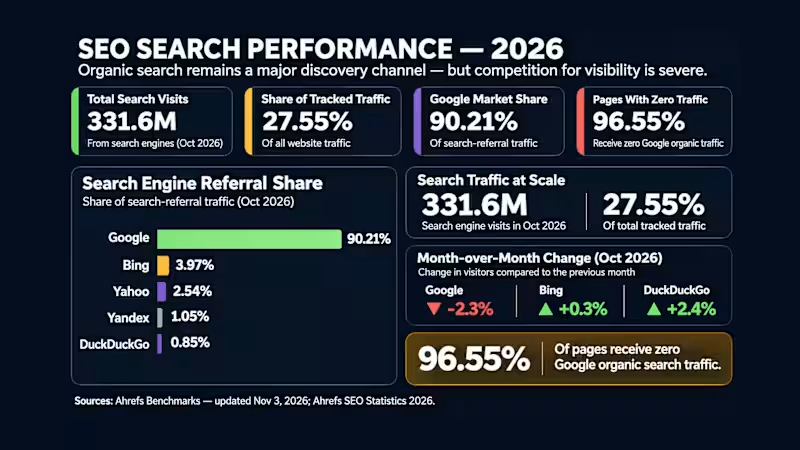
This project examines how difficult it has become for individual pages to earn meaningful organic search traffic.
Ahrefs’ research found that 96.55% of pages in its index receive no organic traffic from Google. Its October 2026 benchmark also recorded a 2.3% month-over-month decline in Google-referred visitors across more than 118,000 tracked websites, while search behavior continues to spread across traditional engines and emerging AI discovery channels.
The dashboard brings those signals together to show the scale of the visibility challenge: publishing content is not enough. Pages still need clear search intent, useful information, strong technical foundations, authority, and discoverability.
The takeaway is not that SEO is disappearing. It is that volume alone is a weak strategy. Businesses need fewer low-value pages and more authoritative, well-structured content that search engines and AI systems can discover, understand, and surface.
#SEO #SearchEngineOptimization #DataAnalytics #ContentStrategy #DigitalMarketing
1
143