Projects in SaalfeldProjects in SaalfeldUI Factory — The Alert Component
I've been building interfaces for a while now. And for most of that time, I did what everyone does — reached for a library, dropped in a component, tweaked the colors, shipped it. Job done.
But I kept noticing something. No matter how polished the product, the UI always felt borrowed. Like you could see the seams of whatever design system was underneath. Everything started looking the same.
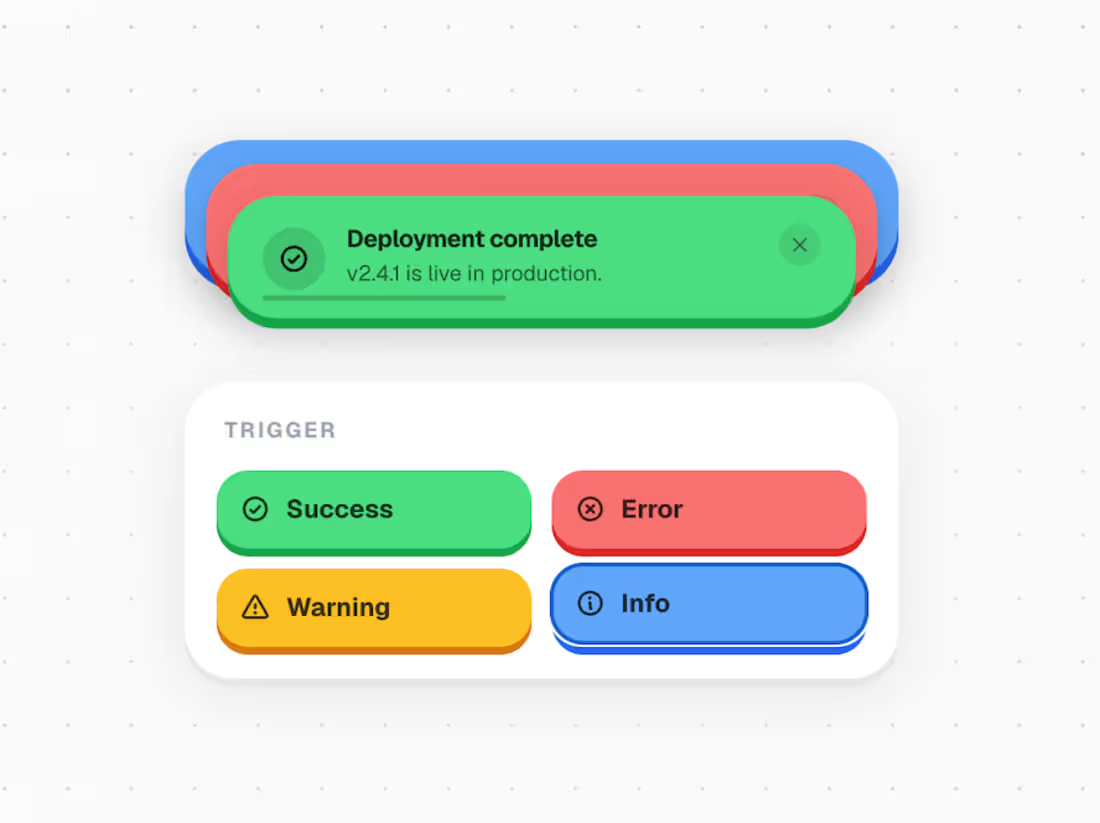
So I decided to start building my own things from scratch. No templates, no defaults. The rule I set for myself: every component has to have its own identity. Its own material, its own physics, its own personality. A notification alert shouldn't feel anything like a pricing card. A dock shouldn't feel like a modal. Each one is its own experiment.
This alert component was the first one I finished. I wanted it to feel physical — like something you could reach into the screen and peel off. That drove every decision: the shadows, the spring physics, the way the stack fans out when you hover it, the way each card exits with a little spin. Nothing about it is accidental.
But claymorphism is just one direction. The library I'm building will go everywhere — glass, depth, brutalism, motion-first, 3D. The point was never an aesthetic. The point is that UI can feel crafted instead of assembled.
I'm in the early stages of building my own UI component library. If this work gets traction, the plan is to open-source the full code so designers and developers can use these in their own products. Every component ships with its own philosophy — no two will feel the same.
This is just the beginning. Follow along.
→ Try it yourself: https://ui-factory-zeta.vercel.app/notification-stack
Stack: React 19 · Next.js 15 · Framer Motion · TypeScript
#SoftwareArchitecture #SystemDesign #FullStack #SaaS #AIEngineering #DistributedSystems #React #PostgreSQL #NodeJS #Python #ProductEngineering #WebDevelopment Building a modular AI-powered SaaS platform is far more about architecture than writing code. 🚀
I've always believed the hard part of building SaaS isn't shipping screens—it's designing a system that can keep evolving without collapsing under its own complexity.
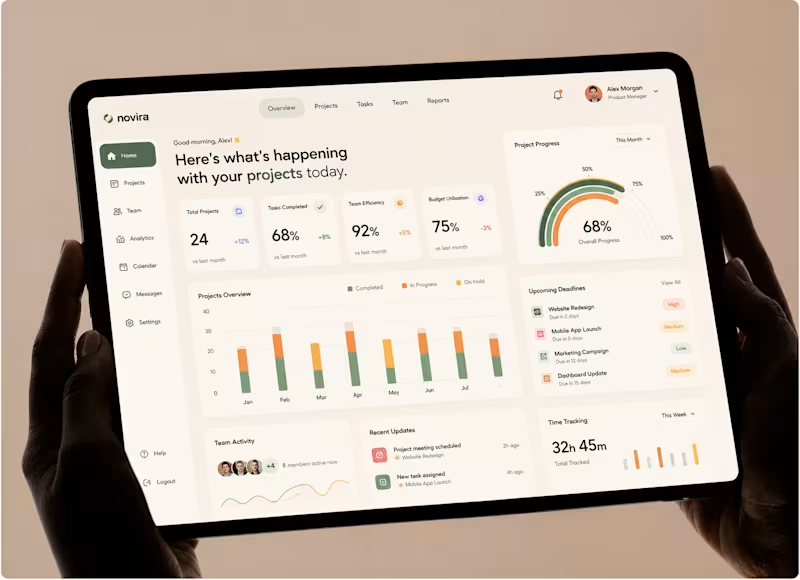
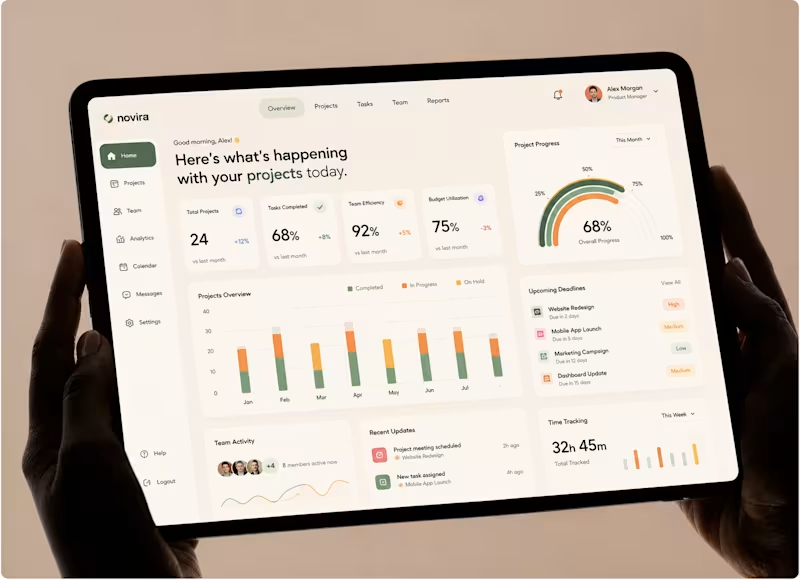
This dashboard started as a simple idea: consolidate business operations into a single workspace. It quickly became an architecture problem. ⚙️
The frontend was built around a modular component system where every feature behaves as an independent capability rather than another page bolted onto the application. That decision paid off later when adding new business domains without rewriting existing flows.
The backend was where the real engineering happened. 🏗️
Instead of tightly coupling business logic with APIs, I pushed the core into service boundaries with clear contracts, making each domain independently deployable and far easier to reason about. Every expensive operation runs asynchronously through event-driven workflows, keeping the request path lean while maintaining eventual consistency across the platform.
Real-time updates were another challenge. ⚡
Polling was never an option. The dashboard streams state changes over persistent connections, with optimistic UI updates, cache invalidation strategies, and fine-grained synchronization to avoid unnecessary renders. The goal wasn't just "real-time"—it was deterministic state across multiple clients without creating race conditions.
Then came the AI layer. 🤖
The biggest mistake I see is treating AI as another widget.
An LLM can generate endless observations, but most of them are operationally useless.
The difficult engineering problem isn't inference—it's context engineering.
The system retrieves only domain-relevant operational signals, enriches them with structured business context, applies retrieval pipelines, and constrains generation so the model produces recommendations with actual decision-making value instead of confident-sounding noise.
Every AI response is grounded in live operational data rather than generic prompts.
On the data side, the reporting layer was optimized to avoid analytical queries impacting transactional workloads. Materialized views, selective indexing, query planning, and aggressive caching keep KPI aggregation predictable even as datasets grow. 📊
The UI intentionally stays quiet. 🎯
No flashy animations. No unnecessary interactions.
Information density, visual hierarchy, and latency matter far more than decorative effects when people spend hours inside a product.
Looking back, the hardest part wasn't React, PostgreSQL, or integrating AI.
It was designing boundaries that let every layer—UI, services, data, and intelligence—evolve independently while still feeling like one cohesive product.
That's the kind of engineering work users never notice.
And that's usually a sign you got it right. 💡
What's the most challenging architectural decision you've had to make on a production system?
#SoftwareArchitecture #SystemDesign #FullStack #SaaS #AIEngineering #DistributedSystems #React #PostgreSQL #NodeJS #Python #ProductEngineering #WebDevelopment