Rat Paw Detection with YOLOv8 + Gradio
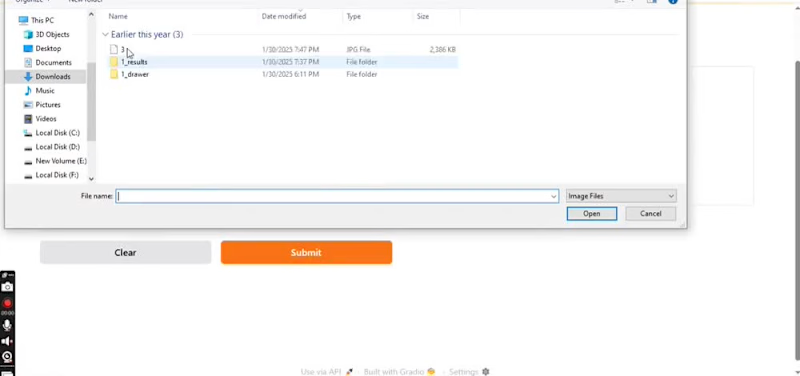
This project showcases a lightweight and intuitive web interface for detecting rat paws in images using a custom-trained YOLOv8 model. Built with Gradio, it allows users to upload an image and receive instant visual feedback with detected paws highlighted.
Key Features:
YOLOv8 object detection fine-tuned specifically for rat paw recognition.
Interactive web app for image uploads and real-time inference.
Built with Gradio for fast prototyping and deployment.
Clean interface with automatic annotation overlay.
2
257

Automated Video Dehazing & Atmospheric Haze Simulation System
🚀 Project Overview
This advanced Computer Vision project is designed to address visibility challenges in adverse weather conditions. The system features a dual-module architecture: it can synthetically inject realistic atmospheric fog/haze into crystal-clear video streams for dataset generation, and conversely, restore heavily degraded, foggy videos into crisp, high-visibility outputs in real-time.
🛠️ Core Functionality & Modules
Module 1: Atmospheric Haze Simulation
Purpose: Generates synthetic datasets to train and benchmark object detection models (like YOLO) for bad weather conditions.
How it works: Implements mathematical scattering models to calculate depth maps and overlay a realistic layer of dense fog or smoke over clean video frames.
Module 2: Real-Time Video Dehazing
Purpose: Restores clarity and vivid color to video streams captured in low-visibility environments.
How it works: Leverages physics-based Computer Vision algorithms (such as Dark Channel Prior - DCP) or Deep Learning frameworks to estimate atmospheric light, eliminate transmission noise, and reconstruct the scene's original contrast.
🎯 Use Cases & Applications
Autonomous Vehicles: Enhances the sight and reliability of self-driving car sensors in dense fog.
Smart Surveillance (CCTV): Improves security monitoring and facial recognition accuracy under harsh outdoor weather.
Drone Navigation: Aids aerial drones in safely navigating through smoke, dust storms, or low-lying clouds.
💻 Tech Stack Used
Language: Python
Libraries: OpenCV, NumPy, Matplotlib, PyTorch / TensorFlow (if deep learning was applied)
Concepts: Image Processing, Atmospheric Scattering Models, Feature Restoration, Video Pipeline Optimization
0
129
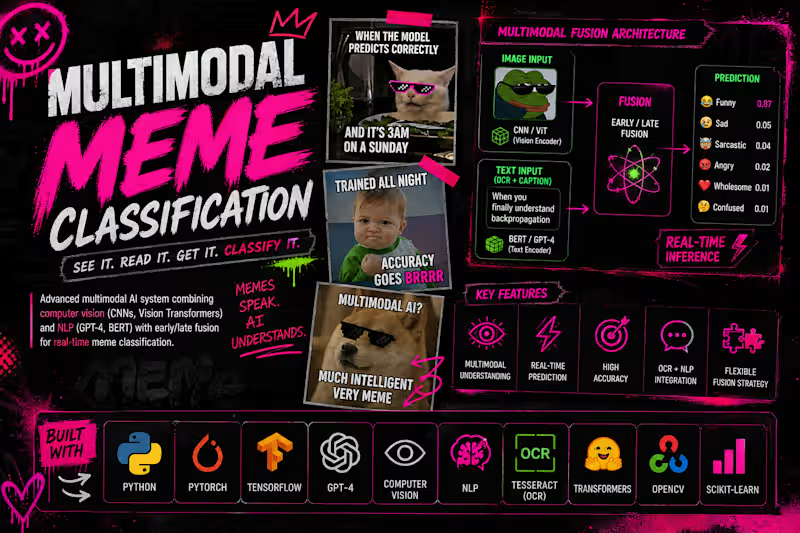
Yeah, this one is a bit out there, but it was super fun. I built an AI that actually understands memes. It looks at the image and the text together using PyTorch, TensorFlow, and GPT 4. I used early and late fusion techniques to combine vision and language, plus Tesseract OCR to grab text from the image itself. The model hits over 95% accuracy on meme classification. It’s not your typical corporate project, but it shows how multimodal AI can understand humor, culture, and context. Definitely one of my favorite experiments.
For more details, please visit: https://arham-nexus.vercel.app/work/memechecker
1
0
90
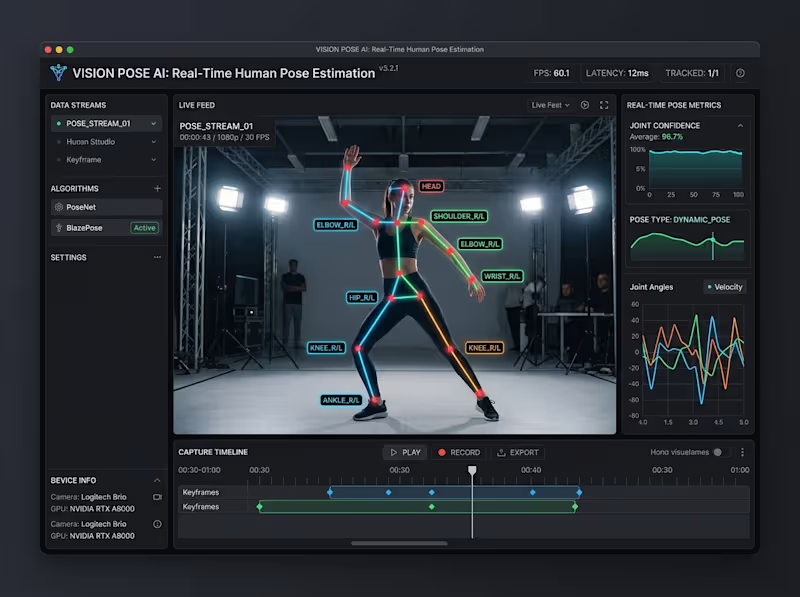
AI Pose Tracker - Real-Time Computer Vision
Built a high-performance computer vision application capable of real-time human pose detection. Utilized OpenCV and MediaPipe to track body joints and skeletal movements with precision. Developed a sleek analytics dashboard to visualize movement data, joint angles, and frame-rate performance. This project demonstrates advanced expertise in machine learning model deployment and video stream processing.
Skills : Computer Vision, Machine Learning, Data Analysis
Tools : Python, OpenCV, MediaPipe
0
39


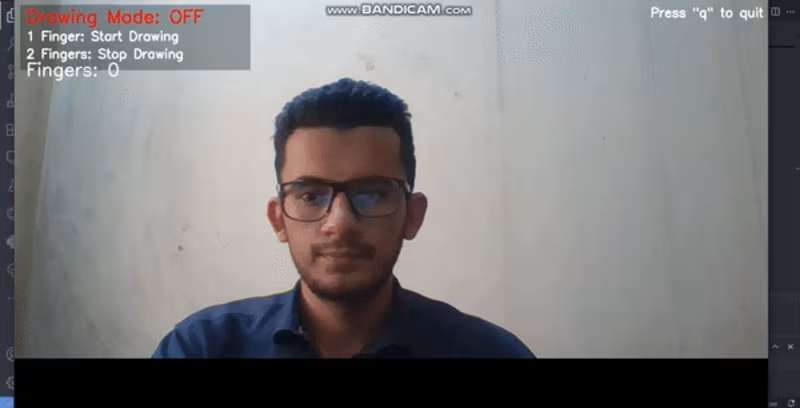
I developed a real-time Air Drawing Application that uses Computer Vision to transform hand gestures into digital input. By utilizing a standard webcam, the app allows users to draw, erase, and select colors in mid-air without any physical contact with the screen.
Key Technical Features:
Hand Tracking: Integrated MediaPipe to track 21 specific hand landmarks with high precision and near-zero latency.
Gesture Logic: Programmed custom state-switching—using a single index finger for "Drawing Mode" and a two-finger gesture for "Selection Mode" to navigate the UI.
Real-time Rendering: Leveraged OpenCV for video processing and to create a dynamic, responsive canvas overlay.
This project demonstrates my ability to build Human-Computer Interaction (HCI) tools and implement real-time AI solutions using Python.
0
57