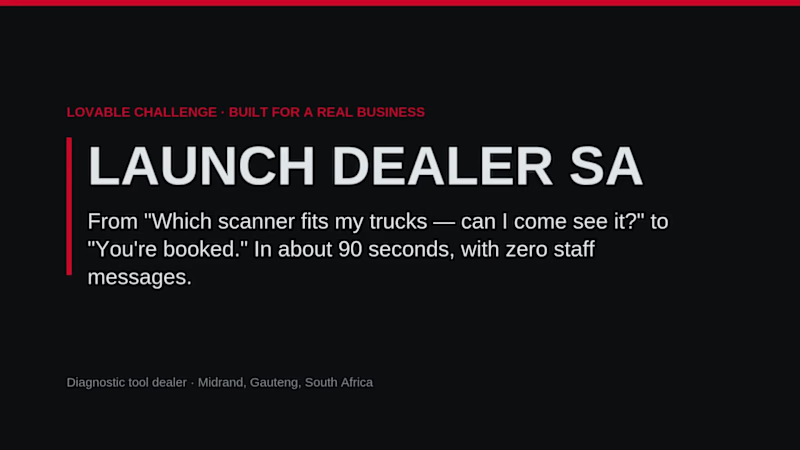
Desktop Apps Development Projects in PunjabDesktop Apps Development Projects in PunjabLaunch Dealer SA — Midrand, Gauteng, South Africa 🔧
Problem solved: every tool sale started with ~15 WhatsApp messages ("Which scanner fits my trucks? Can I see it Saturday?"). Now workshops get matched to the right tool and book a demo with the demo unit reserved in about 90 seconds, with zero staff messages.
THE BUSINESS & ITS QUIRKS
A diagnostic tool dealer with a showroom at Midrand Motor City. One salesperson, one after-sales technician, and only ONE heavy-duty truck demo kit. Out-of-town truck workshops drove 2 hours to find the kit already out. Saturday half-day, month-end rush, no-shows.
CUSTOMER SIDE
4-question Tool Match: AI recommends 2 real products from their catalogue, including what each won't do
Live availability in SAST that reserves the demo unit, not just the time
Instant confirmation, calendar links, self-service reschedule & cancel
OWNER SIDE
Automatic 24h + 2h reminders with one-tap "Yes, I'll be there"; unconfirmed bookings flagged "at risk"
Staff alert with one-tap WhatsApp / Call
AI lead brief per booking: which tool to have on the bench + the likely objection
No-show → automatic rebook email; completed demo → AI-drafted quote + 3-day follow-up
Impact counter: messages avoided, reminders sent, hours saved
TRY IT
Live app: https://launch-dealer-booking.lovable.app
(https://launch-dealer-booking.lovable.app)Owner demo (no login): footer → "View owner demo"
Reviewer login: curious@launchdealer.demo (mailto:curious@launchdealer.demo) / Curiosity2026!
Built entirely in Lovable. I wish I had it months ago.
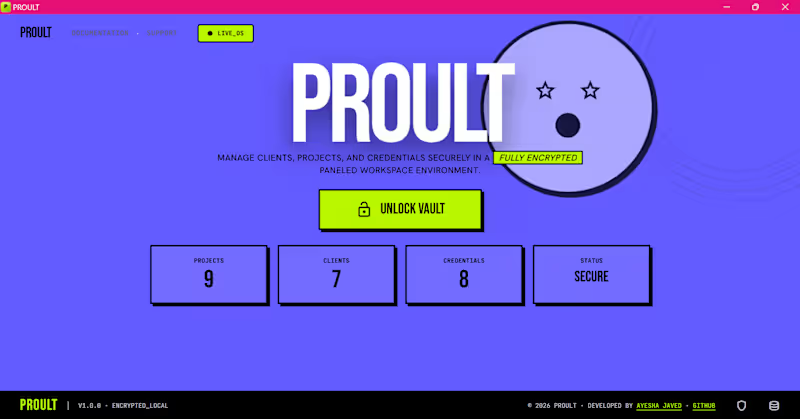
(Launching Proult - Desktop App)
I spent 20 minutes looking for a Stripe credential.
I checked my notes.
My browser bookmarks.
Old chats.
Random text files.
Not because I forgot it.
Because I couldn't remember where I had saved it.
That's when I realized the most dangerous phrase in a developer's workflow isn't:
"I forgot."
It's:
"I've saved it somewhere."
As freelancers, students, developers, and builders, we constantly juggle multiple projects simultaneously.
And each project comes with its own ecosystem of information:
• Client details
• Credentials and passwords
• API keys and secrets
• Domains and hosting accounts
• GitHub repositories
• Deployment links
• Meeting notes
• Project requirements
• Time logs and deadlines
The problem isn't that we don't save this information.
The problem is that we save it everywhere.
-A Notepad file for credentials.
-A spreadsheet for clients.
-A project management tool for tasks.
-Bookmarks for links.
-Chat messages for "important" details.
And before long, finding information takes more time than using it.
After one too many "I know I saved this somewhere" moments,
I decided to build something for myself.
A single place where every project has its own secure workspace.
Not just for storing passwords, but for managing everything related to that project: clients, credentials, API keys, notes, services, links, statuses, and time tracking.
That's how "𝐏𝐫𝐨𝐮𝐥𝐭" started.
So over the last few days, I've been building Proult,
A local-first desktop application designed to keep everything related to a project in one place.
-AES-encrypted credentials, API keys, and secrets
-Project and client management
-Built-in time tracking
-Organization through project domains (Freelance, Personal, Organization, University)
-Global search across projects, clients, credentials, and services
-Full import/export support so your data always remains yours
-Pinned projects, tags, notes, deployment links, and service management
-Local-first architecture; no cloud dependency, everything stays under your control
Still polishing it, but building it has already improved my own workflow significantly.
Turns out, the best developer tools are often the ones built to solve your own frustrations first.
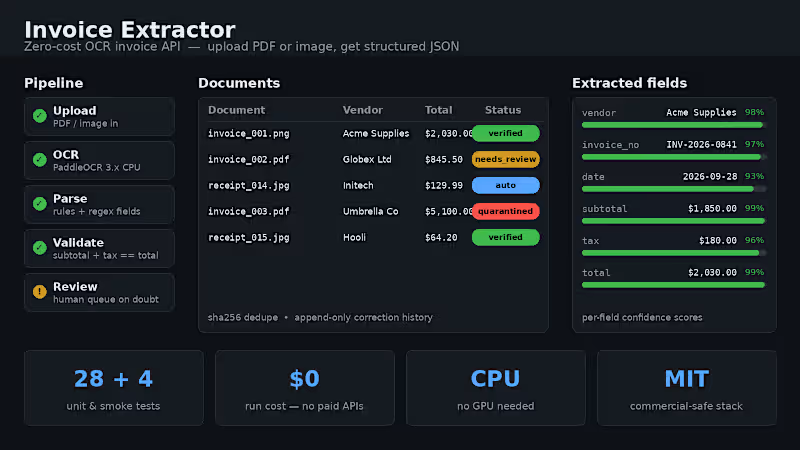
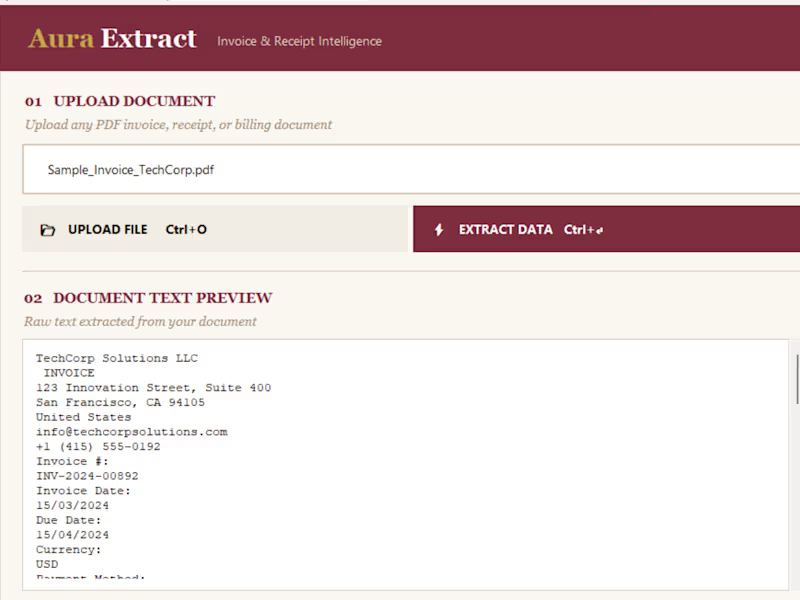
I built an invoice extraction API that costs nothing to run. You upload a PDF or image, and it returns clean structured data: vendor, invoice number, dates, line items, subtotal, tax, total — every field with its own confidence score.
Under the hood it runs PaddleOCR on a regular CPU (Tesseract as backup), then a rule-based parser pulls out the fields. Before anything gets accepted, an arithmetic check makes sure subtotal plus tax actually equals the total — that catches the small digit errors OCR often makes. If something looks uncertain, it goes to a human review queue instead of failing quietly, and every correction is saved in an append-only log so you can always see what changed.
No paid vision APIs, no GPU needed. The whole stack is open-source, it ships in Docker, and it's covered by 28 unit and 4 smoke tests.