Backend Development Projects in PuneBackend Development Projects in PunePDFConverterOnlineFree – Node.js PDF Tool
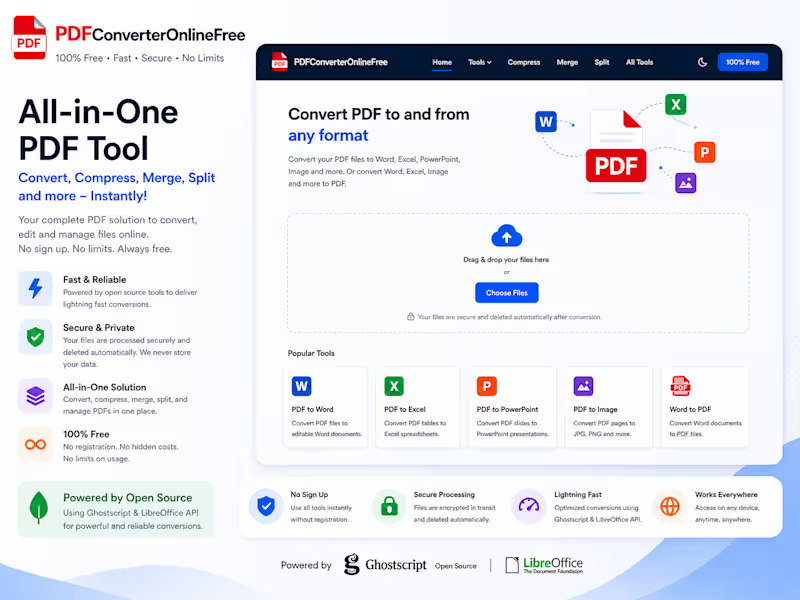
I built this project as a practical, real-world PDF tool that runs completely online and doesn’t rely on any database.
The idea was simple — most PDF tools out there are either paid, slow, or store user files. I wanted to create something lightweight, fast, and privacy-friendly using open-source tools.
🔗 Project Link: https://github.com/deepakpatilauthor/PDF-Tool-Node-JS-Project
What this project does
This web app lets users:
Convert PDFs to formats like Word, Excel, and images
Convert files back into PDF
Merge, split, and compress PDFs
Use everything without signing up
All files are processed temporarily and deleted automatically, so nothing is stored.
How I built it
I used Node.js for the backend and connected it with:
Ghostscript for handling PDF operations like compression
LibreOffice for document conversions
The whole system is stateless (no database), which keeps it simple and fast.
Why I built it this way
I wanted to prove that you don’t always need paid APIs or heavy infrastructure to build something useful. With the right open-source tools, you can create a solid, production-ready app.
What I learned
Working with system-level tools like Ghostscript and LibreOffice
Handling file uploads and processing efficiently in Node.js
Building a clean workflow without relying on a database
Thinking about performance and user privacy
Final thoughts
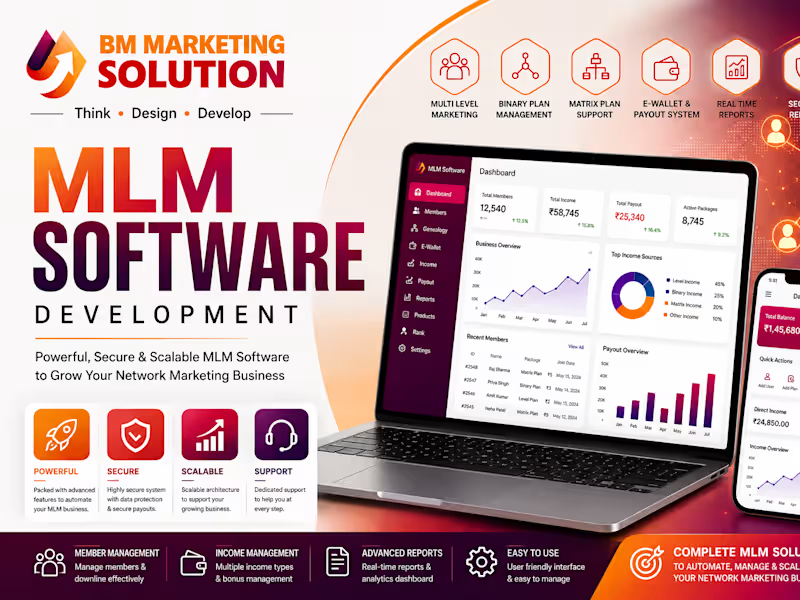
This project is a good example of how I approach building tools — keep it simple, make it useful, and avoid unnecessary complexity. Get complete control over your network marketing business with a centralized, automated administration hub. Based on the robust architecture of MLM Engine, I deliver secure, highly customizable, and "India-Ready" MLM platforms designed to manage your entire downline layout and process accurate commission calculations without glitching.
What you will get:
• Fully custom compensation plans (Binary with leg balancing calculators, Forced Matrix N×N plans, Single Leg, and Generation structures)
• Centralized Admin & Distributor Command Centers (Real-time tracking of registration, sales volume, and conversion rates)
• Secure automated E-Wallet & E-Pin transaction frameworks for payouts and digital token management
• Regional Indian integrations (GST-compliant digital invoicing, UPI payment gateways, and automated WhatsApp notifications)
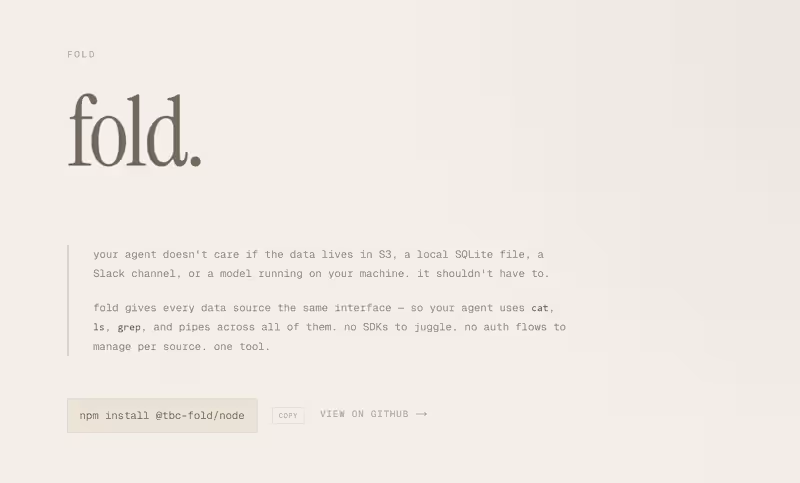
MLM Software, Network Marketing, Binary Plan, Matrix Plan, Generation Plan, FinTech, E-Wallet System, E-Commerce Integration, Software Development I shipped an open-source package called Fold.
Here's the problem it solves:
When you build an AI agent that touches more than one data source S3, Slack, a local database,
your filesystem you end up managing three or four different SDKs, auth flows, and API shapes
before writing a single line of actual agent logic.
Then you give your LLM a list of 12 tools and hope it picks the right one.
Fold takes a different approach.
It's a virtual filesystem. You mount any backend under a path prefix:
/notes → your local Documents folder
/db → a SQLite database
/s3 → an S3 bucket
/slack → Slack channels as directories
/model → a locally running Ollama model
Your agent gets one tool: bash. cat, ls, grep, wc, head, pipe across all of them.
LLMs were trained on bash. They know it cold. Fold exploits that instead of fighting it.
Three things I built that Mirage (the main prior art) doesn't have:
Local-first. SQLite, local files, and Ollama are first-class resources.
Everything can run on-device with zero data egress and zero API keys.
Reactive. ws.watch (http://ws.watch)() lets any resource push events when data changes. Your agent triggers automatically no polling, no cron.
Rich listings. ls -c returns metadata alongside filenames row counts, schemas, member counts, last activity. The agent understands the environment in one call instead of five.
It also ships as an MCP server out of the box. One file and it's available in Claude, Cursor, or any MCP client.
Published under The Builder Company:
npm install @tbc-fold/node
Repo: https://lnkd.in/g6EdaYEx
(https://lnkd.in/g6EdaYEx)Website: https://lnkd.in/g6WjxGGd
Built this alongside Aura. The two are related Fold is the abstraction that lets Aura's
local agent work across your data without sending anything to the cloud.
If you're building agents and hitting the multi-SDK problem, try it.