Projects in PucónProjects in PucónTHE GOOD STUFF
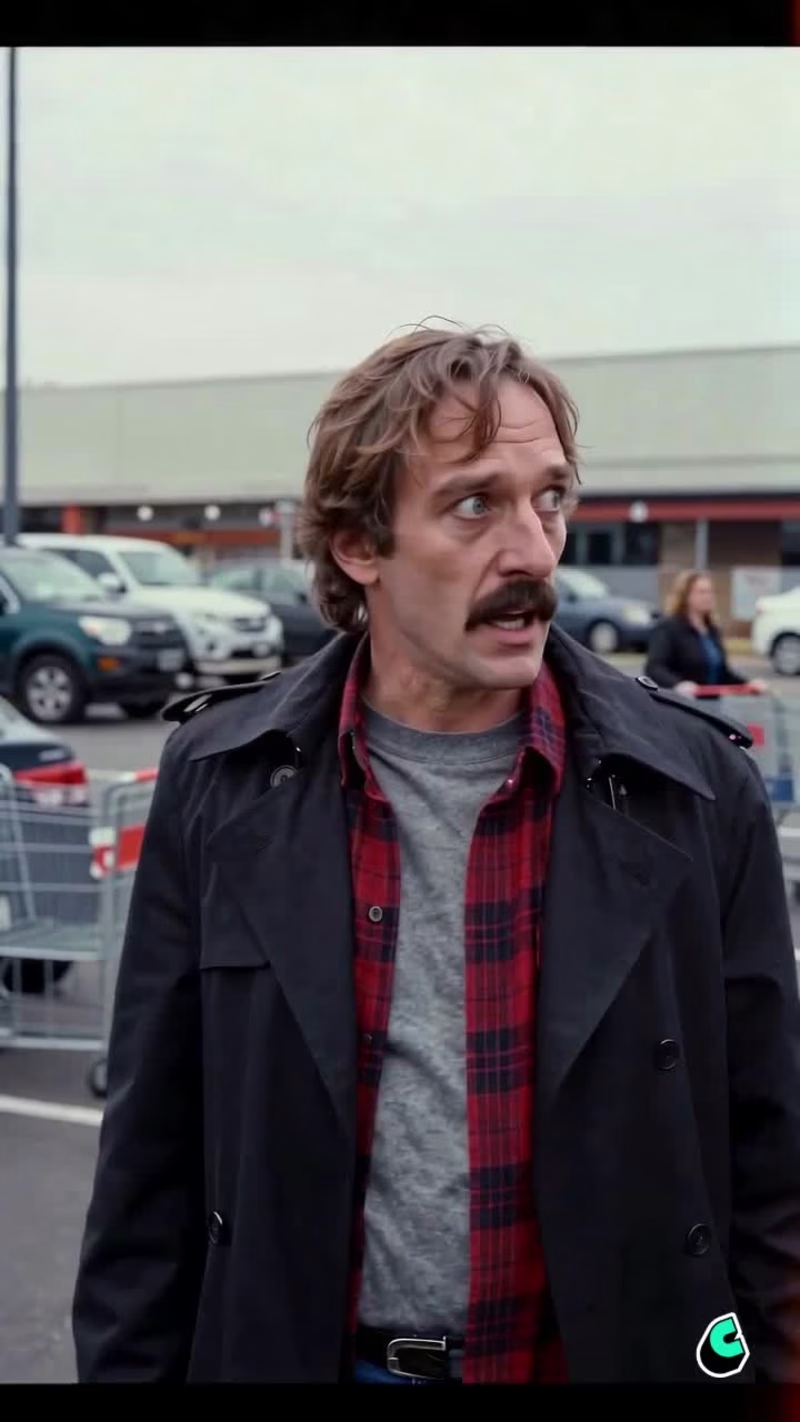
A corporation owns everyone's dreams. REM sells bootleg ones out of the lining of his coat, in a parking lot, in broad daylight, and nobody walking past even looks at him.
Every episode is one sale. You're the customer. The whole thing is shot through your glasses, so you never see your face, and neither does he.
The pilot has REM working outside a big-box store. You walk up, he clocks you immediately, and he starts running you through the latest shipment. Dreams, fresh in, one color at a time. Then you ask him for something stronger. He always has something stronger. He'll judge you for it, and he'll sell it to you anyway.
Where it goes next: same lot, same coat, a new customer every episode. That's the format, and the format is the joke. Whatever you came looking for, REM has a color for it and a speech to go with it.
"This is what you're looking for." He says it every time, and it's always true. The pilot cuts right there, with the iridescent one already sold and no idea what's inside it. A spicy dream, or one last dinner with your parents on a school night. You decide what counts as stronger.
The next episode opens that dream. And that's where the series starts showing its hand: every customer asks for one thing, but what they walk away with says a lot more about them than it does about REM. KITTY.
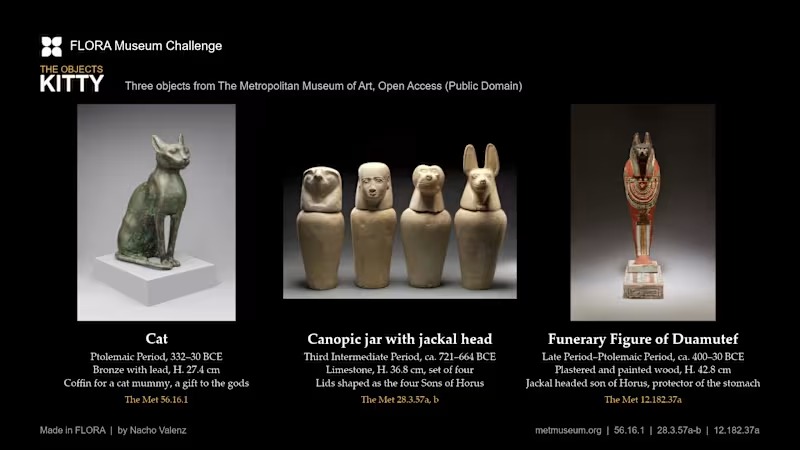
The bronze Cat at The Met (56.16.1, Ptolemaic Period, 332–30 BCE) is not a statue: it is a coffin for a cat mummy, a gift to the gods. KITTY builds the world around the object: the embalmer who made it, and the moment before the cat became sacred. It imagines that cat alive, in an embalmer's workshop, on a table shared with two more objects from the collection: a set of limestone canopic jars guarded by the four Sons of Horus (28.3.57a, b) and Duamutef, the jackal headed funerary figure (12.182.37a). Thirty nine seconds, four takes, graded like a 1940s three strip Technicolor print.
Everything was built inside FLORA. The Met's Open Access photographs became character sheets and a set plate with Nano Banana Pro; the base stills were composed from them and graded with Seedream 5 Pro as a strict LUT, so no object changed its hue. Every take was written by Claude Opus 5 running as a text node on the canvas and animated by Seedance 2.5 with native audio, one take at a time. The score is a small Ptolemaic ensemble generated with Suno; edit and museum labels in ffmpeg. The canvas was driven from Claude Code through FLORA's MCP, and every frame was approved by a human before a single credit was spent.
About the museum piece: Cat, Ptolemaic Period, 332–30 BCE. Bronze with lead, H. 27.4 cm. The Metropolitan Museum of Art, Harris Brisbane Dick Fund, 1956 (56.16.1), Gallery 134. A receptacle for a cat mummy, one of the luxurious offerings buried in temple precincts, especially those of the goddess Bastet. The gold ring in her pierced ear is now missing; the incised collar carries a medallion in the shape of a protective eye.
Original artworks at The Met (Open Access, Public Domain):
Cat, 56.16.1:
https://www.metmuseum.org/art/collection/search/544118
(https://www.metmuseum.org/art/collection/search/544118)Canopic jar with jackal head, 28.3.57a, b:
https://www.metmuseum.org/art/collection/search/559934
(https://www.metmuseum.org/art/collection/search/559934)Funerary Figure of Duamutef, 12.182.37a:
https://www.metmuseum.org/art/collection/search/551149 Title: FOLLOWER OF
FOLLOWER OF wakes a painting nobody signed. "Christ's Descent into Hell" (The Met, 26.244) is by an anonymous follower of Hieronymus Bosch, sold as a Bosch in Prague in 1926 and still unattributed. I chose it because I love Bosch, and because a painting by a follower asks the question the whole panel is about: who follows whom.
For a hundred seconds the painting comes to life without ever leaving the surface of the paint. A lantern wakes it. Light breaks the gate of hell. Adam and Eve beg with empty hands, the saved climb the stairs, Saint Christopher slips away from the devil's army with the child on his shoulders, Judas will not let go of the bag, Sisyphus keeps climbing, and the ones who stay behind keep living by the giant head. The ending comes from the Met's own technical notes: the blue corner of the sky was painted over fire. The painter changed his mind.
Every shot starts from a crop of the Met's open access image: no new figures, no new colors, only what the painter left. Each crop was upscaled with Magnific Precision Upscaler, animated with Kling 3.0 Pro, with prompts refined by Claude Opus 5 inside FLORA. The narration is Gemini TTS, the score is ElevenLabs Music: a sixteenth century Franco-Flemish consort reimagined for a painting of hell. The whole pipeline ran from Claude Code on the desktop through FLORA's MCP: the agent built the graph, ran the models and kept the production ledger, and every creative decision stayed with me. Structure, shot list and sound design follow a kishotenketsu: the turn is not a fight, it is a painter changing his mind.
Christ's Descent into Hell, Follower of Hieronymus Bosch (Netherlandish, second quarter of the 16th century). Oil on two oak planks, 53.3 x 116.8 cm. The Met, Harris Brisbane Dick Fund, 1926 (26.244), on view in Gallery 613. A panoramic hell where Christ breaks the gate to free the just: Adam and Eve, Noah, Abraham, David and the patriarchs climb a ruined tower, Sisyphus heaves his stone up the rock on the right, and Judas is dragged back. Paint analysis shows the orange of the burning sky continuing under the blue in the upper left corner: more of the sky was originally on fire. Public Domain, Open Access.
Original artwork (The Met, Open Access): https://www.metmuseum.org/art/collection/search/435725 CCRROOAAKK!!
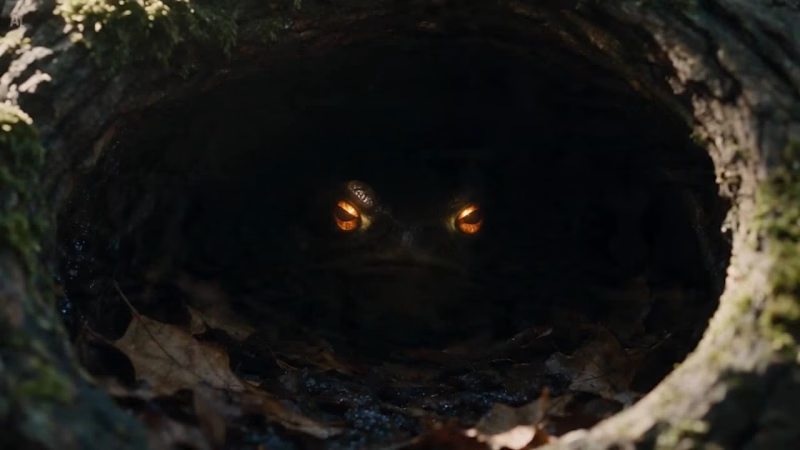
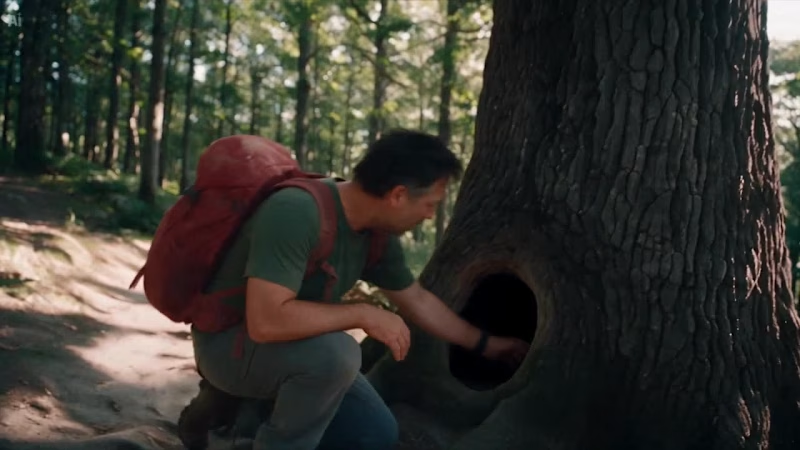
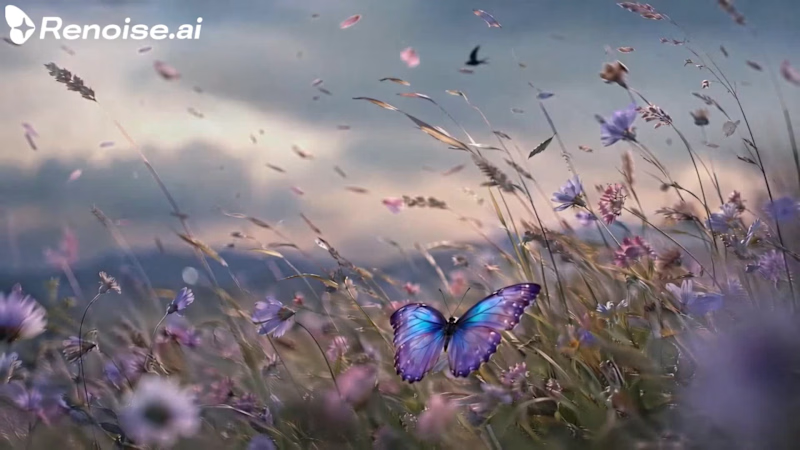
Another chapter from a parallel universe, a 40 second one-take AI film. The hiker returns to the toad's hollow, reaches inside and pulls out a handful of glowing matter. He breathes it in, and the trip takes him: galaxies turn inside his eyes, translucent copies of himself trail behind as he walks, his hands glitch, and his body runs through a chain of altered states, a puppet, a leather jacketed figure in colored smoke, cartoon forms, until he stops and screams inside a burning yellow aura. Then everything folds inward. He is sealed inside a transparent bubble that bursts into a cloud of multicolored particles, and the forest path is left empty.
Made in CapCut Video Studio with Seedance 2.5 (16:9, 720p). Two consecutive prompts written from the same references, the second picking up exactly where the first ends, joined into a single continuous 40 second shot with no cut. Identity, location and stage references were generated as images first, with the same man rendered in each transformed state so the model could copy him faithfully instead of inventing a new character. The forest, the light and the camera stay real throughout; only the man transforms. Audio is forest ambience, footsteps and the sounds of each transformation.
One note on the dialogue: the line the character shouts was not written by me. Seedance came up with it on its own, profanity included, and I left it in because it fits the moment better than anything I would have scripted. DREAM-O — The global registry of dreams.
I almost never remember my dreams. I wanted an app that would tell me what I dreamed last night — and the moment I imagined it working, I knew what the company behind it would actually be. So I built that company instead.
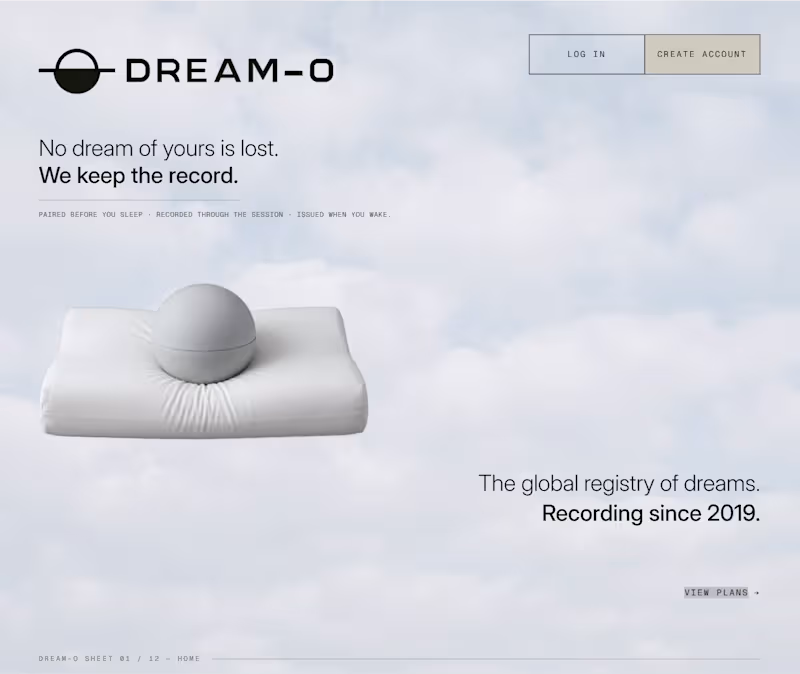
A pillow unit records every session. Twelve minutes after you wake, the company issues a record. It never explains how.
What you're allowed to see of your own dream depends on which plan you pay for. ORIGIN opens one scene a month. The rest stay in custody — described in full, never opened. Their time, their length, their size, their state. Everything except what happened. After fourteen days they're destroyed. Not for the company. For you. And the company doesn't say destroyed. It says released.
Every screen is written in that voice: procedural, patient, institutional. The product never winks. Nothing on any sheet tells you this is wrong — you work that out yourself, somewhere around the retention page.
One prompt in Flowstep produced six screens. From there it was iteration — prompt, look, correct, look again. Text overflowing, blocks colliding, things that looked fine until I zoomed in. Every screen sits on a percentage grid with four x-values and a single hairline spine at 68.4% height. No border radius, no shadows, no serifs, no accent colour anywhere in the system.
Then I connected Claude Code to Flowstep's MCP server, handed it my design guide, and asked it to audit all fourteen screens against it, one by one. A second prompt to fix what the audit found. It worked inside the Flowstep file over MCP. I went off to cook.
I came back and it was ready — I just wired a few links by hand, three clicks each. Fourteen screens for twelve sheets — the record sheet exists three times, one per plan. A path you can walk end to end.
Prototype: https://app.flowstep.ai/file?activeFileId=0a82e6e8-edfa-4dfb-ace8-dfb2e8122859
Social: https://x.com/JosIgnacio17989/status/2083406318304481732
Built with Flowstep · Claude Code over MCP
@flowstep_ai #FlowstepChallenge Pulse — Real-Time Global Seismic Activity Category: Dashboard
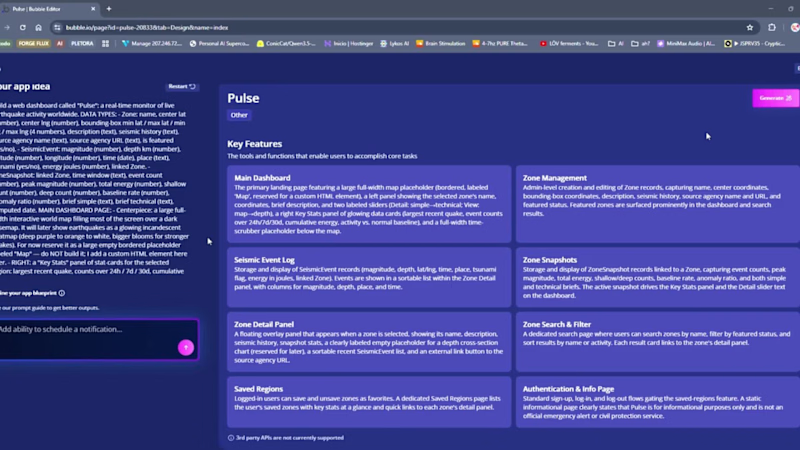
Pulse is a live monitor of earthquake activity worldwide. Open it and the planet is already breathing — every recent quake rendered as an incandescent heatmap, streamed live from USGS. Drag the timeline scrubber to replay the last 30 days and watch seismic activity unfold as a film. Pulse auto-focuses on the most active zone, then opens a full analytical panel: how active the region is versus its baseline, cumulative energy released measured against Hiroshima, and a depth cross-section that reveals the tectonic plate diving beneath the surface — the dimension a flat map can't show, and the one that determines whether a quake is deadly or harmless.
An educational slider reframes each zone's geology from plain language for anyone to technical depth for an expert — the same phenomenon, two audiences, no jargon left behind. Logged-in users save regions to track.
Built on Bubble AI. A single prompt to Bubble's AI builder generated the foundation — data structure, page layout, navigation, and auth. On top of that base I built the live WebGL map (MapLibre + deck.gl (http://deck.gl)), real-time USGS integration, the client-side analytics engine (energy, anomaly, depth distribution), and the bespoke 2D depth cross-section that detects subduction directly from the data.
Pulse is informational, not an official emergency source. Data: USGS.
Live app: https://pulse-20833.bubbleapps.io/version-test/ OmniLearn — be the hero of your own story, literally
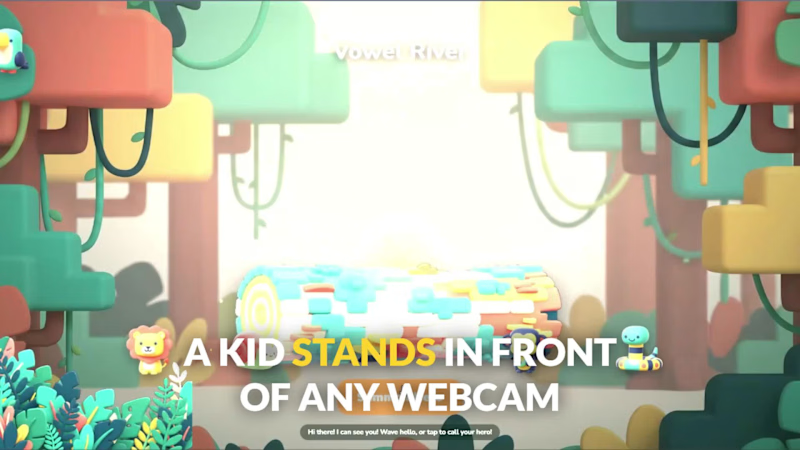
OmniLearn is a body-controlled learning game for kids aged 4–7. A child stands in
front of any webcam, gets scanned, and becomes a soft-voxel 3D avatar of themselves
that they control with their body — no controller, no keyboard. They solve
educational challenges by MOVING: catching falling leaves to count (the golden ones
worth three), and crossing "Vowel River" by grabbing the animals whose names say the
long-A sound.
THE PROBLEM
Kids this age learn by moving, not by reading — but most educational software sits
them down to tap a screen. OmniLearn flips that, and it speaks to the child so they
can play before they can read. It runs on what's already at home: a laptop webcam, no
special hardware.
BUILT ENTIRELY IN FIGMA
The app lives inside Figma Make — screens, flow, and game logic.
Every soft-voxel creature, world, and the avatar were designed in Figma Weave as a reusable asset workflow.
The engine — MediaPipe pose tracking (33 body landmarks, in a web worker) and a three.js avatar that mirrors the child in real time — I wrote and wired into the Make project's code by hand. Soft-voxel was a deliberate choice: rigid rounded chunks make the rig trivial and never deform.
Voice lines are pre-generated TTS; everything else is synthesized SFX.
THE VISION
This demo is one polished journey — but OmniLearn is built to teach ANY subject. The
same body-as-controller engine works for math, language, history, science, logic. In
the full product, worlds and challenges are generated ON DEMAND and adapted to the
exact age and level requested — today's worlds are hand-built, tomorrow's are
infinite. Every child gets a curriculum that meets them where they are.
PRIVACY
100% on-device. The child's camera feed never leaves the browser — nothing uploaded,
nothing stored.
LINKS
Live demo: https://meta-rover-70928932.figma.site/
(https://meta-rover-70928932.figma.site/)Community file: https://www.figma.com/community/file/1649688792758544694/omnilearn-body-controlled-learning-game
(https://www.figma.com/community/file/1649688792758544694/omnilearn-body-controlled-learning-game)Social post: https://x.com/astroph0s/status/2067859955781128419
#ConfigMakeathon