Projects using Adobe Photoshop in Province of BresciaProjects using Adobe Photoshop in Province of BresciaHuman by Design — Tea Pâtisserie & Flower House 🥐🌸
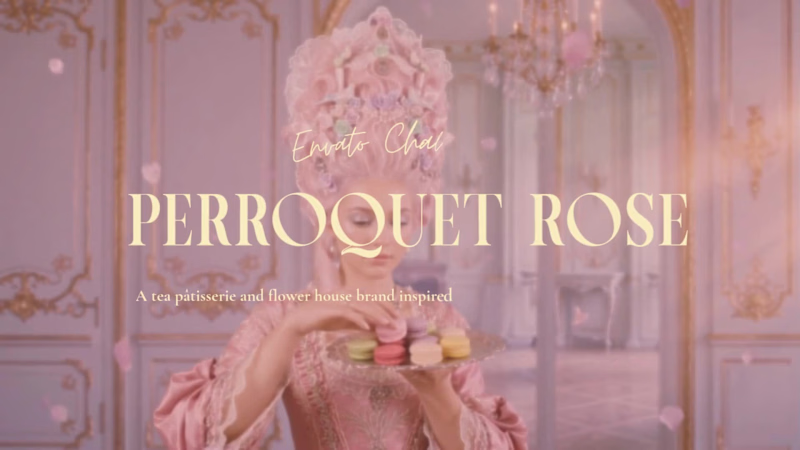
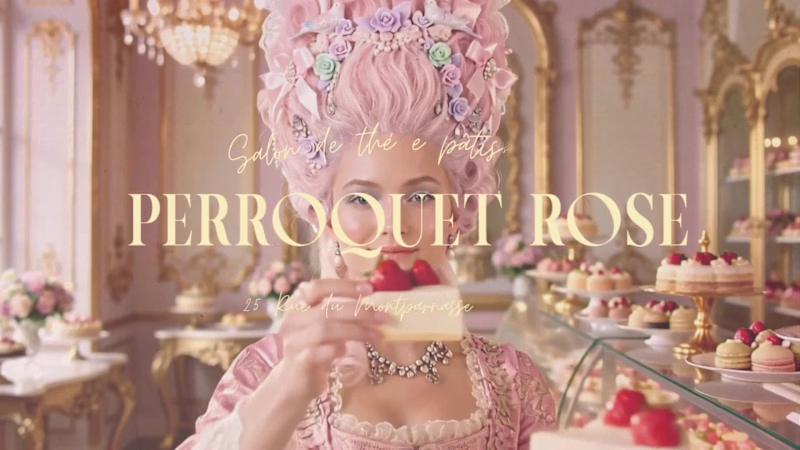
For the Envato Challenge, I created a romantic French pâtisserie and flower house brand inspired by the dreamy, pastel world of Sofia Coppola’s Marie Antoinette.
Using Envato as my creative toolkit, I developed the full brand experience: logo direction, typography, visual identity, mockups, graphic elements, floral assets, textures, stock imagery, video elements and music. I also used Envato AI to explore and generate the initial visual concepts.
Human by Design moment:
AI helped me generate possibilities, but the first outputs felt too perfect and lacked warmth. I made the creative decision to refine them by layering textures, adjusting compositions, selecting the right details and introducing imperfections to create a more tactile, handcrafted feeling.
The final result is not just AI-generated imagery — it is a brand shaped through human taste, intuition and design choices.
AI helped me generate possibilities.
Human judgment turned them into a brand.
Created with Envato Elements + AI
Envato Elements used:
Fonts | Graphics | Floral Assets | Textures | Mockups | Photos | Video Templates | Stock Video | Music
#envatochallenge #HumanByDesign #Envato Human by Design — Final Update
A final update on my Envato Challenge submission: a new video for my Tea Pâtisserie & Flower House brand, and the two "Human by Design" moments behind it.
Texture & warmth: (AI-generated face on the left, my edit on the right) The AI output was clean — too clean. Too smooth, too "perfect," missing the warmth I wanted for a romantic, handcrafted brand. So I stepped in: warmer lighting, added texture and grain, turning a polished AI output into something tactile and human-made.
The eyes don't lie: (two robotic AI takes vs. the final expression) For this new video, character consistency was flawless — but the gaze wasn't. Every take had that flat, robotic stare no amount of polish can fix. I kept rewriting the prompt, take after take, trying to guide the AI toward an expression that felt alive rather than rendered — until I got one where the gaze finally felt real.
AI can nail the character. It takes a human eye to know when it's not looking back.
Want to see the full project? Head to my profile — you'll find the complete brand identity video (logo, full brand explanation) and the behind-the-scenes video too. Atlas of Forgotten Queens
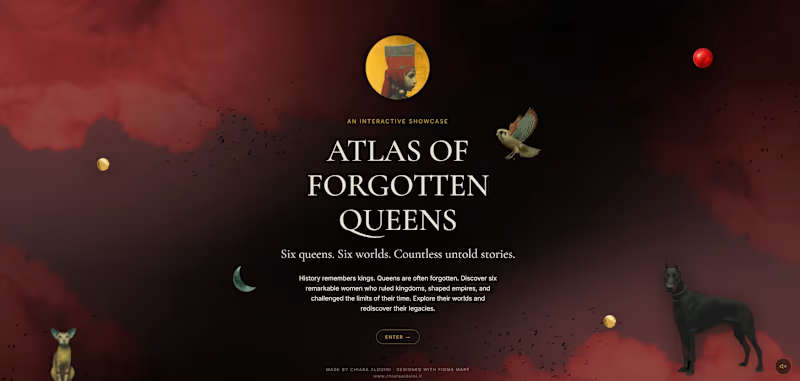
Six queens. Six worlds. Countless untold stories.
History remembers kings. It often forgets queens.
The idea | Atlas of Forgotten Queens is an interactive visual-storytelling project that reimagines six historical women rulers — Zenobia, Nefertiti, Dihya, Tamara, Roxelana, and Artemisia I — through a symbolic, narrative-driven lens. Rooted in historical research across different cultures and eras, it focuses on influential women whose stories have been overlooked in traditional history.
The approach | Rather than presenting history as a fixed reconstruction, the project translates it into a layered visual language where meaning is suggested through imagery, atmosphere, and symbolism. It is at once an archive and a reinterpretation — each queen sits between documentation and imagination, a shifting image shaped by symbols, suggestion, and a subtle sense of myth.
The craft | Each queen is built as a digital collage combining photography, original illustration, and AI-generated imagery, fused into a single portrait that reads as historical identity reinterpreted, never literal reconstruction. Each queen's name is written in her own historical script — Egyptian hieroglyphs for Nefertiti, Tifinagh for Dihya, alongside Arabic, Georgian, and Greek — so that each ruler is named in her own writing, not only in ours.
The process and tools | The project was designed, prototyped, and built in Figma Make, used both through its AI-driven generation and its code editor for precise refinement — Figma Make is the spine that turns the concept into a living, interactive site. Around it sits a wider creative pipeline: Photoshop and Illustrator for visual development and the gold-line maps; Midjourney for image generation; Gemini to compose the original score "The Last Prayer of the Sultan"; and Claude to develop and structure the narrative. The result is a genuine multi-tool, AI-and-manual workflow, with Figma Make at its center.
The experience | The site unfolds like a museum. A soft, slowly drifting haze with floating, parallax collage elements gives way to a gallery of circular portraits; each queen's page reveals her in colour and invites the visitor to read symbolic hotspots placed directly on the artwork. The Geography of Silence gathers all six rulers onto a single map — where they ruled, and where memory let them fade. The Language of Emblems is the project's lexicon, collecting the recurring symbols — the hawk, the fox, the colour red — and reading them in their universal meaning: a key to the clues marked on each portrait. The journey closes with The Unwritten, where the names of other forgotten queens — Sheba, Amanirenas, Nzinga, Boudica, and more — surface and fade around a final illustration: an unfinished, ever-expanding tribute to the countless women still waiting to be remembered. The experience is fully responsive across desktop and mobile: on smaller screens it is rethought for touch rather than scaled down, with a collapsible menu, a pinch-to-zoom map, and enlarged tap targets.
If you've read all the way to here — thank you for your interest! 😊
Figma Site | https://atlasqueens.figma.site/
(https://atlasqueens.figma.site/)Share | https://www.figma.com/make/uXm8S9lkymkTd8URAjmj6C/ATLAS-OF-FORGOTTEN-QUEENS?p=f&t=twAEHRsb3gv3aWaI-0
Community | https://www.figma.com/community/file/1646095544450556274