
AI System Architect | Database Expert | Data Analyst
- $25k+
- Earned
- 1x
- Hired
- 5.0
- Rating
- 94
- Followers
AI System Architect | Database Expert | Data Analyst

Business Systems, AI Workflow Automation and MVPs
- $•••••
- Earned
- 36x
- Hired
- 5.0
- Rating
- 96
- Followers
Business Systems, AI Workflow Automation and MVPs

B2B Lead Generation | LinkedIn Sales Navigator | Data Entry
- $25k+
- Earned
- 2x
- Hired
- 5.0
- Rating
- 52
- Followers
B2B Lead Generation | LinkedIn Sales Navigator | Data Entry

AI & Data Engineer|Data & AI Architect| AWS|Azure |Snowflake
AI & Data Engineer|Data & AI Architect| AWS|Azure |Snowflake
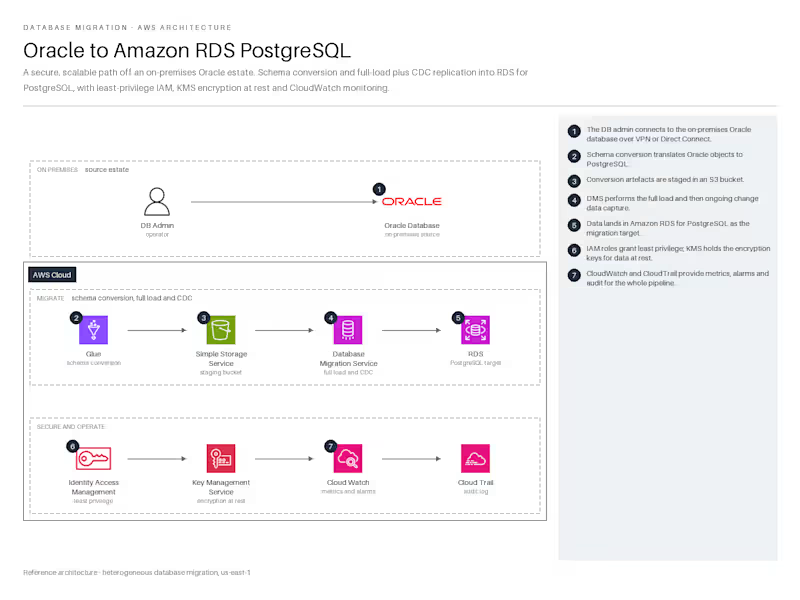
Oracle to Amazon RDS PostgreSQL
Designed and Implemented a secure, scalable architecture to migrate an on-prem Oracle database to Amazon RDS for PostgreSQL.
Data Flow: Modeled end-to-end flow, used AWS Glue (SCT) for schema conversion and DMS for full-load and CDC. Stored artifacts in S3 and loaded into RDS.
Services: Glue for conversion, DMS for Migration , S3 for artifacts, and RDS as target.
Security: IAM roles with least privilege, KMS for encryption at rest.
HA & DR: Architected in us-east-1 with Glue, DMS, RDS, S3, and monitoring via CloudWatch.
0
484
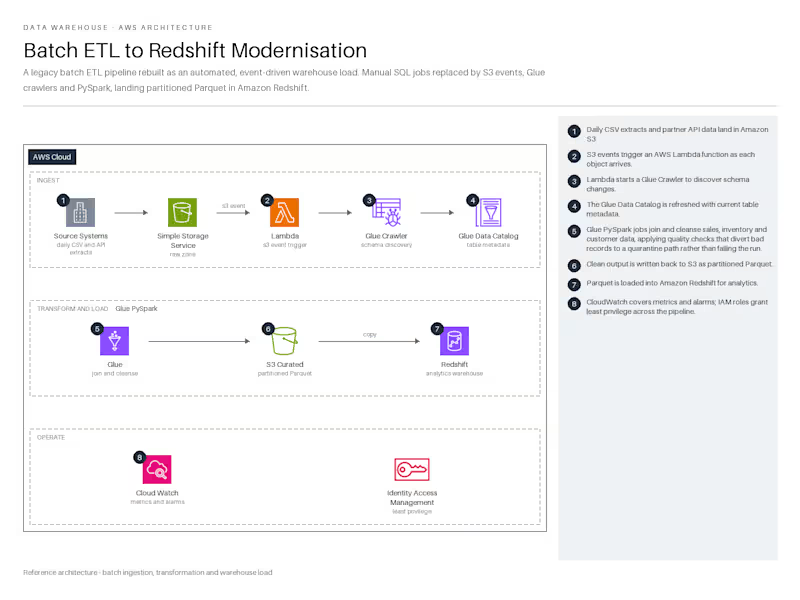
Batch ETL Data Warehouse Modernization
Led modernization of a legacy batch ETL pipeline into a scalable AWS-based data warehouse. Replaced manual SQL jobs with an automated system loading diverse sources into Amazon Redshift.
Ingestion: Daily CSVs and API data land in S3; S3 events trigger Lambda to launch Glue Crawlers and update the Data Catalog.
Transformation: Glue PySpark jobs join and cleanse sales, inventory, and customer data, apply quality checks, and move errors to a quarantine path.
Output: Partitioned Parquet files stored in S3 for loading into Redshift.
0
304
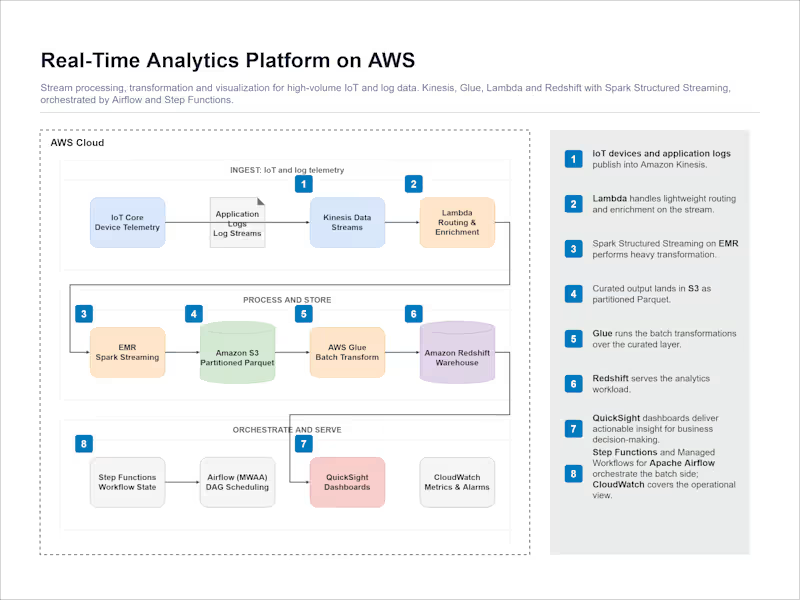
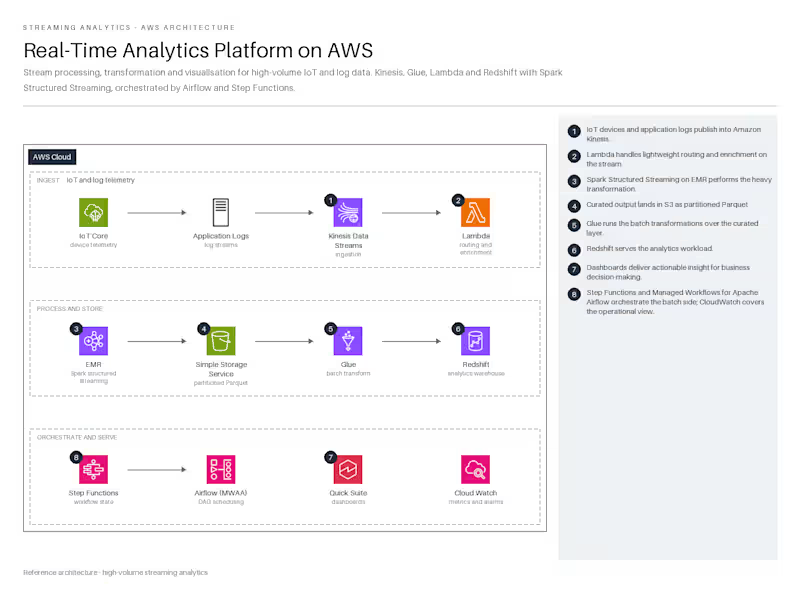
Real-Time Analytics Platform on AWS designed to ingest, process, and visualize high-volume streaming data from IoT devices and application logs.
Ingestion: Device telemetry (IoT Core) and application logs are published into Amazon Kinesis Data Streams, followed by lightweight routing and enrichment using AWS Lambda.
Processing & Storage: Amazon EMR performs heavy data transformations via Spark Structured Streaming, landing the curated output into Amazon S3 as partitioned Parquet files. AWS Glue then handles batch transformations before loading the data into Amazon Redshift for the analytics workload.
Orchestration & Serving: AWS Step Functions coordinate the batch processing workflows. Finally, Amazon QuickSight generates actionable business dashboards while Amazon CloudWatch monitors operational metrics and alarms
0
525

Airtable & Softr Developer | Automation Expert
Airtable & Softr Developer | Automation Expert
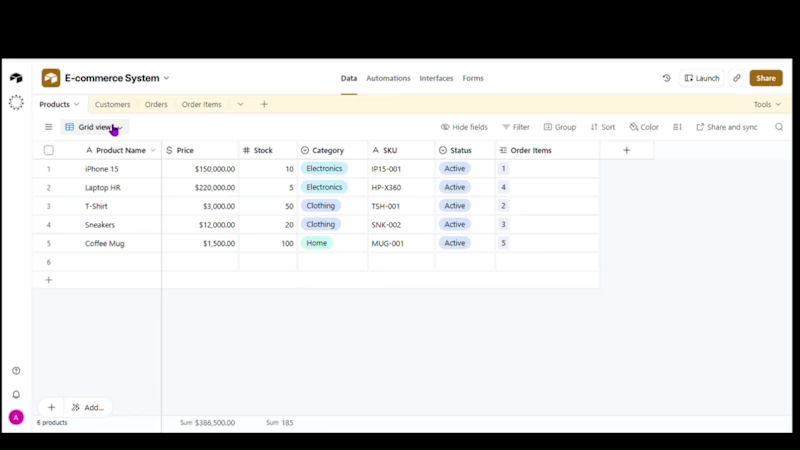
E‑commerce Order Management System
Tools: Airtable | Softr | Make.com
(http://Make.com)Description:
End‑to‑end order management system for an online store. Tracks products, customers, orders, and inventory in real time. When a customer places an order, stock is automatically deducted, and confirmation emails are sent to both the customer and the admin. Includes a dashboard for order status tracking (Pending → Processing → Shipped → Delivered) and low‑stock alerts.
Key features:
· Airtable tables: Products, Customers, Orders, Order Items (linked records, rollups for totals)
· Softr admin dashboard: view all orders, update status, see low‑stock products
· Softr customer portal (optional): customers can view order history
· Make.com (http://Make.com) automation:
· On new order → deduct inventory, send order confirmation email to customer
· On status change → send shipping notification email
· Daily stock check → email alert if any product stock < 5
· Mobile‑responsive design
Built independently – full database schema, frontend dashboards, and multi‑step automation logic
0
104
Real Estate Property Management System
Tools: Airtable | Softr | Make.com
(http://Make.com)Description:
Property management platform for tracking listings, tenants, leases, and maintenance requests. Designed for landlords or agencies to manage rental properties, tenant communications, and maintenance workflows. Includes automated alerts for rent reminders and lease expiries.
Key features:
· Airtable tables: Properties (for sale/rent), Tenants, Leases, Maintenance Requests
· Softr landlord dashboard: property availability, tenant portal, payment tracking
· Softr tenant portal: online rent payment (placeholder), maintenance request submission
· Make.com (http://Make.com) automation: rent reminders via email, lease expiry alerts, maintenance request notifications
· Conditional routing: urgent vs standard maintenance requests sent to different channels
Built independently full database, frontend portals, and automation logic
0
96
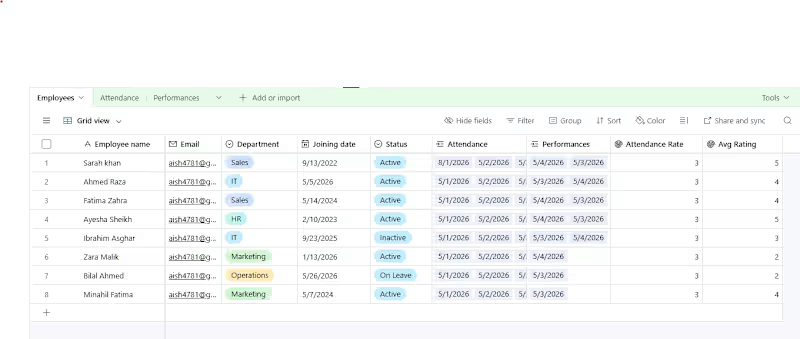
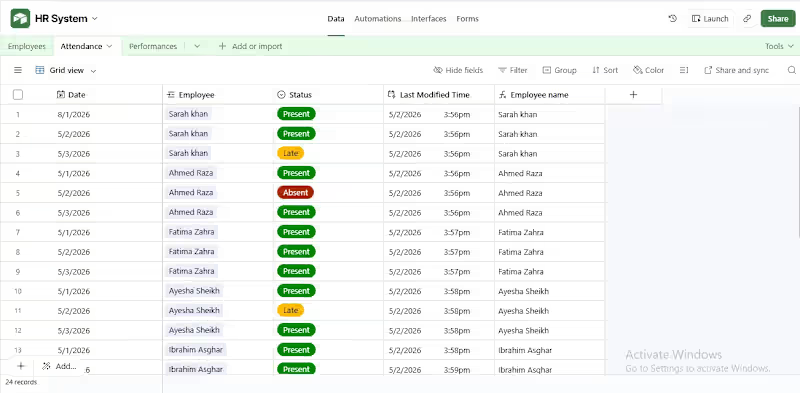
HR Employee Management System
Tools: Airtable | Softr | Make (http://Make.com)com
Description:
Complete HR platform to manage employee records, attendance, performance reviews, and leave requests. The system provides an employee dashboard for submitting time‑off requests and viewing attendance history, plus an admin approval portal for managers. Automated email notifications inform employees when their requests are approved or rejected.
Key features:
· Airtable tables: Employees, Attendance Logs, Performance Ratings, Leave Requests
· Softr employee portal: request leave, view attendance, see performance score
· Softr admin dashboard: colour‑coded status (Pending/Approved/Rejected) for leave approvals
· Make (http://Make.com)com automation: sends email to employee when request status changes
· Daily schedule check for upcoming leave (optional reminder)
Built independently – from database design to frontend and automation
0
110
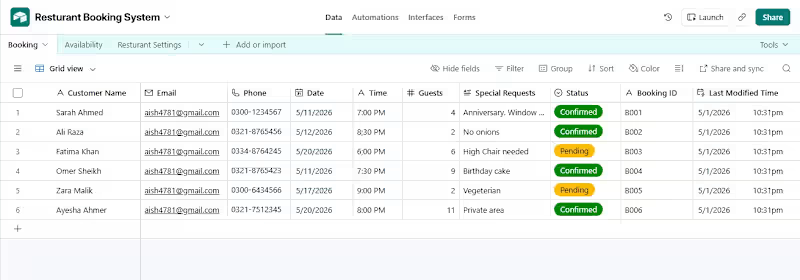
Restaurant Booking System
Airtable | Softr | Make (http://Make.com) com
Complete online reservation system for a mock restaurant. Customers book a table, receive instant email confirmation, and managers get a real‑time dashboard with colour‑coded status (Confirmed/Pending).
Key features:
Airtable tables: Bookings, Availability, Restaurant Settings
Softr dashboard for staff (filter by date, update status)
Make (http://Make.com) com automation: sends confirmation email to customer + manager alert
Mobile‑responsive design
Built the entire system independently
0
109

Database Design & SQL Development Specialist
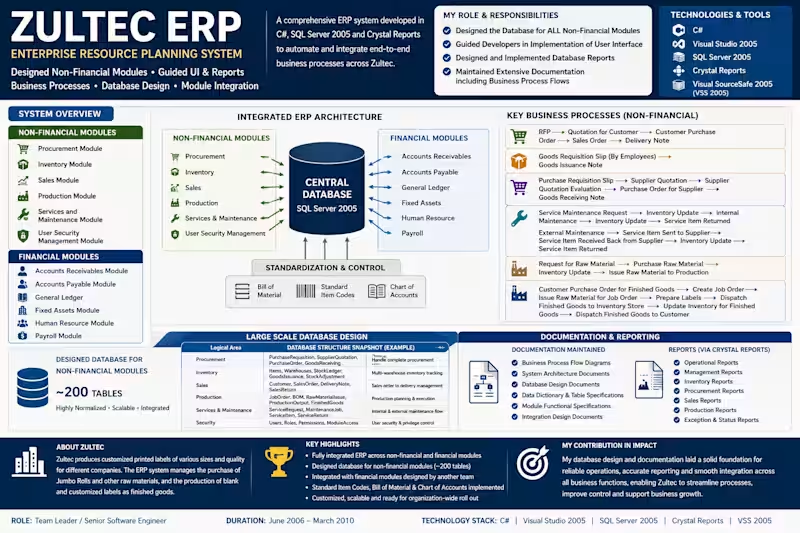
Zultec ERP — Enterprise Resource Planning System
I worked as Team Leader / Senior Software Engineer on the development of the Zultec ERP System from June 2006 to March 2010.
My primary contribution was the analysis, design and database development of the Non-Financial Modules of the ERP, including:
Procurement Module
Inventory Module
Sales Module
Production Module
Services and Maintenance Module
User Security Management Module
I independently carried out the analysis and design of these modules, developed logical and physical database models, and created the integrated database in SQL Server 2005. I also guided developers in the implementation of the User Interface and system functionality using C# and Visual Studio 2005.
A significant part of the work involved Business Process Analysis and Documentation. User requirements were gathered and documented, Business Process Flow Diagrams were developed, and Business Process Reengineering was suggested for important processes.
The Non-Financial Modules were integrated with Financial Modules developed by another team, including:
Accounts Receivables Module
Accounts Payable Module
General Ledger
Fixed Assets Module
Human Resource Module
Payroll Module
The ERP incorporated processes covering procurement, sales, inventory, production, services and maintenance. It supported activities such as customer quotations, sales orders, purchase orders, Goods Receiving Notes, Delivery Notes, production job orders, raw-material tracking, finished-product tracking, repair and service job orders, and warranty claims.
The system also incorporated Standard Item Codes, Bill of Material and Chart of Accounts, providing standardization across the organization. Multi-warehouse and multi-currency functionality was also employed.
My Key Contribution
Database Design • Business Process Analysis • ERP Integration • UI Guidance • Reporting • Documentation • Technical Leadership
Technology: C# • Visual Studio 2005 • SQL Server 2005 • Crystal Reports • Visual SourceSafe 2005
This project represents my experience in designing and integrating an enterprise ERP database around real business processes, while working closely with developers and other technical teams.
0
52
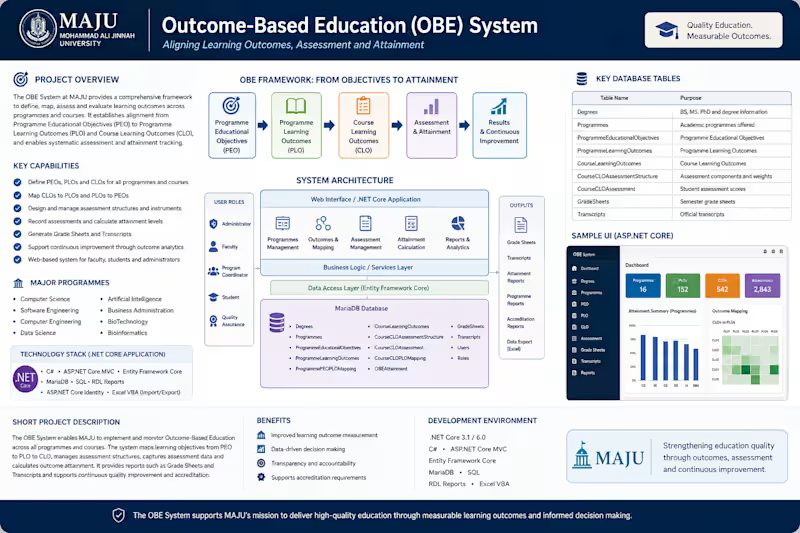
MAJU Outcome-Based Education (OBE) System
Designed and developed the database for an Outcome-Based Education system at Mohammad Ali Jinnah University (MAJU), with the frontend subsequently implemented in both PHP and C#/.NET.
The system models the relationship between:
PEO → PLO → CLO → Assessment
It provides detailed assessment of courses by CLO and PLO for individual students and supports the management of outcome-based education across university programmes.
Key areas represented
Degrees — BS, MS and PhD
Programmes
Programme Educational Objectives (PEO)
Programme Learning Outcomes (PLO)
Course Learning Outcomes (CLO)
CourseCLOAssessmentStructure
CourseCLOAssessment
Grade Sheets
Transcripts
Major programmes included areas such as Computer Science, Software Engineering, Computer Engineering, Data Science, Artificial Intelligence and Business Administration, along with Biotechnology and Bioinformatics-related programmes. Programme availability varies by degree level.
Database & Technology
Database: MariaDB
SQL: SQL
User Interfaces: PHP and C#/.NET
.NET: .NET Core, C#, Entity Framework Core, ASP.NET (http://ASP.NET) Core Identity
Reporting: RDL Reports
Supporting Tool: Excel VBA
The same MariaDB database was used by both the PHP and .NET user interfaces. The PHP version was developed earlier and was practically used with real data; the .NET Core version was developed later.
This project demonstrates database design for a complex academic information system where educational objectives, learning outcomes and student assessment are interconnected through a structured relational database.
0
53
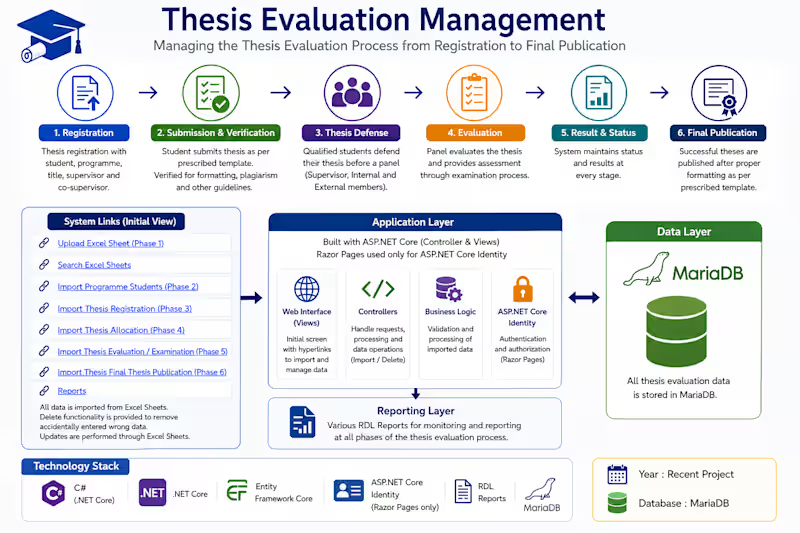
Thesis Evaluation Management
Designed and developed a database-backed web application for managing the thesis evaluation process at an academic institution.
The system manages student and thesis information including registration number, degree/programme, thesis title, supervisor and co-supervisor. It also manages thesis submission according to prescribed templates and verification requirements, including formatting, plagiarism and other guidelines.
Students who qualify proceed to thesis defense before a panel comprising the supervisor and internal and external members. The system maintains the status of the thesis through these stages and supports final publication after successful evaluation and prescribed formatting.
My contribution: Database design and application development.
Technology: MariaDB, C#, .NET Core, Entity Framework Core, ASP.NET (http://ASP.NET) Core Identity and RDL Reports.
0
69
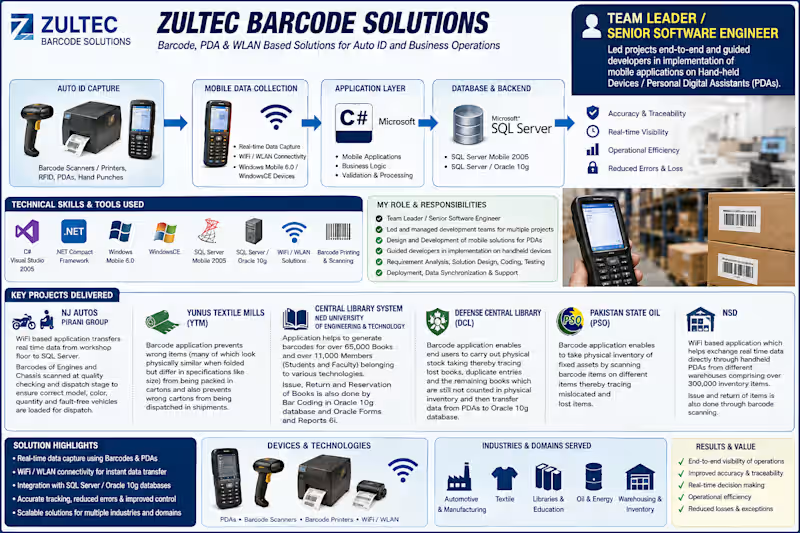
Zultec Barcode Solutions — Barcode, PDA & WLAN-Based Business Solutions
As Team Leader / Senior Software Engineer at Zultec, I designed and guided the development of mobile and barcode-based solutions connecting handheld PDAs, barcode scanning, WLAN/WiFi connectivity, applications, and enterprise databases.
The solutions were developed using C# with Visual Studio 2005, .NET Compact Framework, Windows Mobile 6.0, WindowsCE, and SQL Server Mobile 2005, with integration with SQL Server and Oracle databases where required.
I guided developers in implementing mobile applications on handheld devices and PDAs for a range of operational environments, including:
• NJ Autos, Pirani Group — WiFi-based real-time transfer of workshop-floor data from handheld PDAs to SQL Server, with barcode scanning of engine and chassis information through quality checking and dispatch.
• Yunus Textile Mills (YTM) — Barcode-based verification to prevent incorrect items from being packed and incorrect cartons from being dispatched.
• Central Library System, NED University — Barcode generation and circulation for more than 65,000 books and 11,000 members, including issue, return and reservation using Oracle 10g and Oracle Forms/Reports.
• Defense Central Library (DCL) — PDA-based physical stock taking to identify lost books, duplicate entries and uncounted inventory, with transfer of collected data to Oracle 10g.
• Pakistan State Oil (PSO) — Barcode-based physical inventory of fixed assets to trace mislocated and lost items.
• NSD — WiFi-based real-time data exchange through handheld PDAs across warehouses containing more than 300,000 inventory items, including barcode-based issue and return.
This work combined mobile application development, barcode technology, PDA-based data capture, WLAN connectivity and database integration to support accurate and traceable operational processes across automotive, textile, education, library, oil & energy, and warehouse environments.
0
45

Full-Stack Developer | SaaS, AI & Web Apps

🔧 Another website back online.
Recently worked on Luna’s Ascension, a website that had gone down and was no longer functioning correctly.
I diagnosed the underlying website/server issues, restored the site, resolved the problems preventing it from running properly, and brought the platform back online.
Website recovery projects aren’t always about building something new — sometimes the real challenge is understanding an existing system, identifying what broke, and restoring it without disrupting the parts that already work.
Work included:
• Website troubleshooting & recovery
• Server-side issue diagnosis
• Existing codebase debugging
• Website functionality restoration
• Production environment fixes
• Stability checks after recovery
🌐 Luna’s Ascension
From broken websites to full-stack applications, I help businesses diagnose technical problems and get their platforms running reliably again.
0
260

Full Odoo 14 to Odoo 18 migration and custom development for a cosmetics retailer operating an eCommerce store alongside four physical retail locations.
The standard Odoo upgrade could not preserve the client's legacy customizations, so I rebuilt the business logic as clean, maintainable custom Odoo 18 modules while preserving critical business data and removing legacy technical debt.
Key features delivered:
• Migrated 12,000+ products with a bilingual Arabic/English product catalogue
• Arabic product-name search directly from the English storefront
• Custom makeup shade selector with per-shade image galleries
• Automatic sold-out shade indicators and per-variant barcode support
• Advanced category filters, stock-based product sorting and brand autocomplete
• Cash on Delivery checkout with zone-based shipping across 600+ cities
• Separate eCommerce and POS pricing with fixed and percentage promotions
• Multi-store Point of Sale implementation across four retail locations
• Custom Odoo modules tailored to existing business workflows
• Scalable Odoo 18 architecture using Python, PostgreSQL, OWL and QWeb
The result was a modernized Odoo environment combining eCommerce, inventory, product management, pricing and multi-location POS operations within one maintainable platform.
0
145
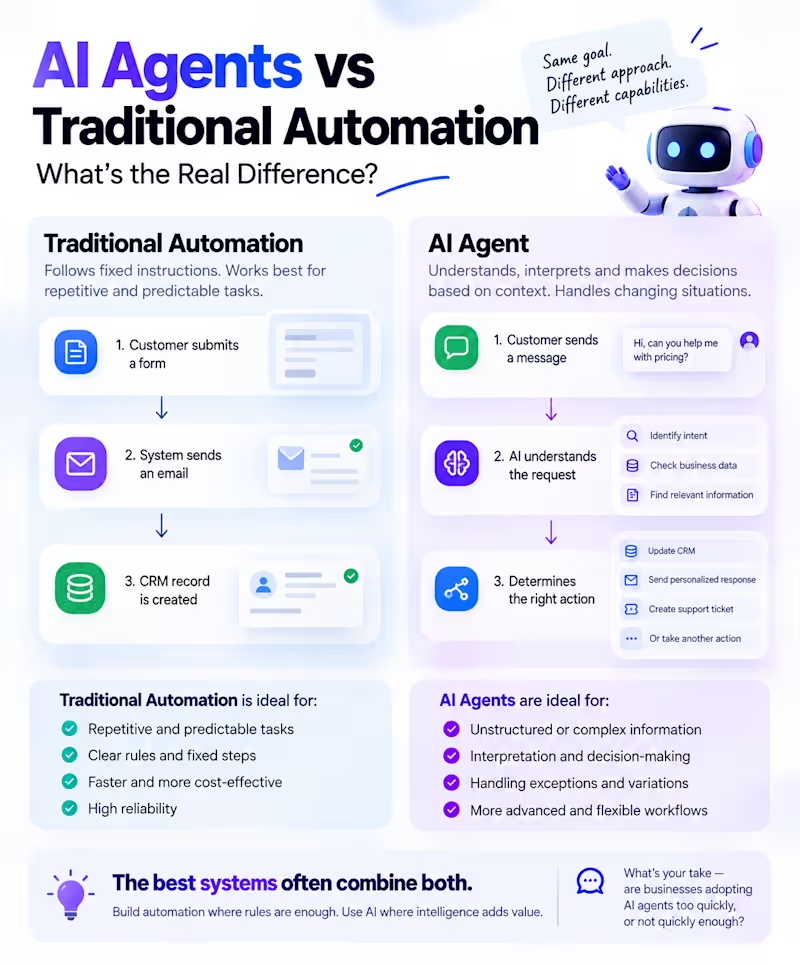
AI Agents vs Traditional Automation: What's the Real Difference? 🤖
Traditional automation follows instructions.
AI agents can interpret information, make decisions within defined boundaries, and choose the next step based on context.
Here's a simple example:
⚙️ Traditional Automation: A customer submits a form → the system sends an email → a CRM record is created.
🧠 AI Agent: A customer sends a message → AI understands the request → checks relevant business data → determines the appropriate action → updates the CRM or prepares a response.
Both are useful. The difference is how they handle changing situations.
And here's something important: not every workflow needs an AI agent.
For predictable, repetitive tasks, traditional automation is often faster, cheaper, and more reliable.
AI agents make more sense when workflows involve unstructured information, interpretation, and decisions that cannot easily be covered by fixed rules.
The best systems often combine both.
Build automation where rules are enough. Use AI where intelligence adds value.
What's your take — are businesses adopting AI agents too quickly, or not quickly enough?
#Automation #WorkflowAutomation
0
58
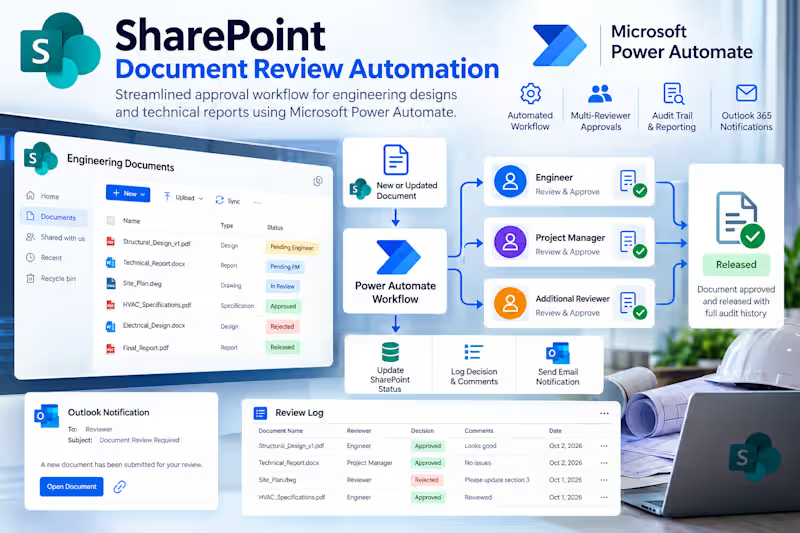
Developed a complete SharePoint Online document review workflow using Microsoft Power Automate for engineering designs and technical reports.
The automation triggers when documents are uploaded or updated, captures metadata, assigns multiple reviewers, tracks approvals and rejections, updates document statuses, and records reviewer decisions and comments in a dedicated Review Log.
Integrated Outlook 365 notifications provide reviewers with direct document links, while SharePoint version history remains intact throughout the review process.
The solution provides a clear, maintainable and auditable approval workflow within Microsoft 365.
2
0
238

Senior .NET Developer | ERP & SQL Server Expert
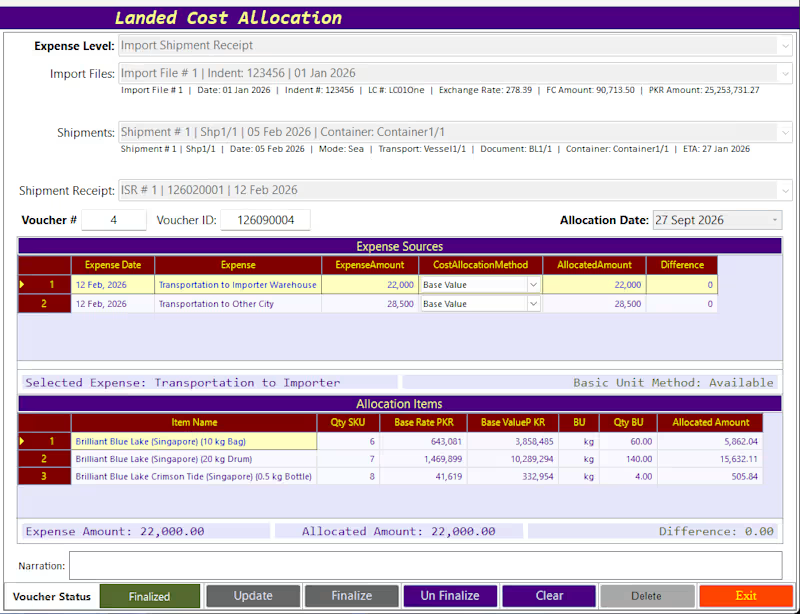
An imported item’s purchase price is only part of its inventory cost. Transport and other related expenses also need to be allocated accurately.
This Landed Cost Allocation screen is part of the custom ERP import module I developed using VB.NET (http://VB.NET) and Microsoft SQL Server.
It allows users to select an import shipment receipt, allocate each expense across received items, and review the allocated total and remaining difference before finalizing.
In this example, a PKR 22,000 transport expense is distributed across three items in proportion to their base values, with no unallocated balance.
The module supports Base Value, Basic Unit Quantity, and Manual allocation methods, helping businesses handle different costing requirements within an integrated inventory and accounting workflow.
Need a similar import-costing module or an enhancement to your existing .NET business software? Let’s discuss your requirements.
#ERP #VBNet #SQLServer #InventoryManagement #LandedCost
1
1
140
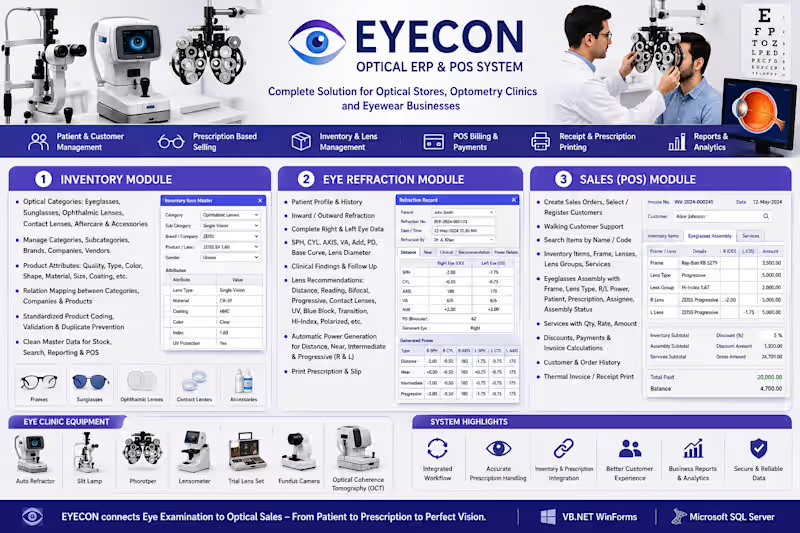
Eyecon | Optical Management System
Eyecon is an intelligent ophthalmic clinic and optical retail management
system designed specifically for optometrists, ophthalmologists, and eyewear
retail stores. The platform combines clinical eye refraction management with
optical product inventory and a fully integrated point-of-sale environment,
enabling clinics and optical shops to manage patient prescriptions, eyewear
products, and sales operations from a single centralized system.
The system maintains a
complete history of patient eye prescriptions, including refractive
measurements such as Sphere, Cylinder, Axis, and additional optical parameters
used in professional eye testing. Eyecon incorporates intelligent logic to
analyse stored prescription data and assist practitioners in determining
appropriate lens power values based on previous refraction records and standard
ophthalmic practices.
Beyond the clinical
environment, Eyecon includes a comprehensive optical retail module that manages
frames, ophthalmic lenses, contact lenses, sunglasses, and eyewear accessories.
The integrated inventory engine tracks product availability, product specifications,
and stock movement while seamlessly connecting with the POS module used for
retail sales.
The POS module allows
optical stores and clinics to sell eyewear products while automatically linking
patient prescriptions with the appropriate lenses and frames. Sales
transactions update stock levels in real time while maintaining accounting
integration for financial tracking.
Built as a cloud-connected
Windows desktop application, Eyecon allows multiple branches or clinics to
operate with a centralized database hosted on a remote server. This
architecture ensures secure data storage, synchronized operations, and
accessibility across different clinic locations.
Key capabilities
include:
• Patient eye
refraction record management
• Intelligent prescription analysis and lens power assistance
• Optical product inventory management
• Integrated optical retail POS system
• Prescription-to-product workflow automation
• Stock tracking for frames, lenses, and accessories
• Accounting and financial integration
• Cloud-connected multi-clinic architecture
Eyecon bridges the gap
between clinical ophthalmic practice and optical retail operations,
providing a unified platform that improves efficiency for eye clinics and
optical businesses
0
42
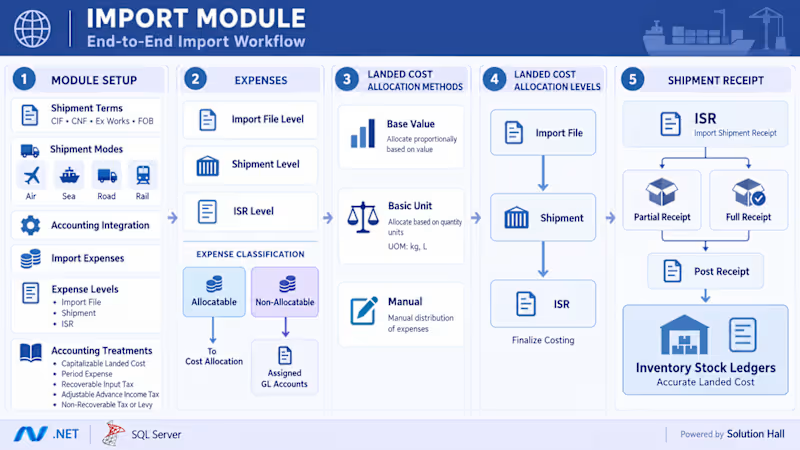
The Import
Module integrates import documentation, shipment management, expense accounting
and goods receipts into a controlled workflow that supports accurate landed
costing and inventory valuation.
Project Brief overview
Developed by
Solution Hall, the Import Module manages the import process from initial setup
and import files through shipments, expense recording and partial or full goods
receipts. It distinguishes capitalizable costs from period expenses and
tax-related amounts, with flexible methods for allocating eligible costs to
imported goods. By linking these activities with accounting and stock records,
the module strengthens financial control, improves cost visibility and provides
reliable information for business decisions.
0
43
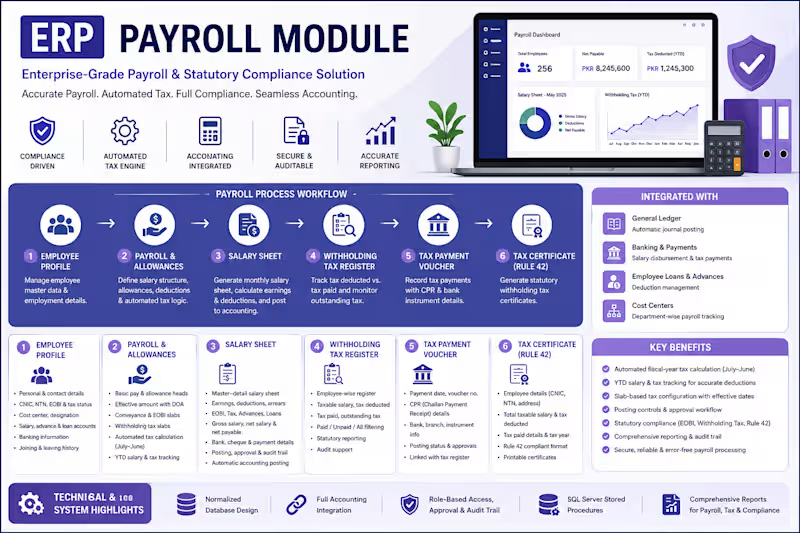
Enterprise-Grade ERP Payroll System with Automated Tax
Engine, Compliance Reporting & Full Accounting Integration.
This Payroll Module is a fully integrated
ERP-based payroll and statutory compliance system designed for medium to large
organizations. It covers complete employee master management, configurable
salary structures, allowance and deduction policies, automated withholding tax
calculation using fiscal-year annualization (July–June), and dynamic slab-based
tax configuration.
The system generates structured monthly
salary sheets using a master–detail architecture with posting controls,
approval workflow, and automatic accounting integration. It intelligently
tracks YTD salary and tax deductions to ensure accurate mid-year adjustments
and regulatory compliance.
In addition to payroll processing, the
module includes a comprehensive Withholding Tax Register (paid/unpaid
tracking), Tax Payment Voucher system with CPR and bank instrument management,
and automated generation of statutory withholding tax certificates (Rule 42
compliant).
The entire module is built with strong
database normalization, audit trail control, and finance integration, making it
suitable for manufacturing, trading, and corporate environments requiring
accuracy, transparency, and compliance-driven payroll automation.
Withholding Tax Register:
This module produces the Payroll
Withholding Tax Register, showing employee-wise taxable salary, tax deducted,
tax paid, and outstanding tax payable with flexible paid/unpaid filtering.
The Withholding Tax Register module is
designed for statutory reporting and tax compliance by maintaining a clear,
auditable trail of payroll income tax deductions and payments. It generates an
employee-wise register that includes key identity fields (Employee Name, CNIC,
NTN), transaction references (date, type, voucher no., serial no.), and
complete tax impact (Taxable Amount, Tax Deducted, Tax Paid, and Tax Payable).
The register supports practical operational
controls such as filtering by employee and cost center, and it
provides separate views for Paid vs Unpaid tax. For paid entries,
it applies a date range to produce period-based compliance reports, while for
unpaid entries it intelligently lists all outstanding liabilities regardless of
date to help finance teams track pending tax payments.
By linking tax entries with tax sections
and enforcing consistent section mapping, this module ensures accurate
classification, improved reconciliation, and readiness for government filings
and internal audits.
0
89