Freelancers in OlomoucFreelancers in Olomouc
Python AI Dev | ComfyUI, LoRA/LLM Training, Web3, Web API

$1k+
Earned
21
Followers
Python AI Dev | ComfyUI, LoRA/LLM Training, Web3, Web API
Cover image for Securing the Next Era of
Securing the Next Era of Solana: Introducing GuardRail Protocol 🛡️⚡ The emergence of the SPL Token-2022 standard represents a major evolutionary leap for Solana DeFi. However, programmable extensions have introduced a dangerous wave of stealth attack vectors: • Predatory 99% transfer taxes siphoned directly to fee collectors. • Malicious Transfer Hook CPIs selectively reverting sells while permitting buys. • Permanent Delegate keys enabling retroactive confiscation of user tokens. Standard wallets like Phantom and major DEX interfaces only simulate basic balance deltas, leaving traders blind to low-level on-chain invariants until funds are permanently lost. To solve this, I designed and built GuardRail Protocol — an immutable, zero-trust pre-execution firewall and byte-level forensic decompiler on Solana. Built for the Colosseum Crypto World's Fair & Superteam hackathons, the protocol introduces: Byte-Level TLV Storage Decompiler: Parses on-chain validator memory buffers directly into standard Type-Length-Value frames, exposing hidden fee schedules and hook bindings. Pre-Execution Firewall Interceptor Sandbox: Simulates headless atomic swap execution against live Solana RPC nodes, visually dropping honeypot transactions locally before wallet signature to ensure 100% loss prevention. Transfer Hook Bytecode Decompiler: Evaluates whether external hook bytecode is immutable or mutable (admin backdoors), dissecting dispatch interfaces and Extra Account Metas PDAs. Anchor On-Chain CPI Invariant Firewall: A smart contract deployed on Solana Devnet allowing DEX aggregators and trading bots to verify invariant rules atomically via CPI before funds are committed. Native Solana Actions & Blinks: Certified implementation of the official actions.json specification, enabling 1-click cryptographic audits directly inside Twitter/X feeds and Phantom wallets. Developer Suite & REST API: Sub-150ms latency endpoint (/api/scan) paired with a CLI scanner for smart contract CI/CD pipelines. Explore the project: • Live Application: https://guardrail-protocol.vercel.app (https://guardrail-protocol.vercel.app)• Product Demo Video: https://youtu.be/Hq3bPsNhInA (https://youtu.be/Hq3bPsNhInA)• Founder Pitch Video: https://youtube.com/shorts/eRLrd_b0lRg (https://youtube.com/shorts/eRLrd_b0lRg)• Open-Source GitHub: https://github.com/Ra9mirez11/guardrail-protocol (https://github.com/Ra9mirez11/guardrail-protocol)• Colosseum Project: https://colosseum.com/arena/projects/guardrail-protocol Huge thanks to Colosseum and Superteam CZ for driving innovation across the Solana ecosystem. #Solana #Web3 #CyberSecurity #BlockchainSecurity #Rust #Anchor #DeFi #SmartContracts #SolanaBlinks #Superteam
0
39
Cover image for Contra x Lovable Challenge Submission:
Contra x Lovable Challenge Submission: Monolith Tattoo Atelier 1. Business Archetype & Profile Business Name: Monolith Tattoo Atelier Location: Berlin (Kreuzberg), Germany Solo Operator: Alex Vance (Specializing in fine-line, blackwork, and sacred geometry) Public Application Link: https://monolith-tattoo-atelier.lovable.app 2. Client Brief & Operational Quirks Alex is a solo tattoo artist operating at peak capacity, spending 6 to 8 hours daily wearing sterile gloves with a running machine. While working, he is physically and hygienically incapable of answering calls or responding to messages. Prior to this solution, his business suffered from three critical bottlenecks: Instagram DM Chaos: Receiving 40+ inbound inquiries daily with vague parameters ("How much for something medium on my arm?"), creating 15+ hours of unpaid administrative back-and-forth weekly. Unscoped Appointments: Clients cannot accurately specify dimensions in centimeters, assess placement difficulty, or identify skin contraindications (fresh scars, active eczema, moles). Chronic No-Shows: A 28% no-show rate caused by booking calendar slots without upfront financial commitment or medical pre-screening. 3. One-Line Description of the Problem Solved Turned vague, open-ended Instagram DMs into deposit-secured, anatomically-scoped tattoo bookings with zero manual back-and-forth from the artist. 4. Technical Architecture & Key Innovations Built in Lovable The application solves both the "Front Door" (client intake) and the "Follow-Through" (studio management) in a synchronized dual-view architecture: Interactive Anatomical Body Selector: Replaces vague text descriptions with a vector silhouette featuring front/back toggles, realistic contouring, and a dynamic Heatmap Pain Index that automatically flags high-sensitivity zones (ribs, neck, spine) requiring session buffers. In-Browser Stencil Composer: Solves the primary hesitation in custom tattoos. Clients can position, scale, rotate, and preview artwork directly over their own skin using authentic 'multiply' blend modes before stepping into the studio. Dynamic Session & Pricing Engine: Calculates exact session tiers (Quick, Half-Day, Full-Day) based on size (cm), anatomical placement difficulty, and artistic style, automatically locking compatible calendar blocks and deposit amounts. Guaranteed Escrow & Medical Gate: Enforces a 4-point safety declaration and a non-refundable Stripe deposit checkout, reducing no-shows from 28% to 0%. Artist iPad Back-Office & Day Sheet: A dedicated studio control dashboard displaying live synchronized appointments, escrow totals, and an iPad Day Sheet with high-res stencil specifications, medical clearances, and outstanding balances due upon arrival. Automated DM Deflection: An integrated router configuration that deflects inbound social inquiries straight into the scoped booking funnel. 5. Attached Deliverables Product Demo Video (< 3 minutes): [https://youtu.be/OmYEf88Qe_U ] Comprehensive end-to-end walkthrough demonstrating both the customer booking journey and the live artist back-office synchronization. Process Walkthrough Video (Bonus): [https://youtu.be/eiHLxgql1b4 ] Fast-paced engineering walkthrough showcasing the Spec-First development methodology, phased prompt injection, and code hardening in Lovable. Architectural Specification (Markdown): [https://github.com/Ra9mirez11/Monolith-Tattoo-Atelier/blob/01cae1362b10ef001ee2606415491dcc673707a3/Lovable%20plan%20atelier%20tattoo.md ] Initial domain blueprint, data schemas, mathematical formulas, and operational states drafted prior to code generation. Phased Prompt Engineering Log (Markdown): [https://github.com/Ra9mirez11/Monolith-Tattoo-Atelier/blob/main/Prompt%20for%20lovable%20.md ] Chronological record of all 12 systematic prompts utilized to construct and optimize the production build.
2
234
Cover image for RECLAIM - Gamified Eco-Volunteering Working
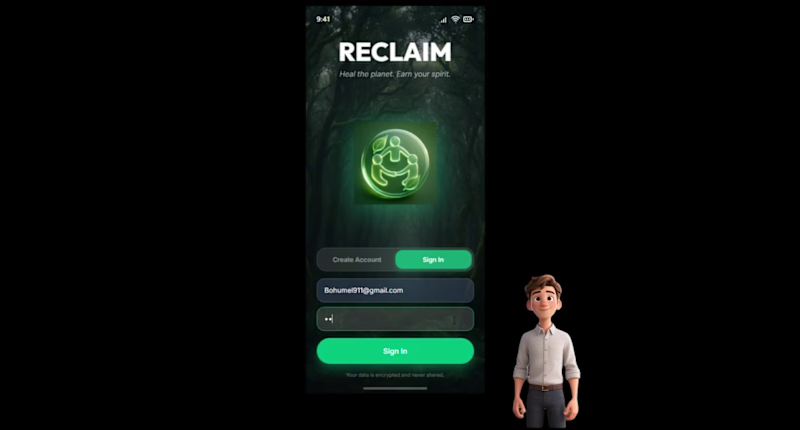
RECLAIM - Gamified Eco-Volunteering Working Prototype The Problem Traditional eco-volunteering often lacks engagement, making it difficult to motivate individuals, especially the younger generation, to participate consistently. The process of reporting and verifying cleaned areas is manual, inefficient, and untrusted. The Solution: RECLAIM RECLAIM transforms eco-volunteering into a real-life RPG, making healing the planet fun, competitive, and highly rewarding. Users create an account, secure it via Supabase email authentication, and select their unique 3D Eco-Spirit avatar. The core innovation is our automated verification loop: Users find cleanup missions on a real-time map. They complete the mission and take an "after" photo. We integrated Gemini AI to perform a strict direct comparison between the "before" task image and the new "after" photo. There are no bypasses—Gemini AI decides if the location is pristine. Upon AI verification, the Supabase backend awards XP and unlocks premium 3D badges. The Advanced Figma AI Workflow This project serves as a showcase for the advanced capabilities of Figma's new AI toolkit: • Figma Agent was used to generate and iterate upon the entire multi-screen design flow, strictly adhering to our premium 'Eco-Glassmorphism' style. • Figma Weave generated all procedural 3D visual assets, including Eco-Spirit companions and collectible badges. • Figma MCP was utilized to integrate live, data-driven satellite maps directly into the dashboards. • Figma Make exported the completed design into a functional Next.js/React application, making it a working prototype. Live Links Working App: https://path-os-41270623.figma.site Figma Community File: https://www.figma.com/community/file/1648087862770865252 (https://www.figma.com/community/file/1648087862770865252)Pitch Video: https://youtu.be/skytzF6qljY Technology Stack • Frontend: Next.js (exported via Figma Make), React, Tailwind CSS • Design: Figma (Agent, Weave, MCP) • Backend: Supabase (Auth & Database) • Verification: Gemini AI (Visual Comparison)
6
8
467
Cover image for While most participants naturally lean
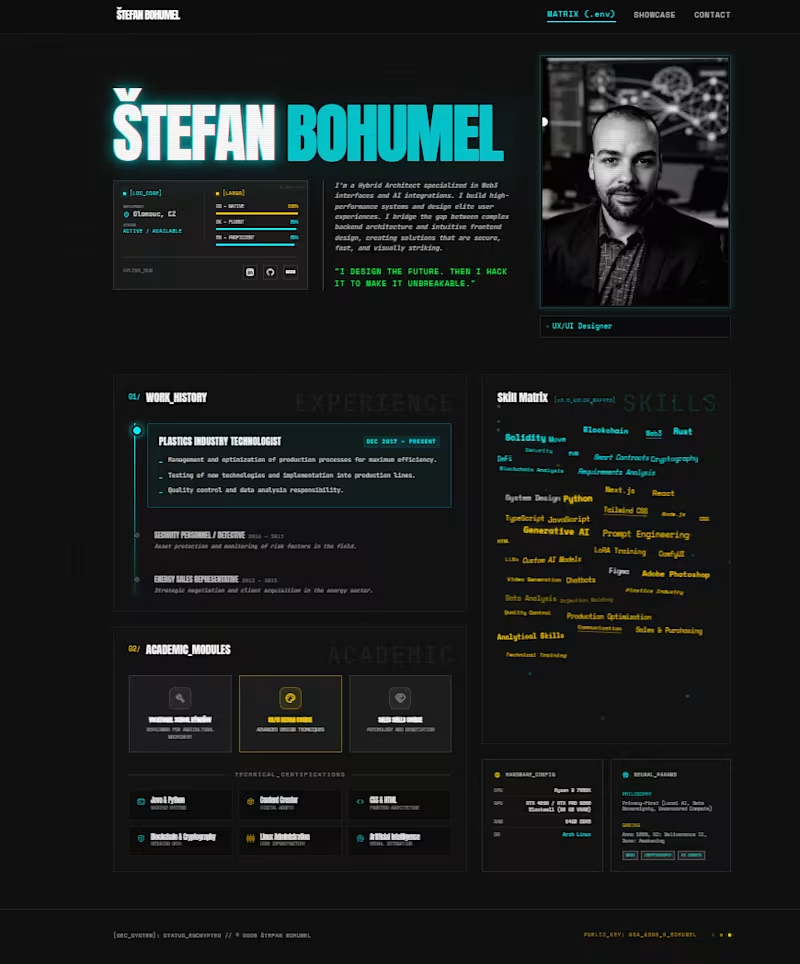
While most participants naturally lean towards building standard web apps or generic startup dashboards—concepts the industry is already highly familiar with—I decided to bring the theme 'Interfaces that feel alive' to a space that is notoriously static, flat, and outdated: the professional resume. I built 'The Living Portfolio,' a next-generation interactive CV tailored for a hybrid Web3, AI, and Security Engineer. By breaking away from traditional dead PDFs, this interface uses premium dark glassmorphism, tactical micro-interactions, and responsive canvas layers to transform a career summary into a breathing, high-fidelity digital identity that actively engages the user. I utilized Google Stitch as the core engine for establishing the initial responsive layout and grid structure. From there, I transitioned into an iterative process using in-place edits to inject custom CSS motion properties, technical typography, and interactive button states. Finally, despite heavy platform limitations regarding multi-page structures, I successfully leveraged Stitch's export capabilities to deploy the compiled pages directly onto Netlify, achieving a fully functional and publicly accessible live prototype. While the core concept of Google Stitch is highly innovative and the visual potential of the canvas is impressive, the developer interaction with the AI agent was a deeply frustrating experience filled with friction. During the detailing phase, the agent consistently suffered from severe context drift. It repeatedly violated explicit constraints—such as generating entirely new layout windows instead of modifying existing components in-place as instructed. Furthermore, it frequently erased pre-existing text data and wiped out working elements during subsequent prompts. It felt as though the agent is programmed to over-generate new code overzealously rather than respecting precise, incremental boundaries. While I see the immense value in Stitch as a builder, managing the agent for high-fidelity UI work currently requires an exhausting amount of backtracking to fix forgotten or deleted elements. P.S. I'm honestly not 100% satisfied with the final result, but iterating with the agent is a never-ending loop—with every new edit, something else kept getting lost or forgotten :-D. So, I'm submitting it as is and going to chill. https://stitch.withgoogle.com/projects/4307425184075552527 https://stefan-bohumel-resume.netlify.app/ https://github.com/Ra9mirez11/stitch-projekt
1
5
422
Web designer & developer for bold, memorable brands.
New to Contra
Web designer & developer for bold, memorable brands.
Vue.js and Node.js developer building scalable web apps
New to Contra
Vue.js and Node.js developer building scalable web apps
Cover image for TrustFlow — an AI scanner
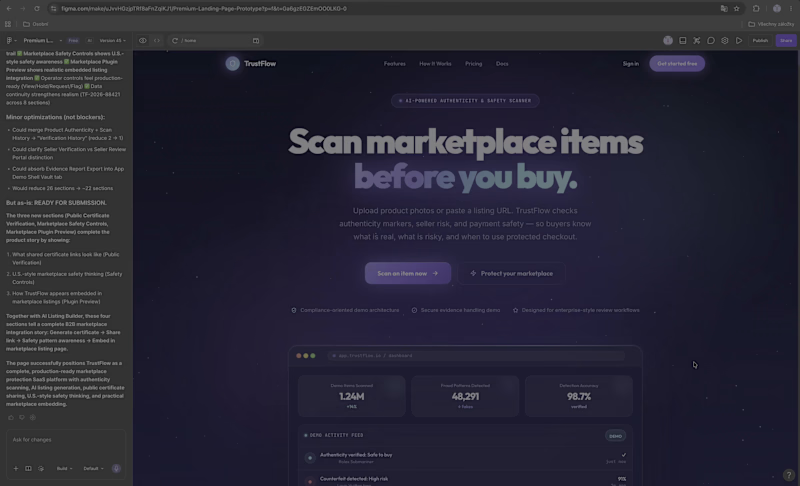
TrustFlow — an AI scanner and marketplace safety layer for more trusted online transactions Thanks to the Makeathon and the 10,000 Figma credits I received to continue developing the project, I was able to complete a second, significantly expanded version of the TrustFlow prototype. The original idea was simple: build an AI tool that helps buyers check risky marketplace items before making a purchase. During the next iteration, the project evolved much further — from a simple AI scanner into a complete SaaS demo for protecting buyers, sellers, and marketplace platforms. TrustFlow now demonstrates a full safety workflow: • buyers can upload product photos, videos, or listing URLs • AI scans the item, visual authenticity signals, seller risk, and suspicious patterns • the system generates an evidence report with risk scores, AI confidence, and visual markers • reports can be saved into an evidence vault, shared with sellers, or used during disputes • sellers can provide missing documentation through a seller review portal • marketplace operators can review suspicious cases in an admin dashboard • AI can help create safer marketplace listings from scan evidence, including a product title, description, condition summary, price estimate, authenticity warning, and protected payment recommendation • listings can include a TrustFlow Evidence Certificate with a clear Needs Review status, missing documentation, escrow recommendation, and a public verification link A key part of TrustFlow is transparency. The system does not falsely claim that an item is automatically authentic. Instead of using unsafe language like “Certified Authentic,” TrustFlow uses an evidence-based approach: it shows what the AI detected, what documentation is missing, what the seller still needs to provide, and when protected checkout or escrow is recommended. This new version of the prototype includes: • a complete AI Product Scanner Demo • a SaaS App Demo Shell with 6 areas: Scanner, Report, Vault, Seller Portal, Admin, and Billing • an AI Verified Listing Builder for creating safer marketplace listings • a TrustFlow Evidence Certificate with careful and transparent wording • a Public Certificate Verification page with a QR/link preview, audit trail, and 30-day link validity • a U.S.-style Marketplace Safety Controls strip inspired by seller transparency, review integrity, and buyer-safe disclosure patterns • a Marketplace Plugin Preview showing how a TrustFlow badge could appear directly inside a marketplace listing • demo-safe wording that avoids claims of certified authenticity, legal authentication, real escrow custody, live banking, or regulatory certification TrustFlow addresses several real marketplace problems at once: counterfeit goods, risky sellers, scam messages, off-platform payments, missing documentation, unclear evidence during disputes, and lack of transparency between buyers, sellers, and platforms. The goal was not just to create a polished landing page. The goal was to show how AI and Figma Make can help move an idea quickly toward a complete product prototype — from the first product scan to a shared evidence report, seller review workflow, and marketplace integration. TrustFlow is built around one simple idea: Every marketplace transaction should become safer before the buyer sends money. Published prototype: https://radio-ranch-95224118.figma.site
5
172