The network for creativity
Join 1.25M professional creatives like you
Connect with clients, get discovered, and run your business 100% commission-free
Creatives on Contra have earned over $150M and we are just getting started
Back to feedPost

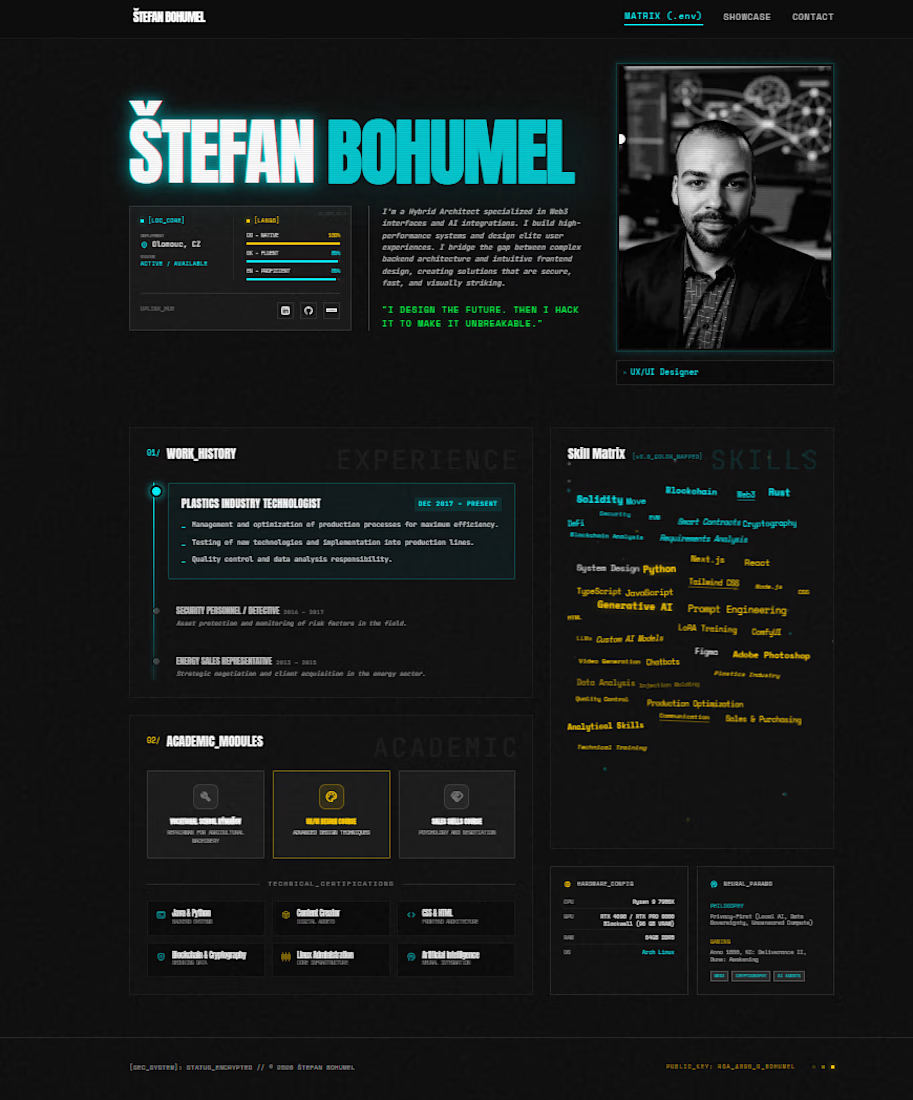
While most participants naturally lean towards building standard web apps or generic startup dashboards—concepts the industry is already highly familiar with—I decided to bring the theme 'Interfaces that feel alive' to a space that is notoriously static, flat, and outdated: the professional resume. I built 'The Living Portfolio,' a next-generation interactive CV tailored for a hybrid Web3, AI, and Security Engineer. By breaking away from traditional dead PDFs, this interface uses premium dark glassmorphism, tactical micro-interactions, and responsive canvas layers to transform a career summary into a breathing, high-fidelity digital identity that actively engages the user.
I utilized Google Stitch as the core engine for establishing the initial responsive layout and grid structure. From there, I transitioned into an iterative process using in-place edits to inject custom CSS motion properties, technical typography, and interactive button states. Finally, despite heavy platform limitations regarding multi-page structures, I successfully leveraged Stitch's export capabilities to deploy the compiled pages directly onto Netlify, achieving a fully functional and publicly accessible live prototype.
While the core concept of Google Stitch is highly innovative and the visual potential of the canvas is impressive, the developer interaction with the AI agent was a deeply frustrating experience filled with friction.
During the detailing phase, the agent consistently suffered from severe context drift. It repeatedly violated explicit constraints—such as generating entirely new layout windows instead of modifying existing components in-place as instructed. Furthermore, it frequently erased pre-existing text data and wiped out working elements during subsequent prompts. It felt as though the agent is programmed to over-generate new code overzealously rather than respecting precise, incremental boundaries. While I see the immense value in Stitch as a builder, managing the agent for high-fidelity UI work currently requires an exhausting amount of backtracking to fix forgotten or deleted elements.
P.S. I'm honestly not 100% satisfied with the final result, but iterating with the agent is a never-ending loop—with every new edit, something else kept getting lost or forgotten :-D. So, I'm submitting it as is and going to chill.


Talk about raising the bar for everyone who comes after.
The network for creativity
Join 1.25M professional creatives like you
Connect with clients, get discovered, and run your business 100% commission-free
Creatives on Contra have earned over $150M and we are just getting started







Related posts

Took a WebGL fabric physics simulation and pushed it to the absolute limit.
Built a complete visual concept for a Peptides brand around it. Pure interaction, zero boring static layouts. Let's go!


Pushing fabric physics that far for a peptides concept is a strong choice. The quiet editorial layout lets the motion carry the brand instead of competing with it.

Designed the website for Dovora — an agency that builds businesses for creators, not brand deals. "We don't represent brands, we don't split focus" is basically the whole pitch, and I wanted the site to feel just as uncompromising.
So no polished stock creator-economy visuals. The hero is a wall of real streamer/podcast footage arranged in overlapping diamonds and rounded frames — actual creators, mid-stream, mid-laugh — with a glowing gradient orb behind bold "WE BUILD CREATOR BUSINESSES" type. It reads more like a highlight reel than a landing page, which felt right for an audience that lives on camera.
The second section flips the energy completely — dark, minimal, almost aggressive typography ("BUILT EXCLUSIVELY FOR CREATORS. FULL STOP.") paired with huge chrome-and-neon 3D letterforms spelling out CREATORS. It's loud in a completely different way than the hero, and that contrast is intentional — this isn't a buttoned-up agency deck, it's built for people who make content for a living.
Genuinely fun brief to lean all the way into.