Projects using Google Ads in LagosProjects using Google Ads in LagosI'll change the way you think about Google Ads...
Don't be GOLD FISH, read it through!!!
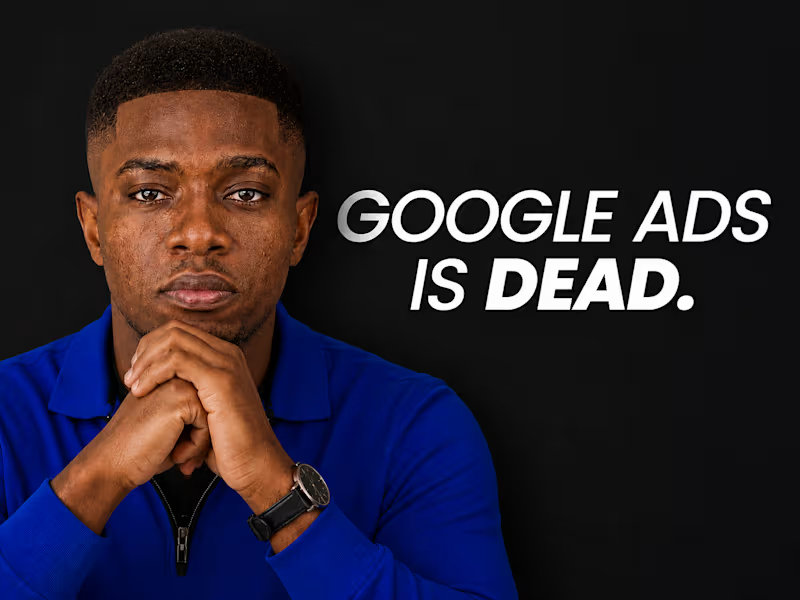
A friend called me recently in a total panic. He'd just spent $3,000 on Google Ads and got absolutely nothing back. Zero leads. Zero sales. Just gone. And of course, his conclusion was "Google Ads is dead."
I hear this a lot. And honestly, I get why people believe it. But let's actually talk about what's true here, because there's a real difference between "Google Ads doesn't work" and "MY Google Ads didn't work", and almost everyone mixes those two up.
Here's the honest part first: Google Ads has genuinely gotten harder. More competition, higher costs per click, way more automation, less manual control than it used to have. If you're running it the same way you did 5 years ago, you will lose money. That part is real, not made up.
But here's what actually happened when I looked into his account, and it's the same pattern I see over and over:
→ No conversion tracking set up at all. Google was spending completely blind, no idea what was actually working.
→ Broad match keywords on a tiny budget, so ads were showing to people with barely any relevant intent.
→ Generic ad copy, the kind that could describe literally any business in any industry.
→ Zero negative keywords, zero ad extensions.
→ The campaign ran for 6 weeks and nobody had looked at the search terms report once.
None of that is Google's fault. That's a setup problem, and setup problems are fixable.
Here's the thing that really gets me: most people who say "Google Ads doesn't work" tested one bad setup, once, for a few weeks, and quit. That's like going to the gym twice, not seeing abs, and telling everyone fitness is a scam. Nobody thinks that way about fitness, everyone accepts it takes skill and consistency. Google Ads is exactly the same. It's a skill. It can be learned. It just LOOKS deceptively simple from the outside, and that's exactly what traps people.
And honestly, some of what Google's automated over the years is genuinely good, smart bidding can process signals no human could ever track manually. The automation isn't the problem. The problem is people hand control over to the algorithm before giving it anything useful to actually learn from. Like hiring a great chef and handing them an empty fridge.
Here's what we actually did to fix my friend's account, none of it cost extra:
✓ Set up proper conversion tracking for the first time
✓ Went through the search terms report and built a real negative keyword list
✓ Rewrote the ad copy to speak to an actual specific problem, not generic fluff
✓ Tightened match types
✓ Added sitelinks, callouts, a location extension
Same budget. Same platform. Within 6 weeks, more leads than the previous 6 months combined.
The platform didn't change. The approach did.
Here's the real takeaway: if you tried Google Ads once and it flopped, don't write off the platform, write off the version of yourself that ran it that first time. You know more now. Most competitors are still stuck obsessing over match types and bid tweaks while ignoring whether their offer or landing page is even any good. If you're willing to actually understand this at a strategic level instead of just clicking buttons, you're already ahead of most people running ads right now.
Follow along, more real breakdowns like this coming. 👀 KEYWORD RESEARCH IS NOT JUST AN SEO TASK. IT IS THE FOUNDATION OF YOUR DIGITAL PRESENCE.
Most business owners want their website to appear on Google.
They invest in a beautiful website.
They create social media pages.
They publish blog posts.
They even run ads.
But here is the question many businesses never ask: “Are we creating content around what our potential customers are actually searching for?”
That is where keyword research comes in.
Think about it this way.
Your customer has a problem.
They go to Google and type:
“best real estate agent in Lagos”
“affordable web designer in Nigeria”
“how to get more customers online”
“best digital marketing agency for small businesses”
If your website, content, and digital assets are optimized around the right search terms, you have a better opportunity to put your business in front of that person at the exact moment they need what you offer.
But without proper keyword research, you could spend months creating content that nobody is searching for.
And that is one of the biggest mistakes businesses make online.
Why keyword research matters:
1. It helps you understand your customers
Keywords reveal the questions, problems, needs, and intentions of your target audience.
2. It helps you build the right content
Instead of guessing what to post, you create content based on actual search demand.
3. It improves your SEO strategy
You can optimize your website pages, blog posts, product descriptions, headings, and other content around relevant search terms.
4. It helps you discover less competitive opportunities
You don't always need to fight for the biggest keywords.
Sometimes, highly specific long tail keywords can bring you visitors who are much closer to making a buying decision.
5. It connects your business with search intent
There is a huge difference between someone searching:
“what is SEO?”
and someone searching:
“SEO agency for small business in Lagos.”
The first person may be researching.
The second person may be looking for someone to hire.
That difference matters.
Your digital presence should not simply be visible.
It should be visible to the right people, searching for the right things, at the right stage of their buying journey.
So before you publish another blog post, redesign another website page, or create another piece of content, ask yourself:
“What keywords are my potential customers actually using?”
Because when you understand what your audience is searching for, you stop creating content based on assumptions and start building your digital presence around real demand.
Want to know whether your website is targeting the right keywords and opportunities?
Send me a DM with “KEYWORD AUDIT” and let's identify the search opportunities your business could be missing.