Freelancers using CSS3 in Islamabad Capital TerritoryFreelancers using CSS3 in Islamabad Capital Territory
Web Developer | UI/UX| 3D Product Animation |
9
Followers
Web Developer | UI/UX| 3D Product Animation |

Cover image for StreamPro — Brand Website for
StreamPro — Brand Website for a Live Event Broadcasting Studio Live Website: saif-stream-pro-website.netlify.app (http://saif-stream-pro-website.netlify.app) What I built😍 A fully responsive, mobile and web based single-page marketing website for StreamPro, a Brisbane-based live-streaming production studio that broadcasts memorial services, weddings, sports events, and community occasions. The site was designed and developed from scratch to establish a premium, trustworthy brand presence and convert visitors into booking inquiries — working seamlessly whether accessed from a phone, tablet, or desktop. What it does🙌 The website guides visitors through a structured narrative — introducing the brand, building credibility, showcasing services, explaining the booking process, displaying social proof, and closing with a direct contact/quote form. It's built to load fast, adapt fluidly across mobile and web based environments, and feel as polished and reliable as the broadcast service it's selling. Core concepts & techniques applied💯 Semantic document structure — content organized into meaningful, accessible sections rather than generic divs, improving both SEO and screen-reader usability. Design system / design tokens — a centralized set of reusable variables (colors, gradients, typography, spacing) so the entire visual identity stays consistent and can be updated globally from one place. Responsive, mobile-first layout design — fluid grids and breakpoints so the layout adapts smoothly across mobile and web based screens without needing separate versions. Scroll-based interactivity — dynamic navbar states, scrollspy navigation (highlighting the active section as the user scrolls), and progressive scroll-reveal animations for content. DOM manipulation & event handling — mobile menu toggling, animated statistic counters, and form interaction logic, all built with vanilla JavaScript (no frameworks). Accessibility considerations — visible focus states, reduced-motion support for users sensitive to animation, and descriptive alt text on all imagery. Brand identity integration — a custom 3D gradient logo mark and supporting visual graphics applied consistently across the navigation, hero section, and footer to reinforce brand recognition. Conversion-focused UX — strategic placement of trust signals (stats, testimonials, direct phone contact) and a structured lead-capture form to turn visitors into inquiries. Outcome🚀 A performant, framework-free static website that's lightweight, cheap to host, easy to maintain, fully mobile and web based responsive, and built entirely around fundamental web development principles — structure, styling systems, interactivity, accessibility, and conversion design.
0
99
Cover image for Synapse — Designing an AI
Synapse — Designing an AI Assistant People Actually Want to Open A personal case study on building an AI-powered product, from idea to interface What This Project Is Synapse is a concept landing page for an AI-powered assistant app — the kind of tool that can chat with you, write content, help with code, generate images, and even listen through voice mode. Think of it as one AI brain that switches roles depending on what you need that day: writer, designer, developer, or thinking partner. I didn't build the actual AI behind it (that needs a real backend and a language model). What I built is the front door — the website that would greet a new user, explain what the product does, and convince them to try it. It's coded by hand using HTML, CSS, and JavaScript, and it's designed to feel like a real, funded, 2026-era AI startup — not a template. Why I Made It AI products are one of the most in-demand niches for designers and developers right now. Every week, a new AI tool launches, and every one of them needs the same three things: a website that explains it, an interface that's easy to trust, and a visual identity that doesn't look like everyone else's chatbot page. I built Synapse for three reasons: To learn by doing. Reading about animations and 3D CSS is one thing — actually building a rotating 3D orb, scroll reveals, and a typewriter chat demo forced me to understand how these effects really work under the hood. To build a strong portfolio piece. Clients hiring for AI-product design want to see that you can design for AI — chat interfaces, live-typing states, "thinking" animations — not just static pages. To practice going from brief to finished product, the same way a real freelance or agency project would run: picking a name, a color story, a tone of voice, and carrying it consistently across every section. What's Inside Section Purpose Hero Introduces Synapse in one glance — headline, floating 3D orb, live chat bubbles Marquee strip Builds trust by showing "who uses it" Stats Numbers that count up on scroll, for quick credibility Features grid Explains the 6 things Synapse can do How it works A simple 3-step flow: ask → Synapse reasons → get result Live demo A fake but realistic chat window that types out an answer, showing how the product feels in use Voices (testimonials) Social proof from "users," scrolling infinitely CTA band The final push to get someone to try the product Footer Quick links and closing brand mark Skills I Practiced UI/UX design thinking — deciding what a first-time visitor needs to see first, second, and last Visual design & branding — building a color palette (violet, cyan, magenta, amber) and pairing three fonts (Space Grotesk, Inter, JetBrains Mono) that feel techy but warm Responsive layout — making sure the page holds up on mobile, tablet, and desktop Motion & interaction design — deciding where animation adds meaning (a "thinking" AI deserves movement) instead of adding effects just because I could Front-end development — writing real, working HTML/CSS/JS instead of just designing static mockups Copywriting — writing headlines and feature text that sound like a real product, not placeholder "Lorem ipsum" text Problem-solving / debugging — like the navigation bug we just fixed, which taught me how a small JavaScript mistake can break a whole page's usability Tools Used HTML5 / CSS3 — structure and all visual styling, including 3D transforms and keyframe animations Vanilla JavaScript — scroll reveals, cursor glow, orb parallax, counters, typewriter effect, mobile menu Google Fonts — Space Grotesk, Inter, JetBrains Mono Unsplash — free stock photography for avatars and testimonial faces What I'll Build On Next (Future Contributions) This version is the front door only. Here's where it can grow: A working chat interface — connect it to a real AI API so the "demo" becomes a real conversation A pricing page — since every SaaS/AI product needs a clear plan comparison A dashboard / product screens — the inside of the app, not just the marketing page Dark/light mode toggle — a common expectation in 2026 products Accessibility pass — screen reader labels, better color contrast checks, keyboard navigation testing Case study presentation — turning this into a polished Behance/Dribbble post with before/after and process shots Closing Thoughts Synapse started as a way to practice one skill — building an AI-product landing page — but it ended up teaching me design decisions, real front-end code, and debugging, all in one project. Link to see my whole project: https://saifullah-ai-assistant.netlify.app
2
1
129
Cover image for Title: Pawsability Web & Mobile
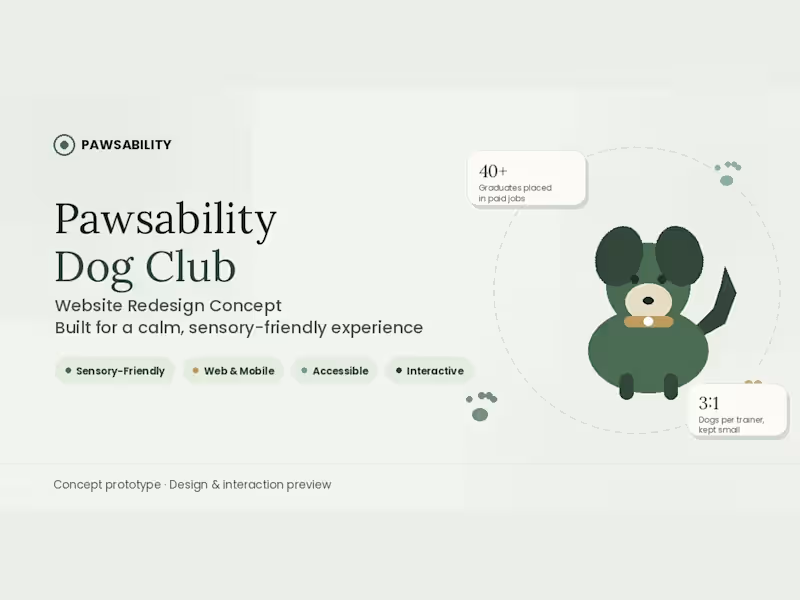
Title: Pawsability Web & Mobile Based Redesign Concept 🐾📱✨ Complete Project Description 🚀 Pawsability is a modern, high-converting web and mobile platform designed as a UI/UX case study and interactive digital experience for a Bushwick, Brooklyn-based social enterprise 🏙️🐶. The platform seamlessly bridges two powerful missions: delivering top-tier professional dog training services to pet owners while providing structured vocational training and career pathways for neurodivergent and autistic adults 💡💙. The site is engineered with a sensory-friendly, highly accessible design architecture 🎨, featuring soft color palettes, smooth micro-interactions, clean visual hierarchy, and full support for reduced-motion preferences ⚡. Core Sections & Features Breakdown 🛠️ Hero & Impact Metrics 🎯 Bold Value Proposition: "Every leash has two ends" — instantly engaging both target audiences 🐕. Dual-Path Navigation: Clear CTAs for dog owners booking services & individuals seeking vocational training 🚀. Trust-Building Stats: Highlighting key performance metrics like 01:1 graduate job placement focus and a calm 3:1 dog-to-trainer ratio 📊. Our Story (Dual-Purpose Model) 🤝 Visual storytelling showing how pet care and workplace skill training intersect naturally. Transparent model explaining how dog service bookings directly fund participant paychecks 💰✨. Vocational Training Roadmap 📌 Interactive 4-stage progression guide: 01. Meet & Assess ➔ 02. Hands-On Training ➔ 03. Supervised Shifts ➔ 04. Job Placement 🏆 Dog Services Hub 🐕‍🦺 Structured, high-converting service cards detailing 1:1 Private Training, Small Group Classes, and Structured Daycare & Boarding 🎾. Get Involved & Call to Action 📩 Multiple conversion touchpoints allowing visitors to book services, sponsor a trainee, or hire graduates 🤝✨. Skills Applied 🧠💎 UI/UX Design & Spatial Architecture: Crafting intuitive user flows, conversion-focused wireframes, and sensory-friendly layout systems 📐. Fully Responsive Design: Building fluid desktop grid systems and flexible layouts optimized seamlessly for mobile, tablet, and widescreen displays 📱💻. Accessibility (a11y) Standards: Implementing high-contrast text, clear focus states, and reduced-motion options for an inclusive user experience ♿✨. Brand Strategy & Visual Identity: Curating muted color palettes, cohesive visual tone, and modern typography 🎨. Interactive Prototyping & Motion: Designing subtle scroll-triggered effects, micro-animations, and fluid state changes ✨. Tools & Tech Stack ⚙️🧰 Framer: Used as the primary design canvas and interactive visual production engine to build fluid, fully responsive web layouts without manual backend overhead 🚀. Framer Motion Logic: Powers smooth transitions, custom keyframe animations, and adaptive micro-interactions 🔥. Auto-Layout & Dynamic Components: Guarantees pixel-perfect layout responsiveness across all screen resolutions 📐. Semantic Web Principles: Structured with high-performance CSS/HTML visual principles for fast loading speeds and smooth responsiveness ⚡. 🚀 To see my project click on this link https://pawsability-redesign.netlify.app
0
109
Expert Custom Website Developer
1x
Hired
5.0
Rating
1
Followers
Expert Custom Website Developer
Code the stack. Add the intelligence
5.0
Rating
6
Followers
Code the stack. Add the intelligence
Automating workflows & AI tools to grow your business
Web Developer Building Fast, Custom Websites & Tools.
New to Contra
Web Developer Building Fast, Custom Websites & Tools.
Cover image for AskTechDigital.com (http://AskTechDigital.com) is a lightweight
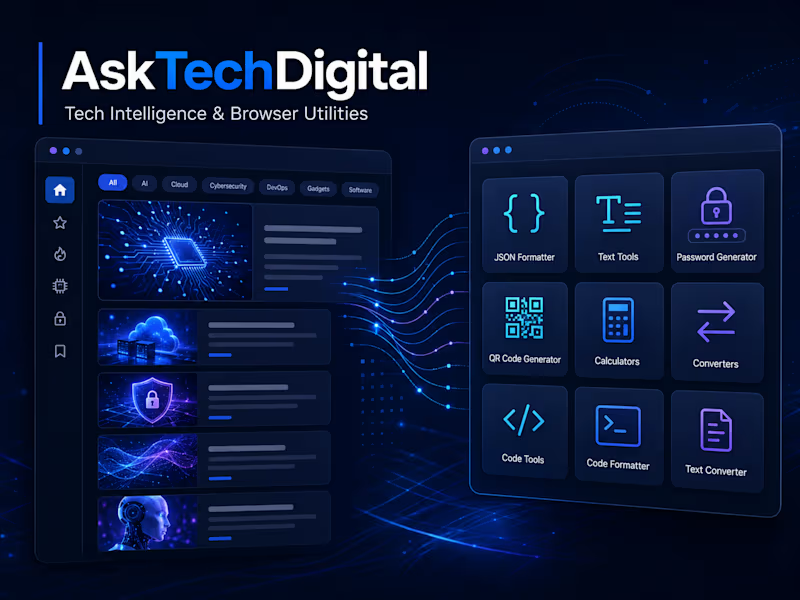
AskTechDigital.com (http://AskTechDigital.com) is a lightweight technology platform combining two complementary services: an automated technology-news discovery feed and a collection of practical browser-based utilities. The news section organizes current developments across software, artificial intelligence, cybersecurity, consumer technology, cloud services and digital products. Its automated workflow helps identify and organize relevant technology stories while preserving source attribution and directing readers to the original publisher for complete coverage. The second major component is the Web Utilities Directory. It provides fast, tracking-free tools that run primarily inside the visitor’s browser, reducing unnecessary server processing and helping protect user data. The utility collection includes text-processing tools, word and character counters, case conversion, JSON formatting and validation, Base64 encoding, URL encoding, password generation, QR-code creation, UUID generation, barcode generation, calculators, measurement converters and frontend-code utilities. The platform was developed with a lightweight PHP and JavaScript architecture suitable for standard hosting. Its modular structure allows additional utilities, content categories and automation workflows to be introduced without rebuilding the entire website. Responsive layouts provide a consistent experience across desktop, tablet and mobile devices. Technical SEO was incorporated through descriptive page titles, metadata, canonical URLs, internal linking, crawlable tool descriptions and sitemap-based discovery. Performance improvements include deferred functionality, efficient asset loading, browser-side processing and reduced dependency on heavy frameworks. The monetization structure also supports carefully placed affiliate recommendations inside relevant commercial content. Affiliate destinations are separated from general editorial navigation and accompanied by appropriate disclosure, helping preserve transparency and user trust. AskTechDigital.com has the potential to expand into a broader technology decision and productivity platform. Future services could include software-comparison pages, AI-tool directories, hosting comparisons, saved utility histories, user accounts, embeddable tools, API access and premium business utilities. The result is a scalable digital platform that attracts visitors through timely technology discovery while giving them practical reasons to return through its expanding collection of free web tools.
0
29
Cover image for HowToDocument.com (http://HowToDocument.com) is a technical
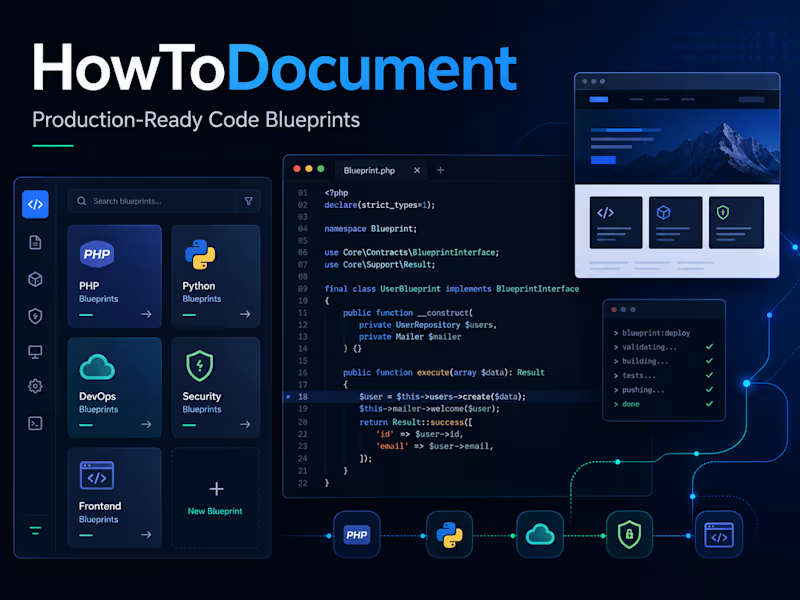
HowToDocument.com (http://HowToDocument.com) is a technical knowledge platform designed to make practical engineering solutions easier to discover, understand and reuse. Instead of publishing long, theory-heavy tutorials, the website organizes focused code blueprints covering PHP, Python, DevOps, server configuration, application security, data engineering and frontend performance. The platform combines a searchable blueprint catalogue with category filtering, individual documentation pages and community features. Registered users can interact with published solutions through upvotes and technical notes, helping useful implementations become easier to identify. A key component of the project is the browser-based Code Playground. It allows developers to write and preview HTML, CSS and JavaScript without installing a development environment. The playground includes separate editing tabs, automatic preview, console output, browser-based autosaving, code copying, reset controls and downloadable project output. The website was developed around a lightweight architecture intended to remain practical on standard hosting. The interface uses responsive layouts and reusable components to provide a consistent experience across desktop and mobile devices. Content is structured so that new blueprints and technical categories can be added without redesigning the platform. Search discoverability was treated as an important part of the architecture. Blueprint pages support focused titles and descriptions, internal category linking, crawlable content and sitemap-driven discovery. Performance work includes controlled asset loading, efficient frontend code and an interface that avoids unnecessary framework overhead. HowToDocument.com has strong expansion potential. Future development can introduce contributor profiles, blueprint collections, verified solutions, saved favourites, advanced code search, downloadable project bundles and premium implementation guides. The platform could eventually support subscriptions, sponsored technical content, expert reviews and a marketplace connecting businesses with developers capable of implementing the published solutions. The result is more than a documentation website it is the foundation of a community-driven technical blueprint library and practical developer toolkit.
0
34
Cover image for CronShieldLabs.com (https://CronShieldLabs.com) - A SaaS
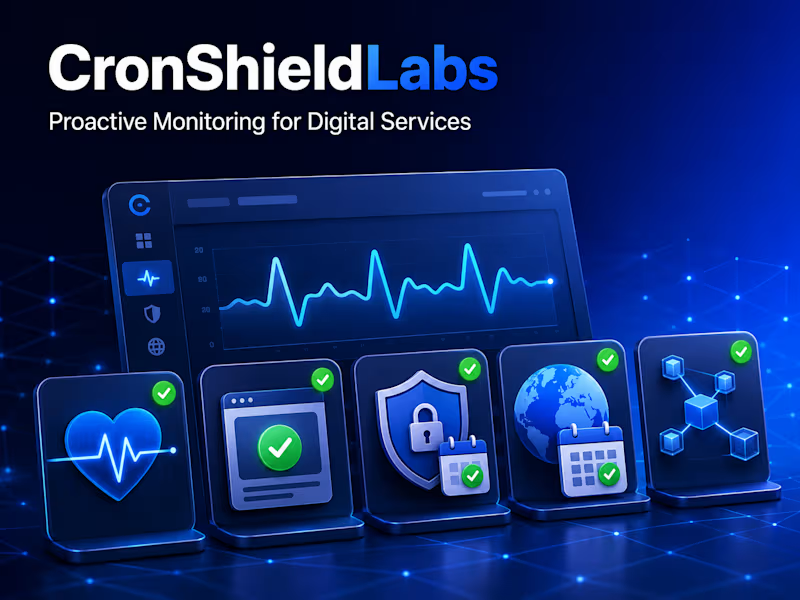
CronShieldLabs.com (https://CronShieldLabs.com) - A SaaS Monitoring Platform I designed and developed CronShieldLabs.com as a lightweight SaaS platform that helps developers, agencies and online businesses detect silent failures across their digital services. The platform combines five monitoring functions within one secure dashboard: cron heartbeat monitoring, website uptime and response-time checks, SSL certificate tracking, domain-expiry monitoring and DNS-change detection. Users can create and manage monitors, review historical results and receive failure, recovery and expiry notifications. I developed the application using PHP, MySQL/MariaDB, HTML and CSS, with scheduled server-side processes handling automated checks. The architecture includes secure authentication, account-based data isolation, CSRF protection, prepared database queries, rate limiting and private configuration stored outside the public website directory. CronShieldLabs.com also includes Free, Pro and Business subscription plans, manual Binance Pay verification, an administrator dashboard, registered-user management and service limits based on each customer’s plan. A major technical consideration was securing website checks against private-network access and unsafe redirects. The platform validates public destinations, blocks private and reserved addresses and rechecks redirect targets before connecting. The project was designed as a cost-efficient shared-hosting MVP with a clear expansion path. Future opportunities include branded public status pages, API and keyword monitoring, Telegram and webhook alerts, team accounts, incident management, multi-location checks and automated subscription billing. CronShieldLabs.com demonstrates my ability to design a complete SaaS product from public marketing pages and secure authentication to database architecture, background monitoring processes, payment workflows and future commercial planning. Website: https://cronshieldlabs.com
0
48
Course Creator PLUS Sales Page Designer