Results that are similar to your search
Similar results



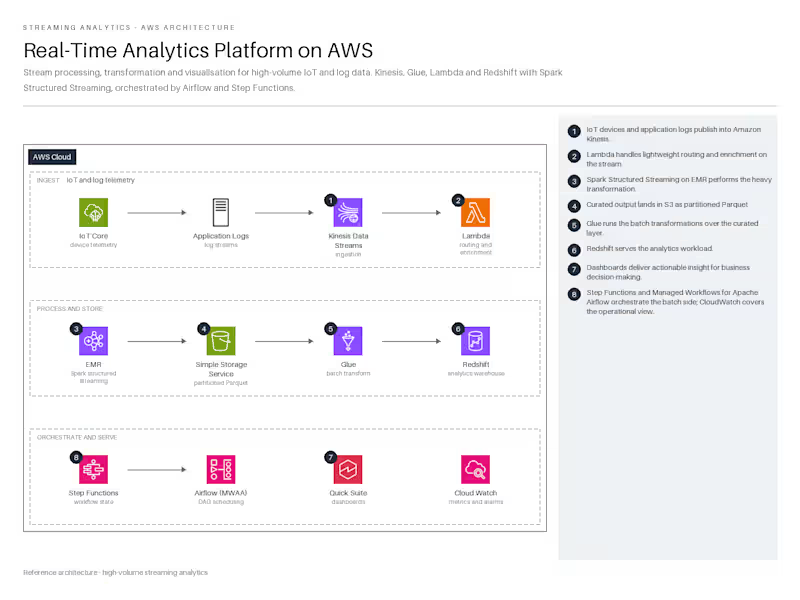
Real-Time Analytics Platform on AWS designed to ingest, process, and visualize high-volume streaming data from IoT devices and application logs.
Ingestion: Device telemetry (IoT Core) and application logs are published into Amazon Kinesis Data Streams, followed by lightweight routing and enrichment using AWS Lambda.
Processing & Storage: Amazon EMR performs heavy data transformations via Spark Structured Streaming, landing the curated output into Amazon S3 as partitioned Parquet files. AWS Glue then handles batch transformations before loading the data into Amazon Redshift for the analytics workload.
Orchestration & Serving: AWS Step Functions coordinate the batch processing workflows. Finally, Amazon QuickSight generates actionable business dashboards while Amazon CloudWatch monitors operational metrics and alarms
0
515





AWS VPC Peering Project
📌 Overview
This project demonstrates how to establish a VPC Peering connection between two Virtual Private Clouds (VPCs) on AWS using the AWS Management Console. VPC peering allows resources in both VPCs to communicate with each other using private IP addresses, as if they were part of the same network.
🏗️ Architecture
VPC A: 10.0.0.0/16 (Region: ap-south-1)
VPC B: 192.168.0.0/16 (Region: ap-south-2)
Peering Type: Different-region VPC Peering
Connectivity: Private IP communication between instances in both VPCs
🛠️ Steps Followed
Created two separate VPCs with non-overlapping CIDR blocks
Launched an EC2 instance in each VPC
Initiated a VPC Peering Connection request from VPC A to VPC B
Accepted the peering connection request from VPC B
Updated route tables in both VPCs to route traffic through the peering connection
Updated security group inbound rules to allow traffic between the VPCs
Tested connectivity between instances (ping/SSH) to confirm the peering worked.
✅ Result
Instances in both VPCs were able to successfully communicate with each other using private IP addresses through the peering connection
1
78