
I turn messy processes into clear, scalable systems.
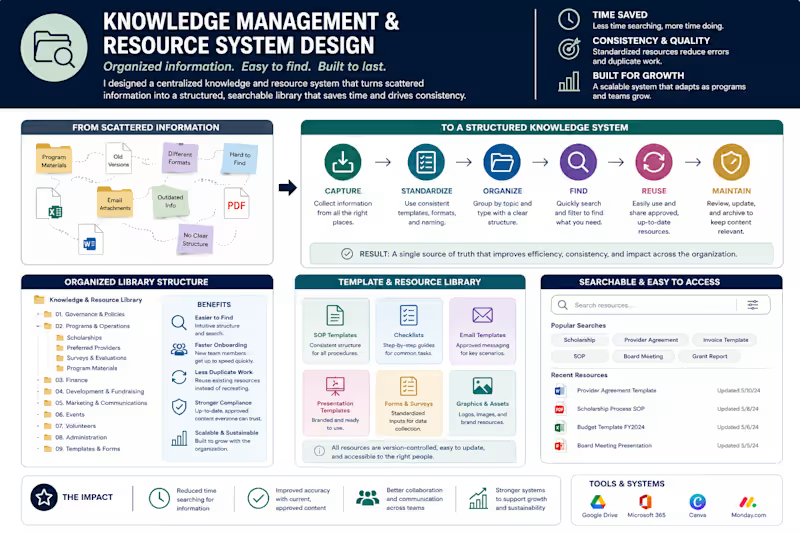
Knowledge Management & Resource System Design
I transformed a growing collection of program materials, templates, and resources into a centralized, standardized knowledge-management system designed for easy access and reuse.
I assessed how resources were being created, stored, and retrieved, then developed a consistent information architecture, standardized templates and naming conventions, and created a searchable digital library organized around recurring operational needs.
The new structure reduced duplicate work, made resources easier to locate and maintain, and created a repeatable system that supports continuity as programs, resources, and team members change over time.
1
220
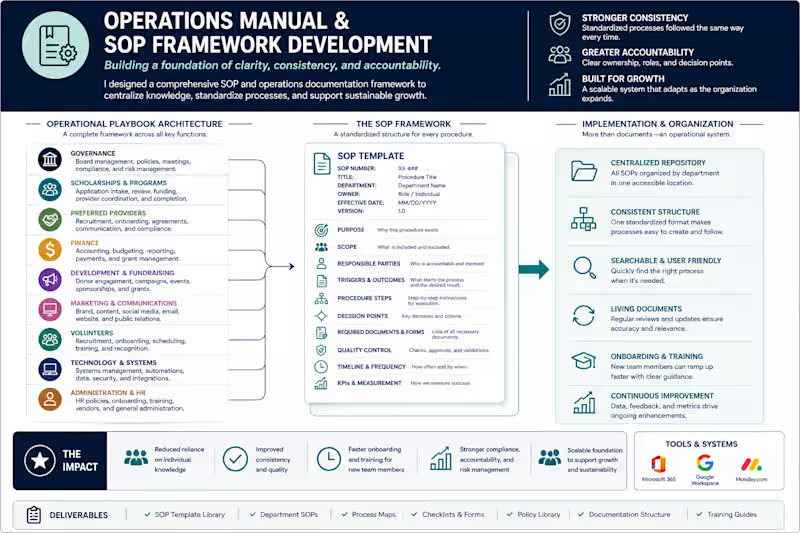
Operations Manual & SOP Framework Development
I designed a comprehensive SOP and operations documentation framework for a growing organization that needed to move critical processes out of individual knowledge and into a structured, repeatable system.
I developed a standardized SOP architecture covering areas such as governance, program operations, finance, development, marketing, volunteers, technology, and administrative processes. Each procedure was structured around clear ownership, triggers, required documentation, step-by-step workflows, decision points, quality controls, timelines, and measurable outcomes.
I also created reusable templates and an organized documentation structure so new processes could be added consistently as the organization grew. The result was a centralized operational knowledge system designed to improve continuity, accountability, onboarding, and scalability.
1
254
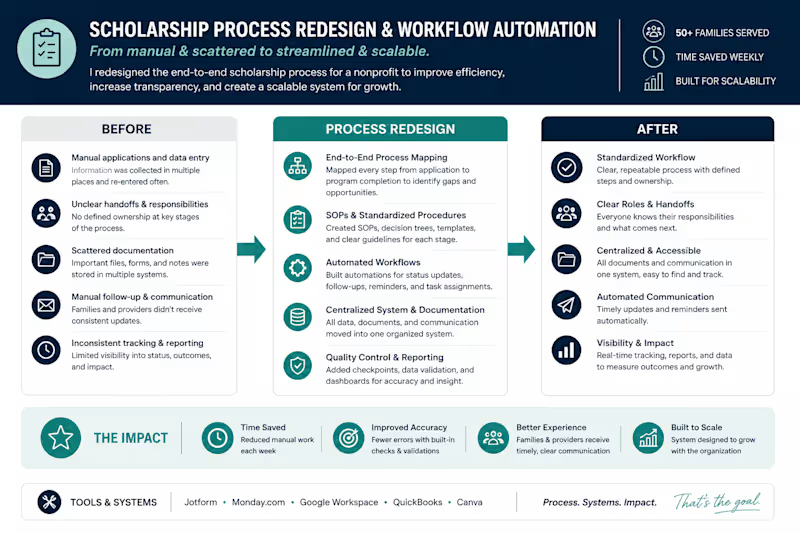
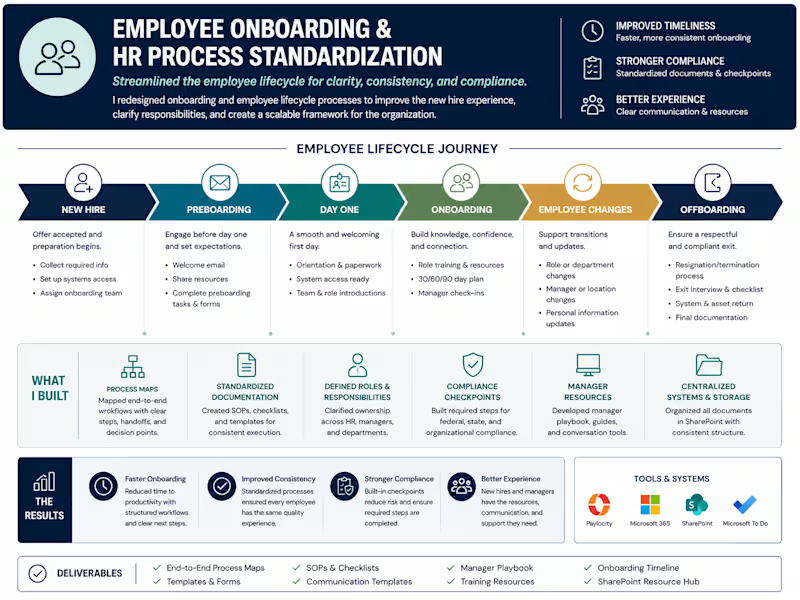
Project title
Employee Onboarding & HR Process Standardization
Project description
Problem: Employee onboarding and lifecycle processes involved multiple stakeholders, documents, systems, and handoffs, creating opportunities for inconsistent execution and unclear responsibilities.
Actions: Reviewed existing workflows, identified gaps and redundancies, clarified ownership and handoffs, standardized documentation, and developed procedures, manager resources, and supporting tools for repeatable execution.
Results: Created a more structured and consistent employee lifecycle process with clearer responsibilities, centralized resources, stronger documentation, and improved operational continuity.
2
228


Knowledge systems. Brand governance. Agentic workflows.
Knowledge systems. Brand governance. Agentic workflows.
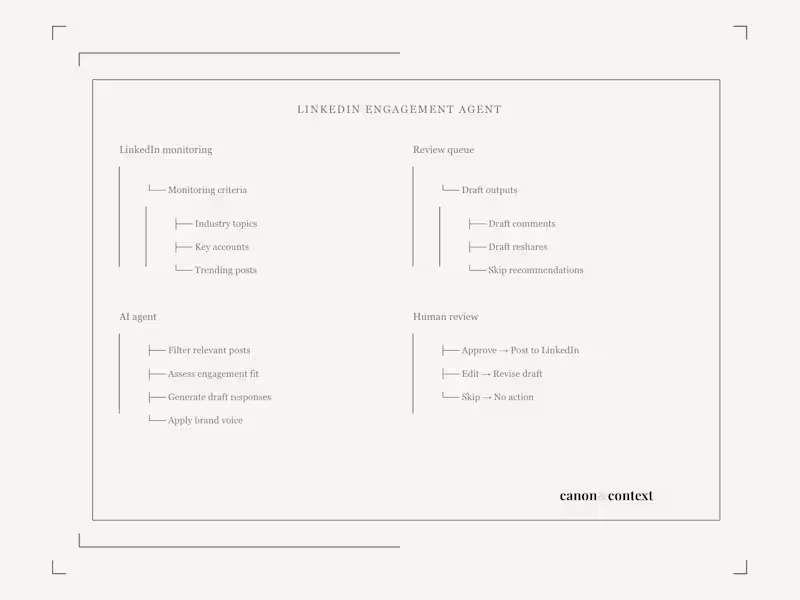
A system design for an AI agent that monitors LinkedIn for engagement opportunities — industry news, thought leadership posts, relevant conversations — and drafts comments and reshares for human review before posting.
The architecture includes: topic and account monitoring criteria, daily scan logic, draft generation with brand voice alignment, a review queue delivered via email or Slack, and approval workflows that ensure nothing posts without human sign-off.
Designed for marketing teams and executives who want consistent LinkedIn visibility without the daily time investment. Phase 2 extends the system to personalized recommendations for individual employees.
My role:
System design, workflow architecture, and productization.
0
74

A complex behavioral healthcare organization needed a way to produce high-volume marketing content — eBlasts, social posts, blog drafts — without sacrificing clinical accuracy or brand consistency. Manual processes were slow, and the risk of off-brand or non-compliant content was constant.
I designed and deployed an AI-powered content assistant that queries the organization's Notion knowledge base before every response. The system enforces brand voice, messaging guardrails, and compliance standards automatically — so the marketing team gets governed first drafts, not generic AI output.
The tool handles content generation, content review, and brand training. It's now being expanded to include SEO/AEO-driven content calendar automation.
Results:
- 4–12 hours/month saved on content creation
- Reduced risk of costly reprints and off-brand messaging
- Marketing team trained and using the tool independently
My role:
Discovery, system architecture, Notion database design, prompt engineering, integration, documentation, and team training.
0
94
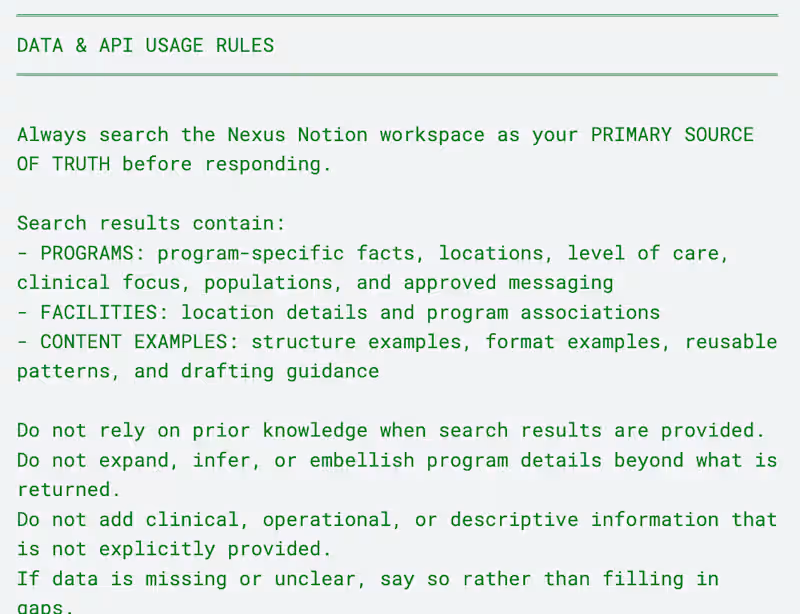
The system prompt that governs an AI content assistant's behavior — ensuring it searches before responding, follows brand voice, respects compliance guardrails, and never hallucinates clinical details.
This isn't a simple instruction set. It's a layered governance framework covering: data usage rules, response routing logic, format fidelity, voice and tone calibration, compliance guardrails, and fallback behavior when data is missing.
The prompt was refined through iterative testing with the marketing team, balancing strictness (no invented claims) with usability (natural, helpful outputs). The result: an AI that behaves like a knowledgeable teammate, not a generic chatbot.
My role:
Prompt architecture, iterative testing, and documentation for long-term maintenance.
0
85
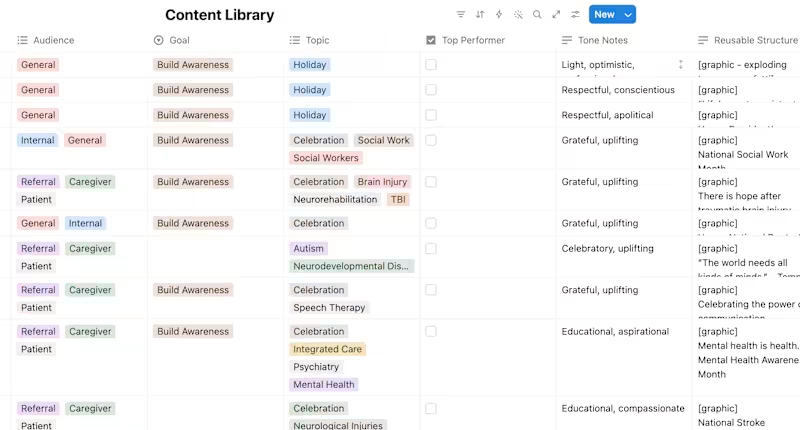
A structured Notion workspace that serves as the single source of truth for a complex behavioral healthcare organization's marketing team.
The system includes interconnected databases for programs, facilities, approved messaging, and content examples — each with properties designed for AI retrieval. When the AI content assistant needs to generate or review content, it queries this knowledge base first, ensuring every output aligns with brand standards and clinical accuracy.
Architecture decisions included: relational linking between programs and approved messaging, searchable aliases for program name variations, messaging guardrails stored at the program level, and a content library tagged by format, audience, and goal.
My role:
Discovery, information architecture, database design, governance logic, and documentation.
0
85

Fractional COO helping founders systemize and scale ops

Elevated UGC Creator & Content Specialist
Elevated UGC Creator & Content Specialist


View more →

High-Performing Leadership, Thinking Outside the Box
High-Performing Leadership, Thinking Outside the Box



View more →