Freelancers using CapCut in Brescia
Sign Up
Post a job
Sign Up
Log In
Filters
2
Projects
People
Chiara Alduini
Brescia, Italy
Creative Director | Brand Identity & Visual Systems
22
Followers
Follow
Message
Creative Director | Brand Identity & Visual Systems
0
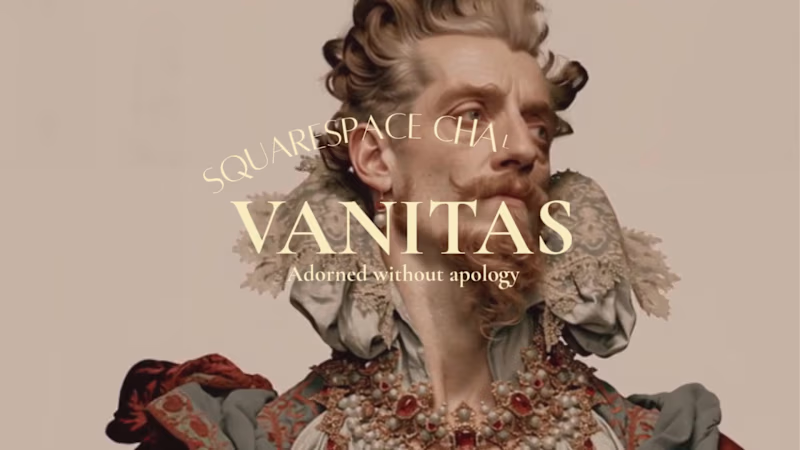
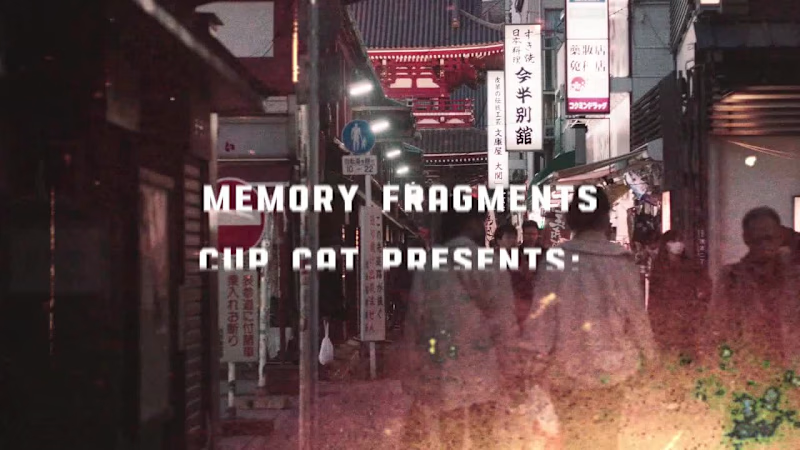
CapCut presents: Fragments of Memory A retro-Tokyo mood film — extension of the Brand Identity Challenge entry This project is an extension of my original challenge entry: "Reimagine CapCut – Tokyo Streetwear Brand Identity" https://contra.com/community/BBshwH0R-reimagine-cap-cut-tokyo-streetwear-brand-identity?r=chiaraalduini It expands the concept by introducing a motion layer that explores how the brand behaves in movement, bringing the identity system into a more dynamic and applied context. While the original submission focused on the visual identity system — logo, typography, color palette, and static applications — this addition completes the narrative by translating the brand into motion and reinforcing its Tokyo streetwear-inspired aesthetic. Together, both parts form a single cohesive exploration of how a digital tool like CapCut can be reimagined as a cultural and fashion-driven brand system. Born to Cut — but sometimes, born to remember. 🎌 #CapCutDesignStudio #BornToCut #TokyoVibes
0
419
61
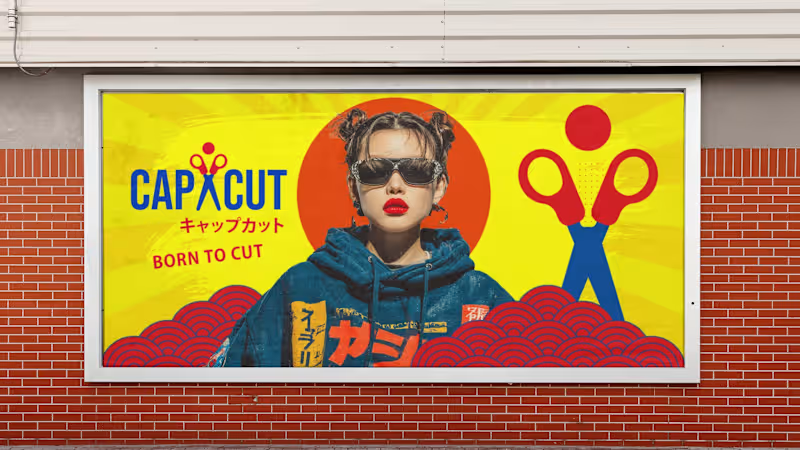
CapCut reimagined as a Tokyo streetwear brand, Born to Cut 😉 A complete brand identity inspired by 1980s Japanese advertising: bold yellow, navy blue, and red. Logo, campaign posters, packaging, and merchandise. Built with CapCut Design Studio
30
61
4.7K
26
Atlas of Forgotten Queens Six queens. Six worlds. Countless untold stories. History remembers kings. It often forgets queens. The idea | Atlas of Forgotten Queens is an interactive visual-storytelling project that reimagines six historical women rulers — Zenobia, Nefertiti, Dihya, Tamara, Roxelana, and Artemisia I — through a symbolic, narrative-driven lens. Rooted in historical research across different cultures and eras, it focuses on influential women whose stories have been overlooked in traditional history. The approach | Rather than presenting history as a fixed reconstruction, the project translates it into a layered visual language where meaning is suggested through imagery, atmosphere, and symbolism. It is at once an archive and a reinterpretation — each queen sits between documentation and imagination, a shifting image shaped by symbols, suggestion, and a subtle sense of myth. The craft | Each queen is built as a digital collage combining photography, original illustration, and AI-generated imagery, fused into a single portrait that reads as historical identity reinterpreted, never literal reconstruction. Each queen's name is written in her own historical script — Egyptian hieroglyphs for Nefertiti, Tifinagh for Dihya, alongside Arabic, Georgian, and Greek — so that each ruler is named in her own writing, not only in ours. The process and tools | The project was designed, prototyped, and built in Figma Make, used both through its AI-driven generation and its code editor for precise refinement — Figma Make is the spine that turns the concept into a living, interactive site. Around it sits a wider creative pipeline: Photoshop and Illustrator for visual development and the gold-line maps; Midjourney for image generation; Gemini to compose the original score "The Last Prayer of the Sultan"; and Claude to develop and structure the narrative. The result is a genuine multi-tool, AI-and-manual workflow, with Figma Make at its center. The experience | The site unfolds like a museum. A soft, slowly drifting haze with floating, parallax collage elements gives way to a gallery of circular portraits; each queen's page reveals her in colour and invites the visitor to read symbolic hotspots placed directly on the artwork. The Geography of Silence gathers all six rulers onto a single map — where they ruled, and where memory let them fade. The Language of Emblems is the project's lexicon, collecting the recurring symbols — the hawk, the fox, the colour red — and reading them in their universal meaning: a key to the clues marked on each portrait. The journey closes with The Unwritten, where the names of other forgotten queens — Sheba, Amanirenas, Nzinga, Boudica, and more — surface and fade around a final illustration: an unfinished, ever-expanding tribute to the countless women still waiting to be remembered. The experience is fully responsive across desktop and mobile: on smaller screens it is rethought for touch rather than scaled down, with a collapsible menu, a pinch-to-zoom map, and enlarged tap targets. If you've read all the way to here — thank you for your interest! 😊 Figma Site | https://atlasqueens.figma.site/ (https://atlasqueens.figma.site/)Share | https://www.figma.com/make/uXm8S9lkymkTd8URAjmj6C/ATLAS-OF-FORGOTTEN-QUEENS?p=f&t=twAEHRsb3gv3aWaI-0 Community | https://www.figma.com/community/file/1646095544450556274
11
26
2.1K
13
Project Title: TimeMap — Historical World Explorer Short description: TimeMap is an interactive historical world map explorer that lets you travel through time and space simultaneously. Select multiple cities and archaeological sites from different parts of the world and see what was happening at the exact same moment in history. What I built: An interactive web app where you can: Search historical cities and archaeological sites Compare up to 4 locations simultaneously across 5,000 years of history Navigate through 7 historical eras via an interactive timeline Filter by world region Listen to era-appropriate ambient music Explore a vintage cartographic map with wave ocean texture How I used Google Stitch: I started from a personal infographic I designed in Adobe Illustrator and Photoshop about the Korean Peninsula. I extracted the visual DNA — warm cream palette, coral accents, serif typography — and brought it into Google Stitch to prototype the interface. Through multiple iterations in Stitch I designed the map layout, the side panel, the leader portrait, the timeline and the editorial aesthetic. Stitch was the bridge between my design vision and the final development in Claude Code. Workflow: Adobe Illustrator + Photoshop → Google Stitch → Claude Code Project link: https://timemap-explorer.netlify.app/ Feedback on Stitch: Stitch is genuinely powerful for rapid UI prototyping. Iterating visually with prompts saved enormous time. The design consistency across iterations was impressive. Areas for improvement: handling complex SVG elements like world maps was challenging, and version history navigation could be more intuitive.
16
13
1.4K
CapCut
(2)
Follow
Message
Explore people