Freelance Communication Designers in Brescia
Freelance Communication Designers in Brescia
Sign Up
Post a job
Sign Up
Log In
Filters
2
Projects
People
Chiara Alduini
Brescia, Italy
Creative Director | Visual Identity & Storytelling
2x
Hired
59
Followers
Follow
Message
Creative Director | Visual Identity & Storytelling
1
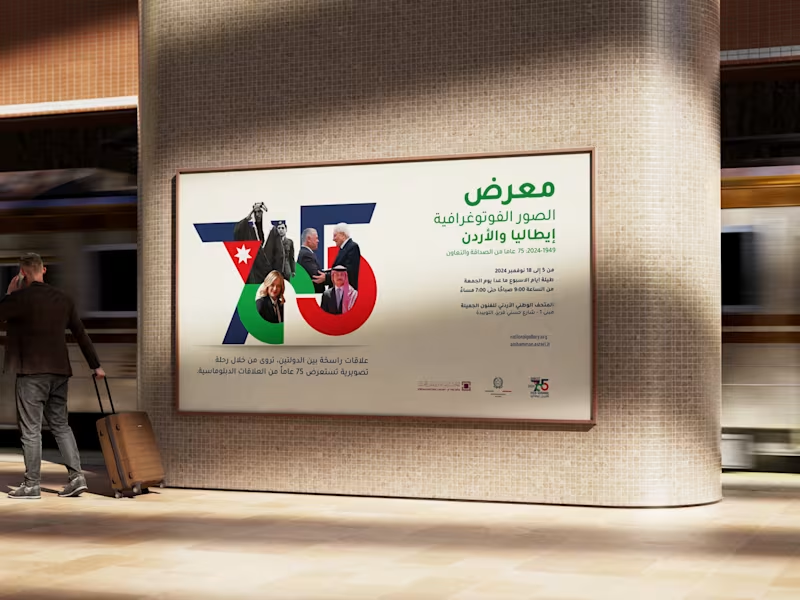
Italy–Jordan 75 Years · Italian Embassy Amman Complete visual identity for the 75th anniversary of diplomatic relations between Italy and Jordan, commissioned directly by the Italian Embassy in Amman. Scope: custom logo design, bilingual brand guidelines (Italian/Arabic), exhibition design at the Jordan National Gallery of Fine Arts, and full collateral — rollup banners, billboard posters, official invitation, and brochure. A diplomatic identity built to carry institutional weight across two countries, two scripts, and three languages.
1
557
1
Educational Visual Identity & Storytelling System for “Discover Petra with Ahmad” Project Overview Educational and cultural storytelling system developed for “Discover Petra with Ahmad”, a bilingual learning experience designed to make the heritage of Petra accessible to younger audiences through narrative, illustration, and interactive formats. The project combines cultural strategy, educational design, and visual storytelling to translate complex heritage content into an engaging and intuitive learning experience. It was developed in close collaboration with a non-profit organization operating within a UNESCO context. Scope Creative Direction · Cultural Strategy · Narrative Design · Art Direction · Character Design · Educational Book Design (Arabic/English) · Museum & Educational Collateral · Interactive Learning Experience Client SELA (Jordan) Sela is a non-profit organization founded in 2015 by members of local communities living around the UNESCO World Heritage site of Petra. Its mission is to actively involve Jordanian communities in the protection, interpretation, and sustainable preservation of their cultural heritage.
1
765
27
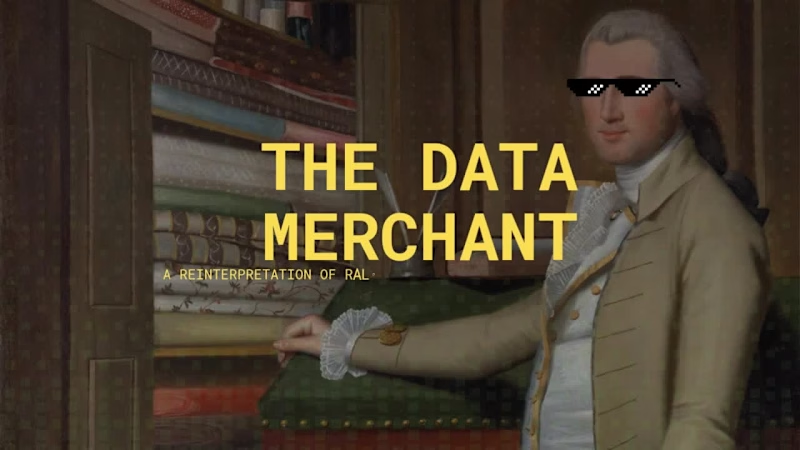
The Data Merchant What if the most valuable commodity of our time replaced the most valuable commodity of theirs? Inspired by Ralph Earl’s portrait of Elijah Boardman, an 18th-century American textile merchant, I reimagined him as a contemporary Data Merchant. The fabrics surrounding Boardman become server racks. His textile shop becomes a data center. The merchant remains — only the commodity has changed. Built and explored in FLORA. Original artwork: The Metropolitan Museum of Art — Elijah Boardman (https://www.metmuseum.org/it/art/collection/search/10830?utm_source=chatgpt.com) #FLORAMuseum
3
27
1.3K
74
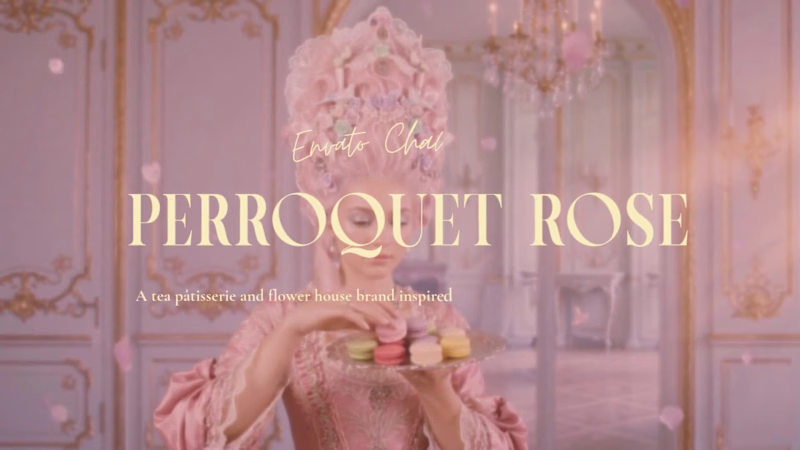
Human by Design — Tea Pâtisserie & Flower House 🥐🌸 For the Envato Challenge, I created a romantic French pâtisserie and flower house brand inspired by the dreamy, pastel world of Sofia Coppola’s Marie Antoinette. Using Envato as my creative toolkit, I developed the full brand experience: logo direction, typography, visual identity, mockups, graphic elements, floral assets, textures, stock imagery, video elements and music. I also used Envato AI to explore and generate the initial visual concepts. Human by Design moment: AI helped me generate possibilities, but the first outputs felt too perfect and lacked warmth. I made the creative decision to refine them by layering textures, adjusting compositions, selecting the right details and introducing imperfections to create a more tactile, handcrafted feeling. The final result is not just AI-generated imagery — it is a brand shaped through human taste, intuition and design choices. AI helped me generate possibilities. Human judgment turned them into a brand. Created with Envato Elements + AI Envato Elements used: Fonts | Graphics | Floral Assets | Textures | Mockups | Photos | Video Templates | Stock Video | Music #envatochallenge #HumanByDesign #Envato
26
74
4.6K
Communication Designer
(2)
Follow
Message
Explore people