
Darshit Vaghela
Strategic branding, creative direction, and marketing.
New to Contra
Darshit is ready for their next project!


Everyone wants more leads.
Almost nobody asks why they aren't trusted.
A few days ago, I visited a company's website after seeing one of their ads.
The ad was good but the website wasn't.
Then I opened their Instagram.
Different logo.
Different colors.
Different messaging.
No customer proof.
No clear positioning.
And then they asked the question I hear almost every week:
"Why aren't our ads converting?"
Here's the uncomfortable truth.
Customers don't buy because you ran an ad.
They buy because every touchpoint quietly tells them,
"You can trust us."
Think about how you choose a restaurant you've never visited.
You don't just look at the food.
You notice:
The photos.
The reviews.
The branding.
The cleanliness.
The consistency.
Within seconds, your brain has already made a decision.
Businesses work the same way.
Every logo.
Every headline.
Every Instagram post.
Every landing page.
Every reply to a customer.
Every design choice.
They're all answering one silent question:
"Should I trust you?"
Most businesses believe marketing is about getting attention.
I think marketing is about removing doubt.
That's why two companies can spend the same amount on advertising and...?
And get completely different results.
One buys clicks.
The other earns confidence.
The difference isn't always the budget.
It's the perception behind the brand.
Here's a simple exercise.
Open your own website or Instagram as if you've never seen it before.
Ask yourself:
Would I trust this business in the first 10 seconds?
Is it obvious what problem we solve?
Does every touchpoint feel like it belongs to the same brand?
Would I confidently recommend this business to a friend?
If you hesitate on any answer...
Your next investment shouldn't be a bigger ad budget.
It should be building a brand people believe in.
Because customers don't convert the moment they discover you.
They convert the moment they stop doubting you.
What's the first thing you notice when you visit a company's website or LinkedIn profile?
#CustomerTrust #Branding #Marketing #BusinessStrategy #DigitalMarketing #Entrepreneurship
2
93

Guru Purnima is celebrated since Dvapar Yug but not find any conceptual post where Guru Purnima showcase both yug in one frame!
Comment your thoughts
#gurupurnima (https://www.instagram.com/explore/tags/gurupurnima/) #education (https://www.instagram.com/explore/tags/education/) #creativedesign (https://www.instagram.com/explore/tags/creativedesign/) #design (https://www.instagram.com/explore/tags/design/)
2
131

Your business doesn't have a marketing problem.
It has a perception problem.
Every week I see founders saying...
"We need more Meta Ads."
"We need more leads."
"We need more content."
But after auditing their business, the problem is almost never the ads.
It's what people think before clicking them because customers don't buy the first time they see your product.
They buy the moment they trust your brand.
And trust isn't built by spending more.
It's built by reducing uncertainty.
Let me give you an example.
Imagine two cafés.
Both sell coffee for ₹250.
The first one has random branding.
Different fonts.
Different colors.
An outdated logo.
Average photos.
No consistent identity.
The second café has the same coffee.
The same price.
But everything feels intentional.
The menu.
The interiors.
The packaging.
The Instagram feed.
The staff uniforms.
Even the takeaway cup.
Nothing changed about the coffee.
Everything changed about the perception.
That's branding.
People often ask me:
What's the ROI of branding?
I think that's the wrong question. A better question is...
What's the cost of looking forgettable?
Because every day your brand is competing with hundreds of businesses asking for the same customer's attention.
Most won't be remembered.
Not because they have a bad product because they never gave people a reason to remember them.
This is why I believe marketing amplifies.
Branding convinces.
Marketing gets attention.
Branding keeps it.
Marketing earns clicks.
Branding earns trust.
And trust is what turns one purchase into a loyal customer.
Before increasing your advertising budget, ask yourself:
Would I remember my own brand after seeing it once?
Does every touchpoint tell the same story?
Am I building recognition or just creating content?
The businesses that win over the next decade won't necessarily spend the most on advertising.
They'll spend the most time becoming unforgettable.
What do you think matters more today—getting attention or becoming memorable?
#BrandStrategy #Branding #MarketingStrategy #BusinessGrowth #PersonalBranding
0
28
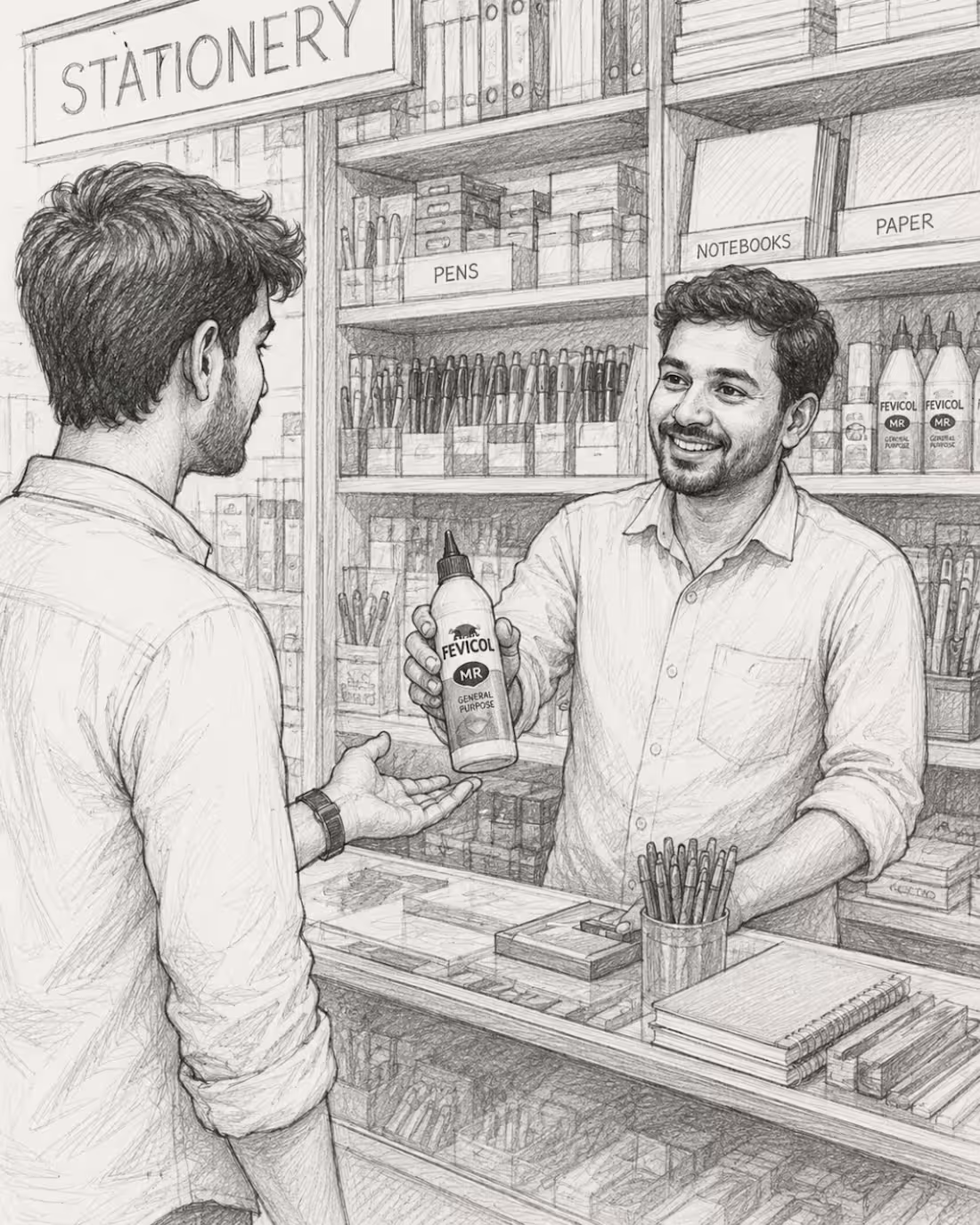
The Day I Walked Into a Shop to Buy Glue…
Some realizations don’t arrive with a big moment, and they don’t come with a sudden spark or a dramatic shift. They slip in quietly, almost unnoticed, and only later do you realize how much they’ve changed the way you see things.
Mine happened inside a small stationery shop.
I wasn’t thinking about branding or marketing that day, and I wasn’t analyzing anything. I just needed a bottle of glue for a small task at home, and it felt like an ordinary errand you don’t expect to remember later.
But something about that moment stayed with me.
A customer walked in before me and said to the shopkeeper,
“Bhaiya, glue dena.”
He didn’t mention any brand or specify anything, he simply asked for glue. The shopkeeper didn’t ask a single question either, and without hesitation, he picked up a bottle and handed it over.
It was Fevicol.
The customer took it without hesitation, showing no confusion, comparison, or second thought. He paid and left, as if the choice had already been made long before he entered the shop.
A few seconds later, it was my turn.
I said the same thing.
“Bhaiya, glue dena.”
And again, without asking anything, the shopkeeper handed me the same bottle. It was Fevicol, and I didn’t question it or ask for alternatives, I simply accepted it.
That’s when something felt strange.
Not because of what happened, but because of what didn’t happen. No one asked for a brand, no one questioned the choice, and yet everyone walked away with the same one.
As I walked back, one question kept repeating in my mind —
How does one brand become the default answer to a generic request?
At first, the answer felt obvious.
Advertising.
Fevicol has created some of the most memorable ads in India, and they are funny, simple, and relatable in a way people remember for years. So it seemed logical that strong advertising might be the reason behind this behavior.
But then I thought about it more carefully.
There are many brands that advertise well and create memorable campaigns, yet very few become the automatic choice when no one even asks for them. That made me realize that something deeper must be at play.
So what makes the difference?
That’s when I stopped looking at the ads themselves and started looking at what stays consistent behind them. Across decades, Fevicol has told hundreds of different stories with different characters, settings, and humor, yet something beneath all that variation never changes.
The idea. The belief. An unbreakable bond.
Every story reinforces it in a subtle and consistent way, without being loud or forceful. They don’t repeat the same ad, but they repeat the same meaning until it becomes familiar and trusted.
Over time, that meaning becomes automatic.
So automatic that when someone asks for glue, no one even thinks of alternatives. Neither the shopkeeper nor the customer questions the choice, because the decision has already been shaped in their minds.
That realization changed how I started looking at brands.
When I began observing others, I noticed something very different. Many brands keep changing what they stand for, shifting from quality to discounts, then to customer service and innovation, making each campaign feel new but disconnected.
And when everything keeps changing, nothing stays long enough to be remembered.
That’s when I understood something simple.
People don’t remember what’s new, they remember what feels familiar and consistent. They trust what they’ve heard enough times and what shows up again and again, even when everything else changes.
Since that day, I don’t just watch advertisements.
I watch for patterns and look for the belief behind the story, because maybe brands aren’t built by saying different things every time. Maybe they’re built by saying the same thing in different ways.
And maybe that’s why, even today, when someone walks into a shop and asks for glue and they walk out with Fevicol without even realizing why!
2
84