Contra - A professional network for the jobs and skills of the futureThe Discount That Felt Right and Cost $2.3 Million: Why Revenue Management Can't Afford "Gut Feel...
The network for creativity
Join 1.25M professional creatives like you
Connect with clients, get discovered, and run your business 100% commission-free
Creatives on Contra have earned over $150M and we are just getting started
The Discount That Felt Right and Cost $2.3 Million: Why Revenue Management Can't Afford "Gut Feel"
A counterpoint: in commercial finance, intuition isn't a partner to your data — it's a liability you have to manage

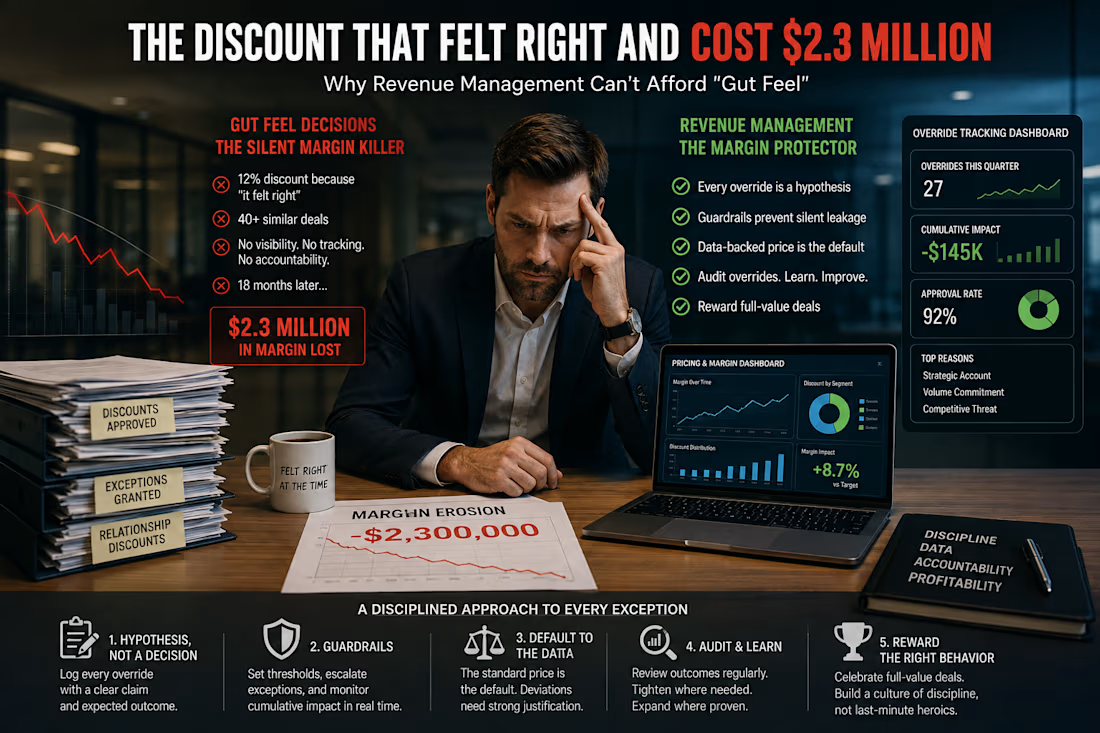
A regional sales VP once pushed through a 12% discount on a strategic account renewal because, in his words, "it felt like the right call to keep the relationship strong." The account stayed. Nobody flagged it as a problem — until finance ran the portfolio analysis eighteen months later and found that "relationship discounts" like his, replicated across forty-odd deals by well-meaning account teams making similarly reasonable-sounding judgment calls, had quietly erased $2.3 million in margin. No single decision looked reckless. The aggregate was a wound the P&L couldn't explain until someone finally added it up.
This is the part of the "balance data and intuition" conversation that sounds wise in a boardroom and falls apart on a pricing desk: in commercial finance and revenue management, gut calls don't fail loudly. They fail quietly, one reasonable-sounding exception at a time, until the erosion shows up as a margin number nobody can trace back to a decision.
Strategic bets — acquisitions, market entries, capex — are lumpy and visible. When intuition steers one wrong, everyone sees the crater. Pricing and revenue decisions are the opposite: high-frequency, low-visibility, and compounding. That asymmetry is exactly why revenue management as a discipline exists, and why it treats intuition fundamentally differently than corporate strategy does. Not as an equal partner to data. As an input that has to earn its way into a decision, every time.
Here's what that looks like in practice.
1. Every override is a hypothesis, not a decision right
In most commercial organizations, a senior enough person can override a price, waive a fee, or approve an exception, and that's treated as the end of the conversation. Revenue management inverts this: an override isn't a decision, it's a hypothesis that the standard price is wrong for this specific case — and hypotheses get tested, not rubber-stamped.
That means every override is logged with an explicit, falsifiable claim ("this discount will secure a 3-year commitment we wouldn't get otherwise") and a date by which that claim gets checked against what actually happened. Authority to grant an exception should never be authority to skip the accounting for it.
2. Build guardrails the gut can't quietly slip past
The $2.3 million problem above wasn't one bad decision — it was forty individually defensible decisions with no aggregate visibility. The fix isn't better judgment from the sales VP. It's a system that makes the aggregate visible in real time, before it becomes a retrospective surprise.
Concretely: floor pricing by segment, automatic escalation above a defined discount threshold, and a live dashboard showing cumulative margin leakage from exceptions — refreshed weekly, not discovered annually. Guardrails don't exist because commercial teams can't be trusted. They exist because no individual, however experienced, can see the portfolio-level pattern from inside a single deal.
3. Make the standard price the hard case to argue against — not the exception
Too many commercial finance functions build a rigorous, defensible list price and then let it get discounted away by informal negotiation muscle memory. The fix is to flip the burden of proof: the data-backed price is the default that requires no justification, and it's the deviation that has to make its case, in writing, before it's approved — not after.
This sounds bureaucratic. It isn't, if it's fast. A one-line justification and an expected outcome, submitted at the point of the ask, adds thirty seconds to a deal desk request and removes months of after-the-fact archaeology when someone finally asks why realized margin doesn't match the model.
4. Audit overrides for their track record — and act on what you find
The same override log that catches the bad calls will also, eventually, surface an account manager whose "gut" is genuinely well-calibrated — someone whose exceptions consistently outperform the model's prediction. That person's judgment is real and valuable. But the only way to know the difference between calibrated instinct and confident guessing is to check the record, not the confidence.
Quarterly, not annually: pull every override, compare predicted outcome to actual outcome, and separate the individuals and deal types where discretion is earning its keep from the ones where it's quietly become a synonym for margin leakage. Then change the guardrails accordingly — tighter where the pattern is bad, more latitude where it's proven good.
5. Reward the save that didn't need to happen
Sales organizations love a hero story: the rep who "saved the deal" with a last-minute concession. Revenue management has to build a culture that rewards the opposite — the deal that closed at full value because the pricing, packaging, and terms were right from the start, and nobody had to feel clever in the eleventh hour to get there.
That's a harder story to tell in a town hall. It's also the only version of commercial performance that scales, because it doesn't depend on every deal having the right person with the right instinct in the room at the right moment.
The asymmetry is the point
None of this means intuition has no place in commercial finance — an experienced account lead really can sense a renewal risk the churn model missed. But strategy and pricing are not the same kind of decision, and treating them with the same "balance data and gut" framework undersells how differently they fail. A bad strategic call is a single, visible, correctable event. A bad pricing instinct, repeated at deal velocity across a portfolio, is a slow leak that only a rigorous, unglamorous discipline of tracking, guardrails, and after-the-fact accountability will ever catch in time to matter.
Post image
Mason's avatar
That's exactly the pattern — no single deal looks like a problem, but the aggregate always tells a different story than any individual approver could see. Thanks for sharing it. It's a good reminder that the "$2.3M" example in the article isn't an edge case, it's what happens by...
Benjamin's avatar
Totally hear that concern, and it's the right one to raise. The intent isn't to add friction to every deal — it's to make the fast path the standard price, and reserve the friction for deviations from it. In practice, a well-built exception flow adds seconds, not days. If...
Caleb's avatar
Totally hear that concern, and it's the right one to raise. The intent isn't to add friction to every deal — it's to make the fast path the standard price, and reserve the friction for deviations from it. In practice, a well-built exception flow adds seconds, not days. If...
James's avatar
Appreciate you sharing that — it's a useful failure mode to flag. Guardrails that are too rigid tend to just push discretion underground into workarounds, which is arguably worse than no guardrail at all. The fix is usually recalibrating thresholds based on the override audit...
Jacob's avatar
Really appreciate you engaging with this — coming from someone with your background in commercial finance, that carries real weight. Happy to compare notes on how this has played out at scale if you're open to it.
Caleb's avatar
That's exactly the pattern — no single deal looks like a problem, but the aggregate always tells a different story than any individual approver could see. Thanks for sharing it. It's a good reminder that the "$2.3M" example in the article isn't an edge case, it's what happens by...
Back to feed
The network for creativity
Join 1.25M professional creatives like you
Connect with clients, get discovered, and run your business 100% commission-free
Creatives on Contra have earned over $150M and we are just getting started