The network for creativity
Join 1.25M professional creatives like you
Connect with clients, get discovered, and run your business 100% commission-free
Creatives on Contra have earned over $150M and we are just getting started
Back to feedPost

The best SEO company in NYC won’t save a landing page that AI can’t understand.
That’s the shift most businesses are missing.
A landing page can look beautiful, rank on Google, and still be practically invisible to AI search.
Here’s the proof:
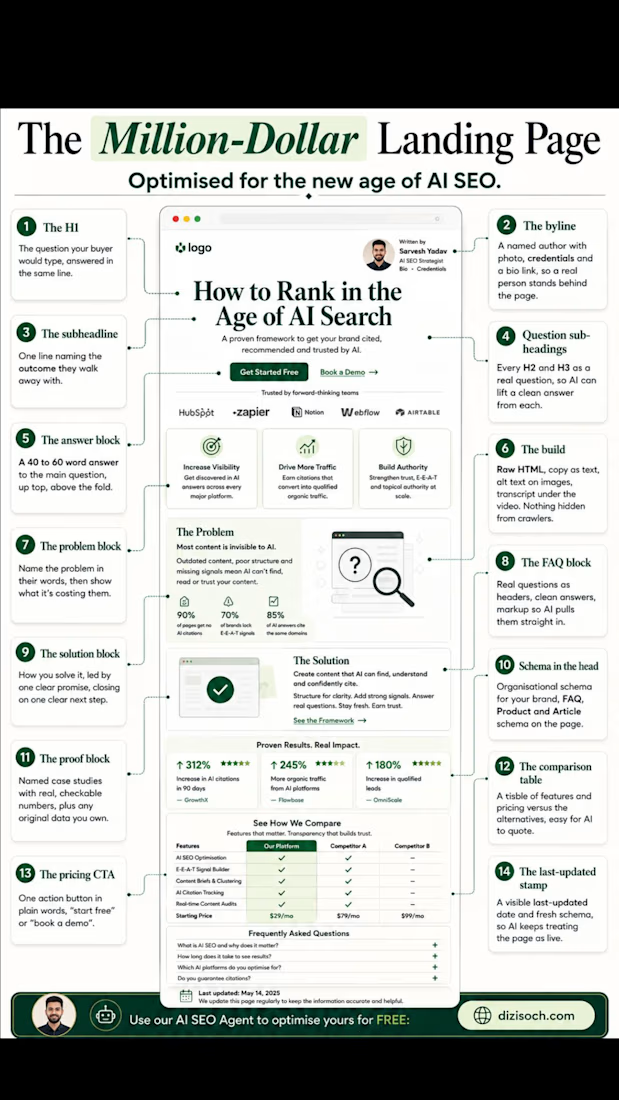
90% of pages get no AI citations.
70% of brands lack strong E-E-A-T signals.
And 85% of AI answers cite the same domains.
The lesson?
AI doesn’t just ask, “Is this page optimized?”
It asks:
Can I understand it?
Can I trust it?
Can I extract an answer from it?
Imagine two landing pages.
One is packed with keywords, vague claims, stock images, and hidden information.
The other has a clear H1, a named expert, answer-first content, question-based subheadings, structured data, FAQs, proof, comparisons, fresh information, and one obvious CTA.
Which one do you think AI is more likely to understand, trust, and cite?
That’s why the old landing page playbook is becoming outdated.
Modern AI SEO requires more than keywords and backlinks.
Your landing page should be built with:
→ A clear H1 answering the buyer’s question.
→ A strong byline showing real expertise.
→ Direct answers near the top.
→ Question-based H2s and H3s.
→ Clean, crawlable HTML.
→ FAQ and relevant schema.
→ Real proof and case studies.
→ Comparison content.
→ Freshness signals.
→ One clear next step.
The goal isn’t simply to rank a landing page.
The goal is to create a page that Google can rank, AI can understand, and customers can trust.
That’s the approach a best digital marketing company in NYC should be thinking about in 2026.
Your landing page doesn’t need more content.
It needs to become more understandable, extractable, and credible.
Want to know whether your landing page is ready for AI search?
Audit it against these 14 elements before your competitors do.
dizisochaiseoservicesseotipsContent StrategySearch Engine OptimizationFacebook AdsGoogle AnalyticsGoogle Search ConsoleSEO Content Managment


The network for creativity
Join 1.25M professional creatives like you
Connect with clients, get discovered, and run your business 100% commission-free
Creatives on Contra have earned over $150M and we are just getting started








Related posts

Modern Landing Page Design & Web Development


This is very nice 👌


AI builds a landing page in 10 minutes now. Nobody's stuck on that part anymore
They're stuck on the first line. What you do and who it's for
Most AI startup sites I open still can't say it


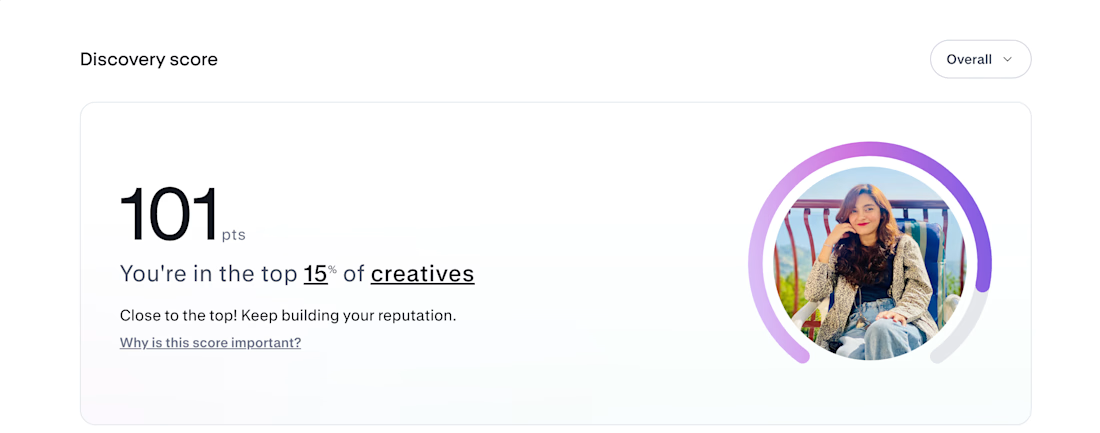
Hey @Contra HQ , my Discovery Score just hit 101, and I want to share something with anyone starting from scratch. 🚀
I didn't get here overnight. I started with zero, not knowing when things would finally work out.
But I kept showing up. Kept putting myself out there. Kept believing that something would eventually click.
I stopped waiting for the perfect moment. Stopped doubting every step. And started trusting the process.
Show up.
Share your work.
Keep building.
Keep going.
I'm still far from where I want to be. But seeing my progress today reminds me why I never gave up.
You don't need to know when it'll happen. You just need to keep going until it does.
Sometimes, everything starts changing right after you decide not to quit. ❤️