The network for creativity
Join 1.25M professional creatives like you
Connect with clients, get discovered, and run your business 100% commission-free
Creatives on Contra have earned over $150M and we are just getting started
Back to feedPost

Case insight: The hidden cost of shared-component bundles
One pattern I keep finding when auditing inventory systems for 7- and 8-figure Shopify brands: bundle SKUs that look perfectly healthy while quietly running out underneath.
The mechanism: A bundle sells, and the dashboard shows the bundle SKU dropping by one unit. What it doesn't show, three component SKUs dropping at different rates, because that same component sits inside several other bundle configurations at once. Most platforms decrement the bundle SKU on sale and leave components untouched until a manual reconciliation catches up, sometimes monthly, sometimes never.
The result: every bundle drawing on that component still reads "in stock," right up until someone tries to fulfill an order the warehouse can't actually complete. It doesn't surface as a stockout, it surfaces as a failed fulfillment, caught by a picker instead of a system.
Why it matters: brands running a dozen bundle configurations off a shared pool of ~20 base components are structurally exposed to this. Every bundle looks fine in isolation. Nothing in a standard setup tracks the combined draw across all configurations at once.
Estimated cost: for a brand in the $1M–$50M range, a single shared-component stockout can run $10,000–$20,000 in lost revenue and wasted ad spend before it's caught, while every affected bundle still shows as available.
The fix I build for clients: rather than treating each bundle as an independent SKU, every configuration gets a live claim against the same shared inventory pool, so a sale in one bundle instantly reflects reduced availability across every other bundle using that component. This is a data and logic layer decision, most platforms already support it, they're just not configured to use it.
This is one of several structural gaps I look for when auditing inventory logic for DTC brands running multiple bundle configurations. If this is happening in your store right now, you likely won't know until an order fails.
The network for creativity
Join 1.25M professional creatives like you
Connect with clients, get discovered, and run your business 100% commission-free
Creatives on Contra have earned over $150M and we are just getting started
Trending

Claude
Claude has entered the design space. How are you using it?

Contra University
Learn from expert creatives how to earn more using next-gen AI tools.
Brand Design
The best brand designers are on Contra. Scroll to see what's trending in brand design. What are you building?
creativeaiflow
Creative AI workflows are evolving. What tools do you use, and what are their strengths and weaknesses?
freelancerlife
Freelancer life is wins, pivots, and everything in between. What’s yours right now?



Related posts

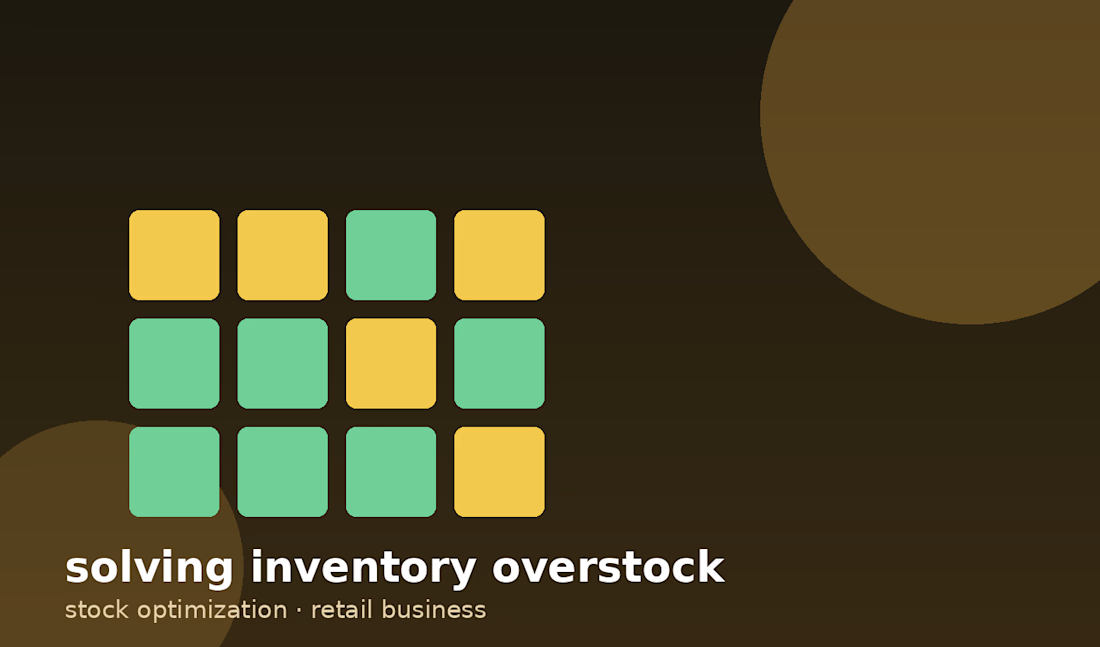
Solving Inventory Overstock for a Retail Business
Problem: A small retail business was tying up cash in slow-moving inventory while frequently running out of its best-selling items — hurting both cash flow and customer satisfaction.
Approach:
Ran an ABC analysis to separate high-demand products (20% of SKUs driving 80% of sales) from slow movers
Recommended a reorder-point system for fast sellers to prevent stockouts
Proposed a clearance/bundle strategy to liquidate slow-moving stock and free up cash
Set a simple monthly inventory review process to keep it from recurring
Result: Projected 15–20% reduction in tied-up inventory cash and fewer missed sales from stockouts, improving overall cash position.


Just launched or updated a Shopify store?
I’m offering a small independent mobile QA pass for founders and agencies: I test one public product-to-checkout flow and return a fix-first report within 24 hours.
Included: up to 5 confirmed issues, screenshots, exact reproduction steps, expected vs actual behaviour, and severity. I stop before payment or order submission — no admin access needed.
It’s a fixed A$25 pilot, designed as a second set of eyes after a build, migration or update.
If you have a public store that needs a focused check, send the URL and the product you want tested.
contra.com
Mobile Store QA: Top 5 Product-to-Checkout Issues by Nathan Blanch
Read more about Mobile Store QA: Top 5 Product-to-Checkout Issues by Nathan Blanch on Contra.

Most subscription brands are losing money daily in places they've never even looked, and it's rarely the offer.
A few things I see all the time:
If subscribing is just a checkbox instead of the default, most people won't bother.
Make "Subscribe" the default and let people opt into a one time purchase instead, that change alone can lift your subscription rate.
A lot of brands blame cancellations on the product, when it's usually the onboarding.
People cancel because they never built the habit.
If your first emails aren't getting customers to use the product consistently, you're setting yourself up for churn.
Billing reminders are another missed opportunity.
Instead of a cold "you're about to be charged" email, send something like, "Your order ships in 3 days. Need to delay it?"
One click is a lot better than sending people straight to the cancellation page.
And stop judging everything by Order 2 retention. Order 3 is the milestone that usually tells you whether someone is sticking around long term.
None of this is groundbreaking tho..
It's just the small things that quietly add up while everyone's focused on launching the next product.

