The network for creativity
Join 1.25M professional creatives like you
Connect with clients, get discovered, and run your business 100% commission-free
Creatives on Contra have earned over $150M and we are just getting started
Back to feedPost
UX Writing vs. Copywriting: What's the Difference?
A landing page and a checkout screen shouldn't communicate in the same way.
And I think that's a great way to understand the difference between UX writing and copywriting.
Both rely on clear, intentional language, but they serve different purposes.
Copywriting is generally focused on attracting attention, communicating value, and persuading people to take action. You'll find it in advertisements, landing pages, product descriptions, and promotional emails.
UX writing, on the other hand, focuses on the words people encounter while interacting with a product or service. Its job is to guide users, explain what happens next, and make digital experiences easier to navigate.
Think about it:
A landing page might use persuasive copy to convince someone to sign up. But once that person reaches the registration or checkout screen, the language needs to be straightforward and helpful.
Buttons, error messages, confirmation messages, instructions, and form labels are all examples of UX writing.
What I'm trying to say is that you can persuade someone to start an interaction, but you shouldn't make them struggle to complete it.
Good UX writing reduces confusion and helps people move forward. Good copywriting communicates why they should want to.
And the two can absolutely overlap. A well-written button, for example, can be both persuasive and useful.
Ultimately, both depend on understanding the audience, choosing the right words, and knowing what the user needs at each stage of their journey.
What do you think matters most in digital communication: convincing people to take the first step or making every step easier afterward?


Making every step easier afterward. Getting people in doesn't help if they bail at checkout.

Absolutely! Getting someone to take the first step is only part of the journey. If the experience that follows is confusing or frustrating, even the best copy can lose its impact. I think that's where UX writing really proves its value.
The network for creativity
Join 1.25M professional creatives like you
Connect with clients, get discovered, and run your business 100% commission-free
Creatives on Contra have earned over $150M and we are just getting started
Related posts


We’re choosing the motion for an AI analytics product demo, and I can’t decide.
Both clips show the same flow. Someone asks a question in plain English. The agent checks permissions, plans the query, runs it past guardrails and builds the dashboard.
1. A walks you through each step as it happens.
2. B skips the steps and drops you straight onto the result.
A shows the work. B shows the speed. For a landing page I keep going back and forth.
Which one would make you trust the product more? Comment A or B, and tell me why.
3 voted
100%
0 voted
0%
3 votes
Closed

I think according to your query the output should consist on a list of clients with late invoices rather then showing charts etc,


What happens when one website has to talk to two different people?
A client of ours teaches two audiences at once: expecting mothers who want a calm pregnancy, and women who want to become doulas. One brand, one site, two very different reasons to visit.
The usual fix is a hero that speaks to "everyone" and lands with no one. We designed it as a fork in the road instead:
1. Two doors in the hero. "I'm pregnant" and "I'm training to be a doula", side by side, equal weight. The visitor picks a path in one click, and the headline above them stays about the shared value.
2. One voice, two tones. The mothers' path is softer: fewer words, more room, gentle photos. The doula path is more structured: modules, certification, dates. Same fonts, same colors, different rhythm.
One proof section, split in two. Testimonials from mothers on the left, from doulas on the right. Each visitor sees people like them before the price.
Writing for everyone is writing for no one. Give each reader a door.
Have you ever designed a page for two audiences at once? How did you split it?

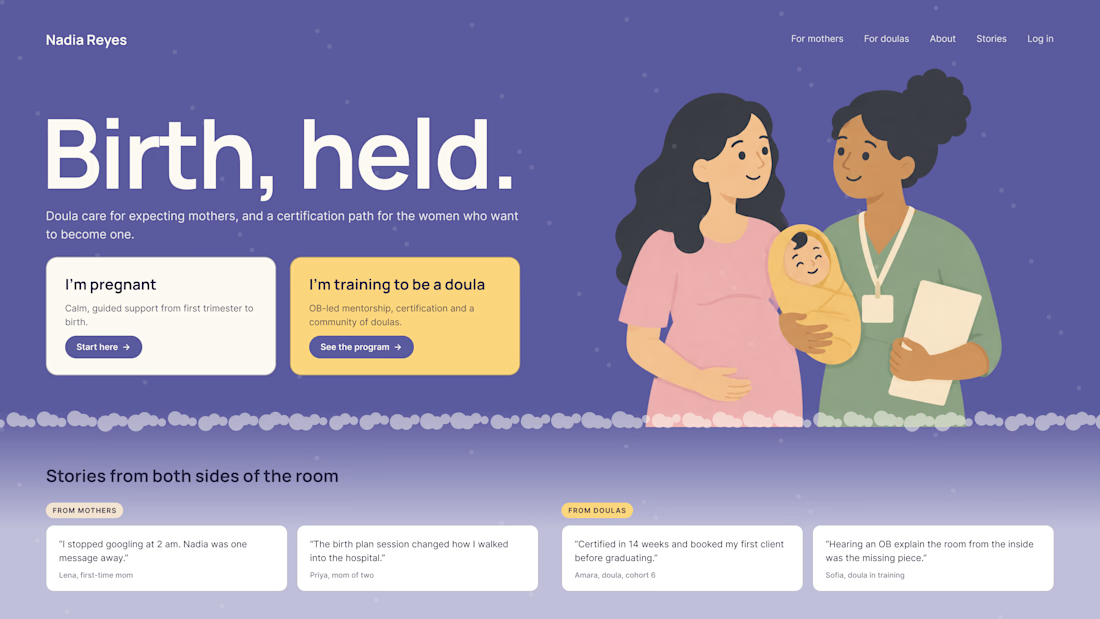

Love that purple hero with the two cards right up top.

I thought the next step would be better software.
I started working with a client in a very niche professional-products sector, first as a technical writer. My background with Chinese documents, test reports, photos and files that need basic electrical knowledge was what they needed.
Then they asked me to build their spec sheets. I expected specialized software, or at least Figma or Adobe. Instead, all their spec sheets are built in PowerPoint.
Two things changed my mind:
PowerPoint is often seen as a low-value tool. It isn't, if you know how to approach it.
The tool matters, but what matters most is knowing your field: what a spec sheet has to say, to whom, and in what order.
Have you ever had to do serious design work in a tool you didn't expect to use?