The network for creativity
Join 1.25M professional creatives like you
Connect with clients, get discovered, and run your business 100% commission-free
Creatives on Contra have earned over $150M and we are just getting started
Back to feedPost

Why We Use 4-20mA Signal in Instrumentation?
In process control and instrumentation, digital protocols are everywhere, but the humble 4-20mA current loop remains the absolute backbone of analog signal transmission.
Ever wondered why this standard has stood the test of time across plants worldwide? Here is a quick breakdown:
Signal Integrity over Long Distances: Unlike voltage signals (which suffer from voltage drops over long cable runs due to wire resistance), current loops transmit data reliably across hundreds or even thousands of meters.
Built-In Fault Detection (Live Zero): Because 0mA represents an actual broken wire or power failure, using 4mA as the baseline (0% process variable) allows control systems to instantly detect open-circuit faults.
Immunity to Electrical Noise: Current signals are far less susceptible to electromagnetic interference (EMI) commonly found in heavy industrial environments compared to low-level voltage signals.
Simple Two-Wire Power & Communication: A single twisted pair can simultaneously power the field transmitter and transmit the process variable (4mA = 0%, 20mA = 100%).
Whether you're troubleshooting a control loop or calibrating a smart transmitter, mastering 4-20mA fundamentals is essential for every instrumentation professional.
What is your go-to method for checking loop calibration in the field? Let’s discuss in the comments!
hashtag#Instrumentation hashtag#ProcessAutomation hashtag#IndustrialAutomation hashtag#420mA hashtag#ControlSystems hashtag#ElectricalEngineering hashtag#EngineeringLife hashtag#ProcessControl hashtag#PlantMaintenance hashtag#FieldInstruments


The network for creativity
Join 1.25M professional creatives like you
Connect with clients, get discovered, and run your business 100% commission-free
Creatives on Contra have earned over $150M and we are just getting started











Related posts

SaaS Video Editing Project Completed for Lexi 🚀
Another successful SaaS project delivered! I had the opportunity to work with Lexi to bring their software product to life through clean, engaging, and professional video editing.
As a video editor, I focus on helping SaaS companies and software brands turn complex ideas into clear, engaging visual stories that connect with their target audience. From smooth transitions and polished visuals to thoughtful pacing and a professional finish, every detail matters when creating videos that showcase a product and its value.
I help SaaS startups, tech companies, and growing businesses create product demos, explainer videos, software walkthroughs, promotional videos, and marketing content that support their brand and business goals.
Looking for a reliable video editor for your next SaaS or software project? I would love to help bring your vision to life.
Services: SaaS Video Editing, Software Demo Videos, Product Explainer Videos, Tech Video Editing, Promotional Videos, and Marketing Content.
Let’s create something great together!
#SaaS #SaaSVideoEditing #VideoEditing #SoftwareMarketing #ProductDemo #TechVideo #Contra


The Clarify, Mobilize, Align framing gives this deck a clear narrative spine, Deep. Practical thinking, measurable progress is a message that will land in any boardroom. A minimalist approach makes the authority of the content stand out.

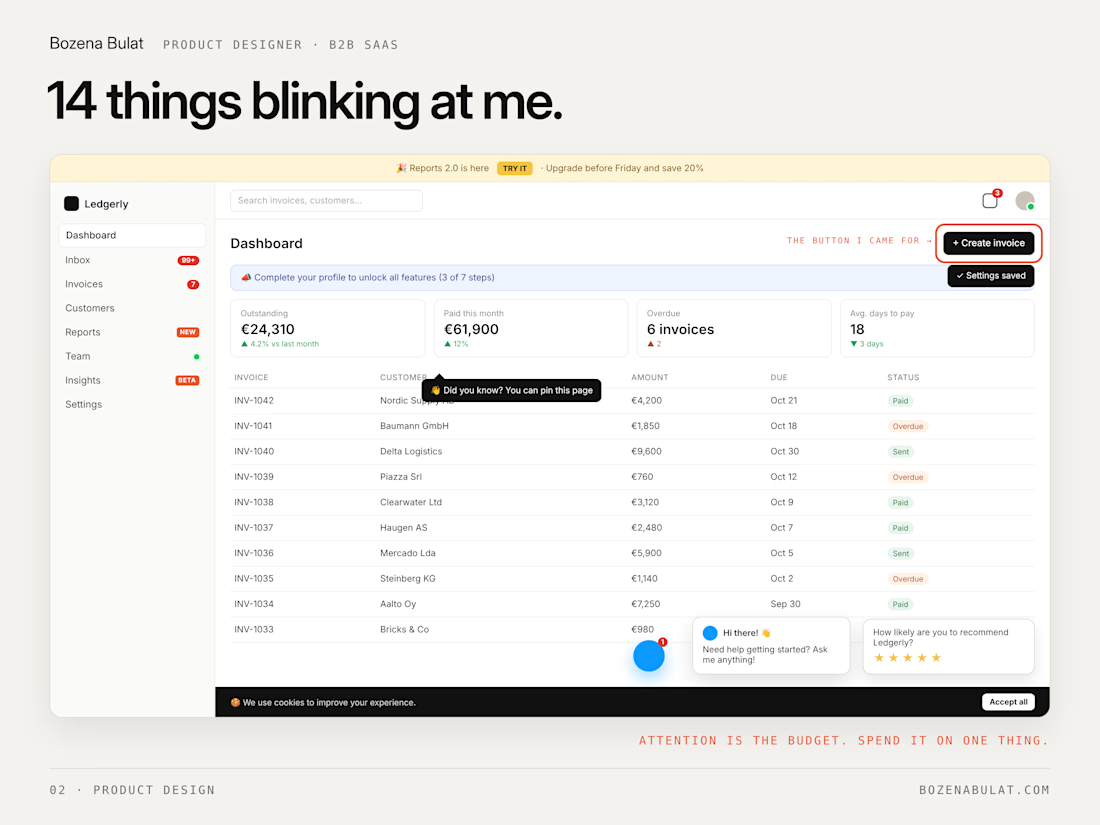
Your product has 14 things blinking at me.
A red badge. A green dot. A “New!” tag. A tooltip. A banner. A survey. A chatbot waving. And somewhere under all that, the button I came for.
Every notification was a good idea on its own. Together they’re a casino.
The quiet products win because:
→ One thing asks for attention at a time → “New” stops being new after a week → The main action is the loudest thing on the screen → Everything else waits its turn
Attention is the budget. Spend it on one thing.
This is most of what I do for B2B SaaS teams: find the one thing on each screen, and get everything else out of its way.
How many things are blinking in your product right now?