The network for creativity
Join 1.25M professional creatives like you
Connect with clients, get discovered, and run your business 100% commission-free
Creatives on Contra have earned over $150M and we are just getting started
Back to feedPost

Building AI-Powered Business Automation: A Practical Approach
AI automation is everywhere right now.
But adding AI to a business process doesn't automatically make that process better.
The real challenge is understanding where AI actually creates value and how to connect it with the systems a business already uses.
At Shipmind Labs, we approach automation by starting with the workflow rather than the technology.
1. Find the Repetitive Work
Before building anything, look for tasks that happen repeatedly.
For example:
answering common customer questions
processing incoming requests
transferring data between systems
generating reports
categorizing leads
sending notifications
processing documents
If a task follows a predictable workflow, it may be a good candidate for automation.
2. Connect Existing Systems
Most businesses already have multiple tools:
Website → CRM → Payment System → Database → Internal Tools
The automation layer connects them.
APIs allow information to move between systems without employees manually copying data from one platform to another.
A simple workflow might look like:
Customer request → AI processing → CRM update → Notification → Follow-up
3. Give AI a Specific Job
AI works best when it has a clearly defined role.
Instead of building a chatbot that "does everything," give it a specific task:
classify incoming requests
extract information from documents
answer frequently asked questions
summarize conversations
generate product descriptions
qualify leads
route requests to the right employee
The narrower the task, the easier it is to measure the result.
4. Keep Humans in the Loop
Not every decision should be fully automated.
For sensitive or complex operations, AI can prepare the information while a human makes the final decision.
This creates a practical balance:
AI handles repetitive work.
People handle important decisions.
5. Measure the Result
Automation should solve a business problem.
Useful metrics might include:
time saved
reduction in manual work
response time
number of processed requests
conversion rate
operational cost
If there is no measurable improvement, adding more AI probably won't solve the problem.
Final Thoughts
Successful AI automation isn't about adding the newest model to every business process.
It's about finding repetitive work, connecting the right systems, giving AI a specific role, and measuring the result.
At Shipmind Labs, we build custom software, AI solutions, Telegram bots, API integrations and business automation for startups and businesses.
If you have a process your team repeats every day, it may be worth asking:
“Could software do this for us?”

shipmindlabs.com
Shipmind Labs — Senior Engineering for Fintech, Crypto & Marketplaces
Senior team that ships payment systems, crypto rails, and marketplace backends to production — backend to DevOps, one accountable partner since 2018.
The network for creativity
Join 1.25M professional creatives like you
Connect with clients, get discovered, and run your business 100% commission-free
Creatives on Contra have earned over $150M and we are just getting started


Related posts

AI automation for contractors starts with one fact. Most construction companies don't need more software. They need the tools they already pay for to talk to each other.
I've spent the last few years inside JobTread, Buildertrend, GoHighLevel and QuickBooks accounts for US builders and remodelers. The same pattern shows up every time. A lead gets typed into the CRM, retyped into JobTread, then typed again into a spreadsheet for the owner.
So I'm focusing my work on construction automation.
• n8n, Zapier and Make workflows that connect JobTread to the rest of your stack
• Claude AI assistants for estimating, RFIs and paperwork
• Job costing and KPI dashboards that owners actually trust
If your construction office still runs on copy-paste, tell me which task eats the most hours. I'll reply with how I'd automate it.


Same thing with coaches. Most already pay for Kajabi or GHL and it's just not connected to anything else

A lot of products are adding AI.
But adding AI doesn't automatically make a product smarter, more useful, or more valuable.
I've seen a common mistake: businesses focus on adding an AI chatbot without thinking about what the AI should actually accomplish.
A useful AI product should do more than answer questions.
It should:
→ Understand the user's context.
→ Connect with the tools and data the business already uses.
→ Help complete real tasks, not just generate text.
→ Handle errors and unexpected situations.
→ Make the user's workflow simpler, not more complicated.
The real opportunity isn't just putting AI inside your product.
It's using AI to remove friction from the way people work.
That's where I believe the most valuable AI applications will come from.
Founders: If you could automate one repetitive task in your business today, what would it be?
#AI #SaaS #AIAgents #Automation #ProductDevelopment #Startup

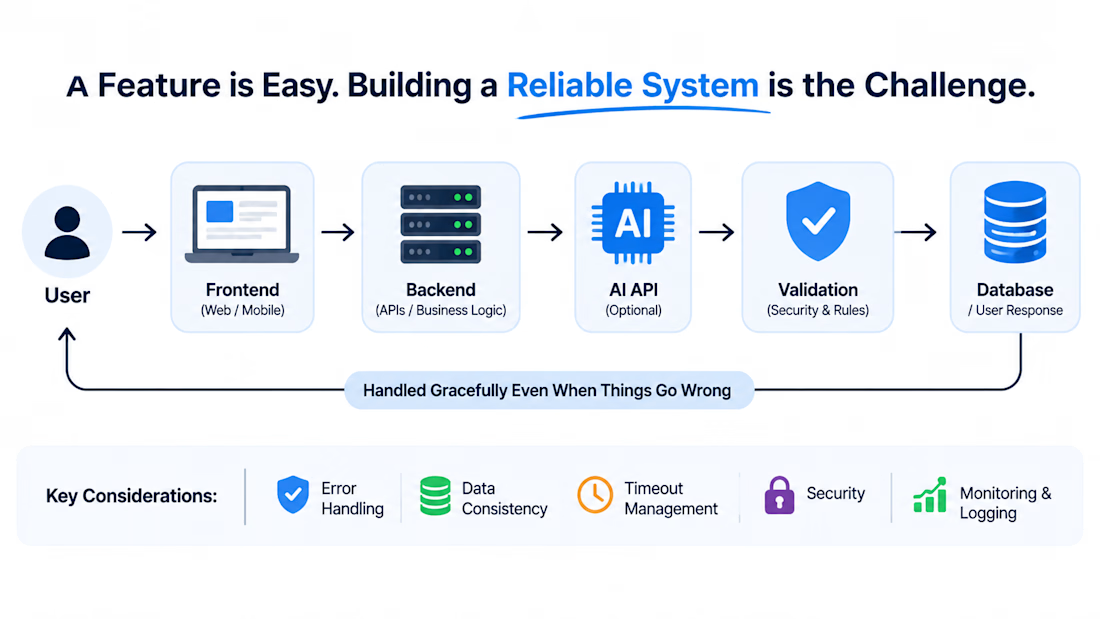
Adding AI to an application is relatively easy.
Making that AI feature reliable enough for real users is a different challenge.
When integrating AI into a web application, I think developers need to consider more than just the API call.
There are several important questions:
→ What happens when the model returns an unexpected response?
→ How do we handle timeouts and failed requests?
→ How do we protect sensitive user information?
→ Can users review or correct AI-generated results?
→ How do we monitor usage, cost and response quality?
An AI feature should fit naturally into the existing application architecture.
It needs proper backend validation, error handling, security and a clear fallback when something goes wrong.
I've worked across web applications, APIs and AI integrations, and I believe the real engineering challenge is making these pieces work together reliably.
AI should improve the product, not make the application unpredictable.


Validating model output as untrusted input is the right frame, and it catches shape and rule violations. The gap is the plausible-but-wrong answer: it passes schema and business rules and still misleads, because the rule set only knows what someone already thought to encode....