The network for creativity
Join 1.25M professional creatives like you
Connect with clients, get discovered, and run your business 100% commission-free
Creatives on Contra have earned over $150M and we are just getting started
Back to feedPost
Most RAG systems fail in production for one reason: they're still running Classic RAG.
Classic RAG works beautifully in a demo.
One document store, one similarity search, one LLM call.
Then real users show up with messy queries, ambiguous intent, and edge cases your test set never had — and retrieval quality quietly collapses.
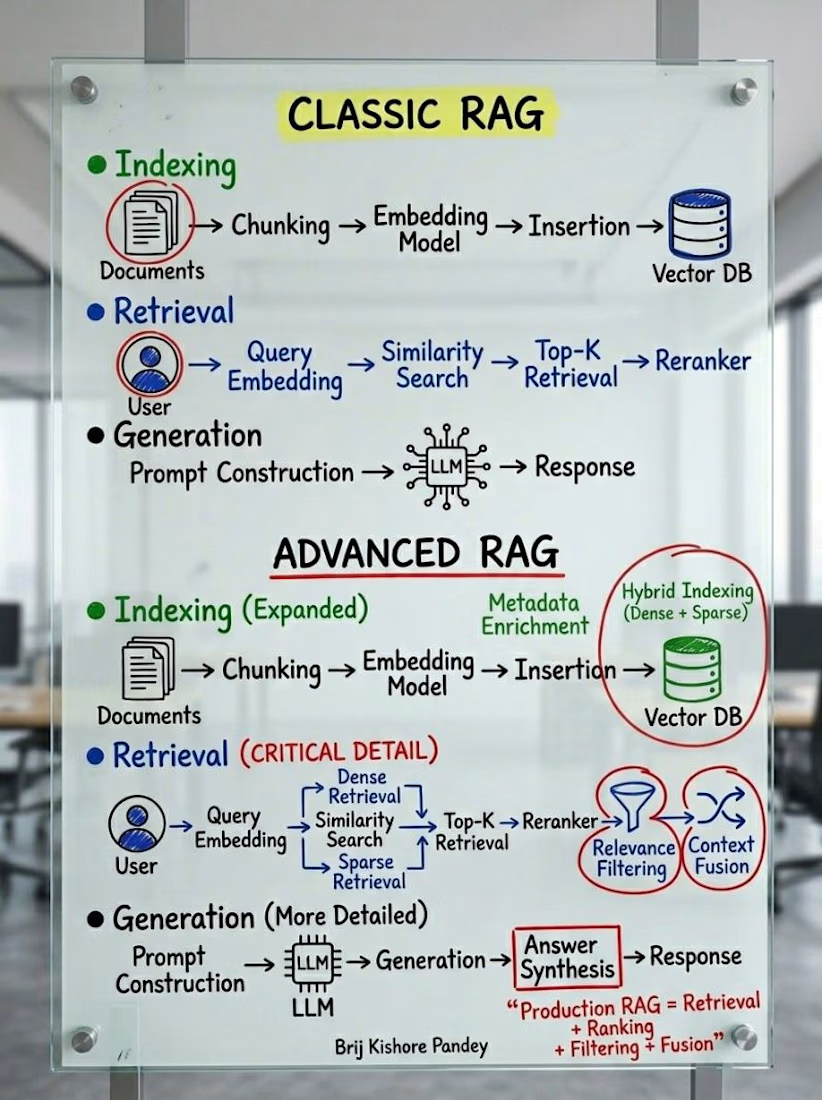
Advanced RAG isn't a bigger model. It's a better pipeline. Here's what actually changes across the three stages:
Indexing:
→ Classic: Documents → Chunking → Embedding → Insertion into a vector DB
→ Advanced: Same backbone, but with metadata enrichment and hybrid indexing (dense + sparse)
The upgrade here is that you stop treating every chunk as a naked vector. Metadata gives you filters. Sparse signals catch the exact-match cases embeddings miss.
Retrieval (this is where most of the value lives):
→ Classic: Query embedding → similarity search → top-K → reranker
→ Advanced: Query embedding fans out into dense AND sparse retrieval, converges at top-K, then passes through a reranker — followed by relevance filtering and context fusion
That last step is the one teams skip. Retrieving the right chunks isn't enough. You have to filter out the near-misses and fuse the survivors into coherent context the model can actually reason over.
Generation:
→ Classic: Prompt construction → LLM → response
→ Advanced: Prompt construction → LLM → generation → answer synthesis → response
Synthesis is the difference between "here's what I found" and "here's the answer."
The pattern is simple once you see it:
Production RAG = Retrieval + Ranking + Filtering + Fusion
Classic RAG stops at retrieval. Advanced RAG treats retrieval as the first step, not the last.
Where do you think the line actually sits — is hybrid retrieval enough to call a system "advanced," or does it only earn that label once filtering and fusion are in the pipeline?
The network for creativity
Join 1.25M professional creatives like you
Connect with clients, get discovered, and run your business 100% commission-free
Creatives on Contra have earned over $150M and we are just getting started





Related posts

If your RAG system is hallucinating, don't blame the LLM. Blame your retrieval pipeline. 🔍
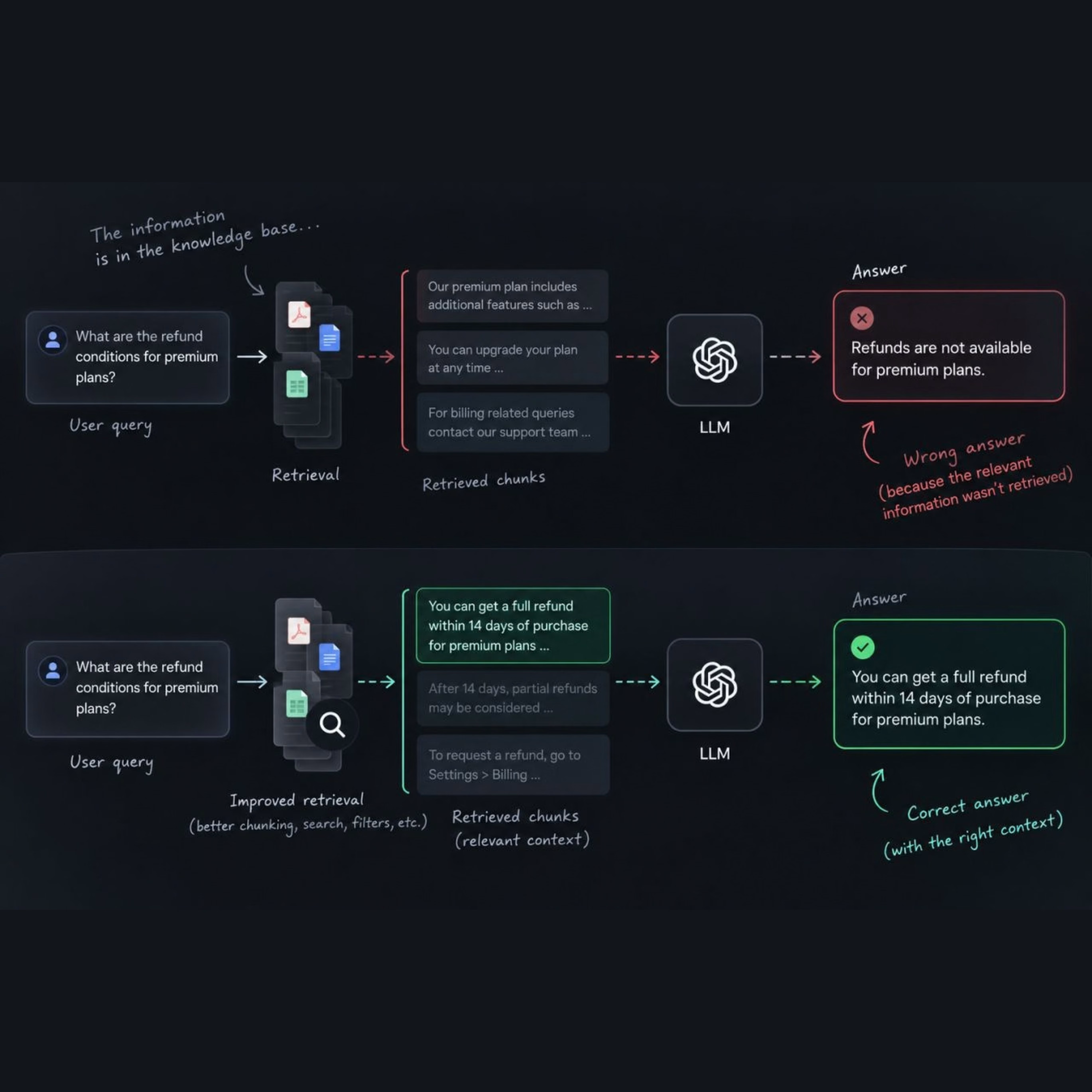
This visual perfectly captures the most common point of failure in Retrieval-Augmented Generation (RAG) applications. The frustrating part? The correct information already exists in your knowledge base, but the system still fails. Why?
❌ The Baseline Failure (Top):
When a user asks a specific question (like refund conditions), a naive retrieval system often pulls chunks that are semantically related to the keywords but lack the actual answer. The LLM is starved of the right context and forced to guess, resulting in a confident—but entirely wrong—hallucination.
✅ The Production Fix (Bottom):
The fix isn't swapping to a more expensive LLM; it's building a smarter search architecture. By implementing improved retrieval—which includes intelligent chunking strategies, metadata filtering, hybrid search, and reranking—we ensure the LLM receives the exact, highly relevant context it needs to synthesize the correct answer.
When building enterprise AI agents, like automated helpdesk routers, optimizing this retrieval step is where 80% of the engineering effort actually goes. Garbage context in, garbage generation out.
What is the number one change you've made to your RAG pipeline to improve retrieval accuracy? Let's discuss below! 👇

Completed "Building and Evaluating Advanced RAG" by DeepLearning.AI (TruEra, LlamaIndex).
The most useful part wasn't building another RAG pipeline, it was learning how to actually evaluate one. The RAG Triad (answer relevance, context relevance, groundedness) gives you a way to catch exactly where a system is failing: bad retrieval vs. the model making things up vs. just answering the wrong question.
Also went through sentence-window and auto-merging retrieval, two ways to fix the classic RAG trade-off between precise matching and having enough context to actually answer well.
Applying this directly to a RAG tool I'm building for equity research. Evaluation is the part of RAG most people skip, and it's exactly where things quietly break in production.
https://www.deeplearning.ai/accomplishments/491d7a76-f89d-4e13-9d6b-3377fced78a2?accomplishmentId=491d7a76-f89d-4e13-9d6b-3377fced78a2&usp=sharing

evaluating RAG is the part nobody talks about, the triad is super handy

A system I designed for local service businesses that consistently lose out on Google reviews. Full build in progress
Automated Review Requests for Local Service Businesses
The Problem:
Google reviews are one of the strongest signals for local search ranking, this is well established across HVAC companies, cleaning services, salons, contractors, and landscaping businesses. Every owner in this space knows reviews matter. Very few of them ask for one consistently.
The reason isn't a lack of care, it's a lack of a system. Asking every customer, right after every job, every single time, is a small task with no natural trigger behind it. It depends entirely on someone remembering in the moment, usually right when the business is busiest and least likely to remember. The result is a steady stream of satisfied customers who were never actually asked, and a review count that grows far slower than it should.
The Solution👍
I designed a system that removes the dependency on memory entirely, so a review request goes out every time, without anyone having to think about it.
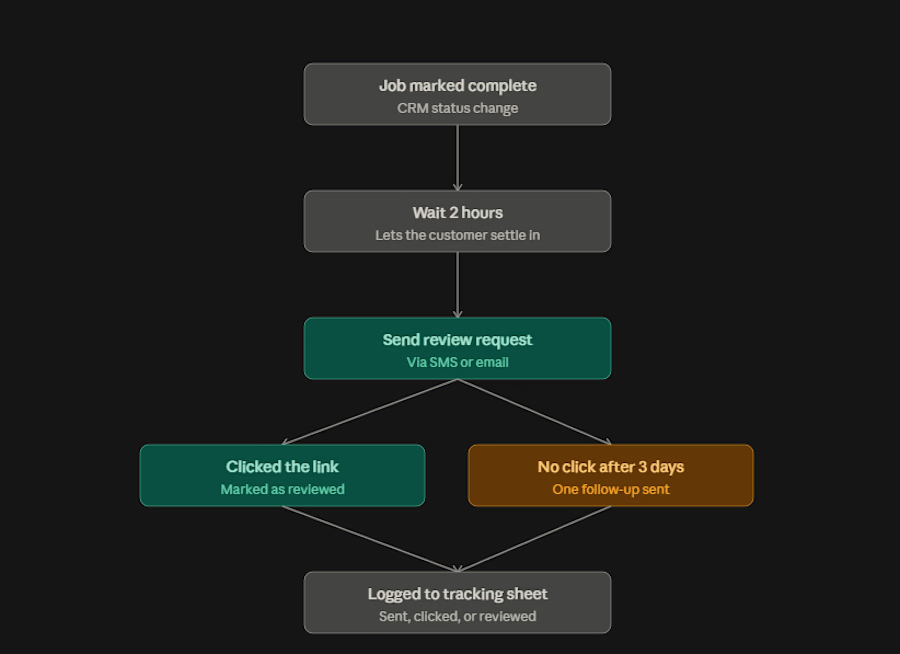
The moment a job is marked complete in the CRM, the system picks it up automatically. It waits a short period first, so the request doesn't feel rushed or robotic, the customer gets a little time to settle in before being asked. Then it sends a review request by SMS or email.
From there, the system tracks what happens next. If the customer clicks through and leaves a review, that's logged as a win and the process ends there, no further messages, no risk of annoying someone who already did what was asked. If there's no response after a few days, the system sends exactly one follow-up, never more than that, since a second or third nudge tends to do more harm than good. Whatever the outcome, sent, clicked, or reviewed, it's recorded in a tracking sheet, so the business owner always has a clear, accurate picture of where every customer stands.
The result is simple: every completed job gets a consistent, well-timed ask, with no manual list to maintain and no customer slipping through the cracks.
What's Next
The full workflow build, including the architecture and the tools behind it, is going up in the next few days.



That email trigger right after a job finishes should cut out the manual reminder step and keep reviews coming in.