The network for creativity
Join 1.25M professional creatives like you
Connect with clients, get discovered, and run your business 100% commission-free
Creatives on Contra have earned over $150M and we are just getting started
Back to feedPost

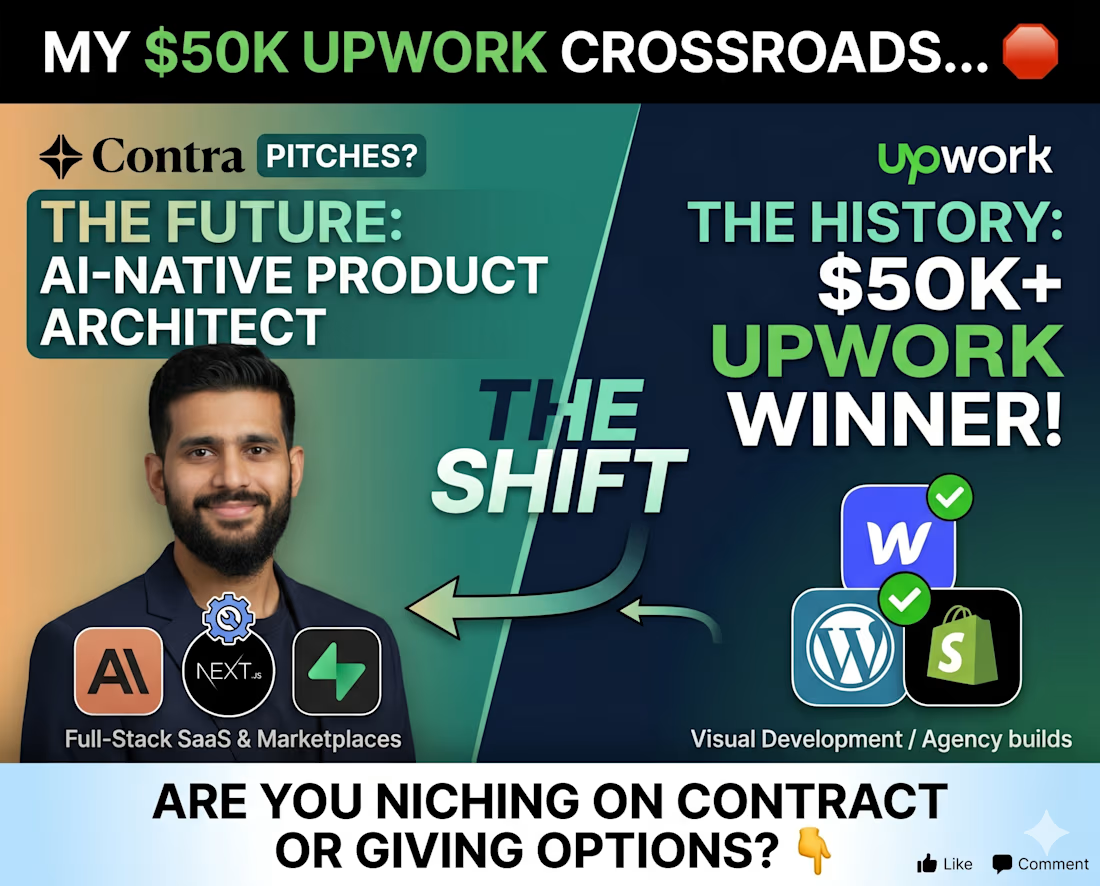
I’ve crossed $50,000+ earned on Upwork. But on Contra, I’m facing a major crossroads.
I used to rely heavily on premium Webflow development and white-label agency builds to hit my numbers. It was a proven system that worked.
But with the recent AI boom, everything is shifting.
Lately, my days are spent building complex, AI-native marketplaces, custom SaaS MVPs, and integrations using Next.js and Supabase. The development velocity we can achieve now with AI assistance is absolute magic.
Here is the problem: I’m trying to map out my new Contra profile, and I’m hitting a massive positioning roadblock.
The Left Side: Do I position myself strictly as an AI-Native Product Architect who builds end-to-end full-stack web applications?
The Right Side: Do I stick to the classic premium Webflow/Visual Developer identity that already made me successful?
If you try to list everything—Webflow, Full-Stack, AI, SEO—you look like a generic generalist, and high-ticket clients run away. They buy elite specialists, not a jack-of-all-trades.
So I want to open this up to the independent builders, agency owners, and founders here:
How are you handling your positioning as technology changes? Do you find that modern platforms prefer talent attached to a specific tool, or are clients looking for an architect who owns the entire solution, regardless of the tech stack?
Let’s talk strategy in the comments. 👇
#claude #react #next.js #astro #AI #AI-automation #SAAS #MVP #Upwork #upworkfreelancer #contratip #contra #Ai-application-development #PersonalBranding #WebDevelopment #AgencyLife #Solopreneur #FutureOfWork #BuildInPublic #Nextjs #Webflow #AI


The network for creativity
Join 1.25M professional creatives like you
Connect with clients, get discovered, and run your business 100% commission-free
Creatives on Contra have earned over $150M and we are just getting started

Challenges
View all


Related posts

Ledger — AI CFO Platform
Ledger is an AI platform that acts as an always-on Chief Financial Officer for founders — connecting to accounts, learning cash rhythm, and surfacing risks before they become real problems. I designed the full landing page.
My role: UI/UX Design
Scope: Landing page
Financial tools for founders usually feel either cold (dashboards) or intimidating (accounting software).
For Ledger, we borrowed from old-world institutional finance instead — serif type, oil-painting textures, classical architecture — so an AI CFO feels like real authority, not another app.


This color pallet works so well with data and makes everything look premium. love it!

Built this over a weekend as an experiment with AI-assisted design and development.
Duo Case is an absurd concept for turning two iPhones into a very unofficial foldable iPhone. The goal was to see how far AI could accelerate the process while keeping creative direction, design decisions and final execution in human hands.


A weekend build that looks this polished is wild. Where did AI actually save you the most time here, the concepting or the production grind?


The low-poly scene already has a strong sense of place, and the 60fps browser target makes the interaction feel ambitious in the best way. I especially like how the restrained palette lets the “Explore the Silo” typography lead the experience.