The network for creativity
Join 1.25M professional creatives like you
Connect with clients, get discovered, and run your business 100% commission-free
Creatives on Contra have earned over $150M and we are just getting started
Back to feedPost

SessionIQ — AI Session Intelligence for Coaches
🧠 The Problem
Coaches don't usually lose clients over one bad session. They lose them in the follow-ups that never happened, or the warning signs nobody caught in time. SessionIQ was built to close that gap.
⚙️ How It Works
A two-stage automation pipeline on n8n, powered by Groq's Llama 3.3 70B.
Stage 1 — Takes raw, unstructured session notes and extracts action items, risks, decisions, and sentiment, enforcing a strict JSON schema so the output is consistent every time — not just usually right.
Stage 2 — Cross-references that data against the client's session history to generate a 1–10 risk score and specific coach recommendations.
🟢 When Things Are Going Well
If sentiment is positive and the risk score stays low, the system stays quiet. The coach's report shows a "healthy" status, the recap email goes out with a normal tone, and everything logs and moves on — no noise, no unnecessary alerts.
🔴 When a Client Starts Slipping
The moment the AI detects negative sentiment, missed action items, or concerning language in the notes, the risk score climbs. At a score of 7 or higher, a high-risk flag triggers automatically — the coach's report changes tone, surfaces the specific warning signs it caught, and pushes direct recommendations instead of a routine summary. That's the difference between a coach finding out a client is disengaging three weeks later, and finding out the same day.
📤 What Happens End-to-End
Once a session is logged, everything runs with zero manual steps: a branded recap email to the client, a confidential report to the coach, follow-up tasks in Google Tasks, and calendar holds for next steps.
🔧 The Hard Part
Wiring the APIs together was the easy half. The real work was making the AI's output reliable enough to trust without a human checking it every time — schema enforcement, duplicate detection, and error handling took as long as the core pipeline logic itself.
🎥 Full architecture walkthrough: youtu.be/SGbv75lRRqg



The network for creativity
Join 1.25M professional creatives like you
Connect with clients, get discovered, and run your business 100% commission-free
Creatives on Contra have earned over $150M and we are just getting started





Related posts

👋 I'm new to Contra and I did my first post without realizing I hadn't even introduced myself!
Hey I'm Katya, I'm an AI Systems Architect, marketer and yoga teacher.
I build AI systems that bring in business and handle the work behind it. A voice agent that calls new leads back within seconds and books the appointment. A pipeline that traced 16,900+ leads to the ads that brought them. Listing videos made from the photos a real estate agent already has.
The marketing side came first. I built the multi-channel campaign for Jay Shetty's launch (22 million followers). After that I discovered the tech world and when AI came along, I realized I'm a builder at heart and never looked back! Building is so much fun 🤍
Here's what I've shared:
My first post: on building a fully AI-made YouTube video, end to end, because I'm camera shy 🙈 https://contra.com/community/MP9mFRuT-im-building-my-first-fully-ai-made
Last thing, if you're building with AI video or automation, I'd like to see what you're working on
And if you're hiring: I may be new to Contra but definitely not new to this work. Reach out for AI agent builds, apps, websites or anything in between.
P.s The video below is my AI avatar. My profile video is the real me :)


Nice Portrait....Has everything from a great pose, great composition and lighting and perfect environment setting.

What if every new lead could be handled before you even open your inbox? ⚡
This AI-powered workflow turns a new email inquiry into a structured, ready-to-handle lead — automatically.
A new inquiry arrives → AI extracts the important details → Airtable/CRM is updated → the response goes through optional human approval → a personalized email is sent → Notion is updated → the team gets notified in Slack → performance data is collected for reporting.
The goal isn't to remove people from the process. It's to remove the repetitive work around them.
This type of workflow can be customized for B2B companies, SaaS businesses, agencies, real estate, e-commerce, recruitment, consulting, customer support, healthcare, finance, education, and other service businesses.
Already know what you want to automate? → Send me your current workflow and I’ll map out how we can automate it.
Still doing repetitive work manually? → Tell me the task that consumes your team’s time, and I’ll help identify what can be automated.
#AIAutomation #AIWorkflow #AIWorkflows #AIAgents #Automation #WorkflowAutomation #BusinessAutomation #ProcessAutomation #n8n #n8nAutomation #ArtificialIntelligence #GenerativeAI #B2B #B2BAutomation #SaaS #SaaSAutomation #SalesAutomation #LeadGeneration #LeadAutomation #LeadManagement #EmailAutomation #CRMAutomation #CustomerSupport #CustomerServiceAutomation #MarketingAutomation #AgencyAutomation #RealEstateAutomation #EcommerceAutomation #RecruitmentAutomation #HRautomation #FinTech #HealthcareAutomation #EdTech #BusinessGrowth #BusinessEfficiency #DigitalTransformation #NoCode #LowCode #OpenAI #AIAgent #CRM #Airtable #Notion #Slack #Productivity #FutureOfWork


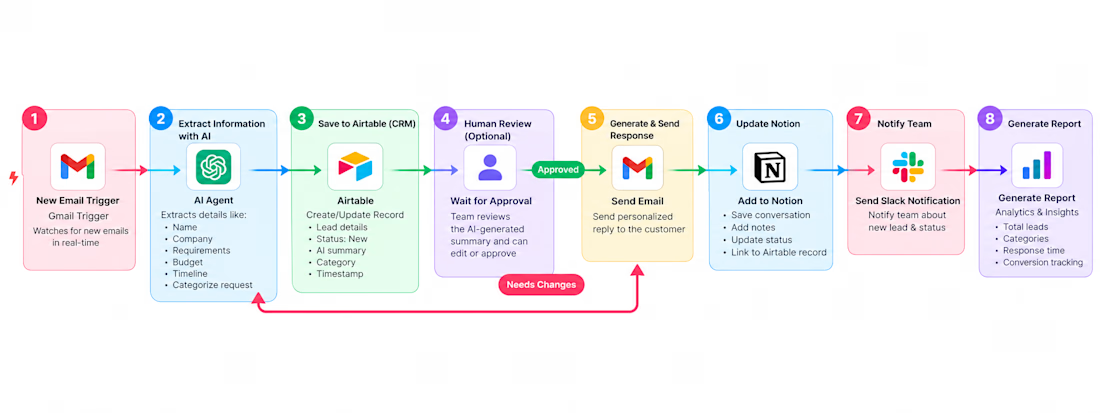

I'd use the human approval step to capture corrections, not just a yes/no decision. If a reviewer changes the extracted lead details, does the workflow update Airtable and the reporting record before sending the email?

Designed a modern AI Automation Agency Landing Page.
A sleek dark interface with a glowing blue glass cube and bold, clean typography for a futuristic first impression.
Glossy 3D visuals, clear service cards, founder testimonials, and simple pricing plans make AI automation feel easy to understand. Balance


Love the clean hierarchy and glowing accents! 🔥