The network for creativity
Join 1.25M professional creatives like you
Connect with clients, get discovered, and run your business 100% commission-free
Creatives on Contra have earned over $150M and we are just getting started
Back to feedPost

AI Can Sound Certain and Still Be Completely Wrong
We’ve all seen it: an AI tool gives a beautifully structured answer, explains it confidently, and even provides examples.
Then you check the facts.
And something is wrong.
The problem isn’t just that AI makes mistakes. It’s that those mistakes can look surprisingly convincing.
Why does this happen?
AI models generate responses based on patterns learned from data. They don’t automatically verify every statement against reality.
When information is incomplete or a question is ambiguous, a model may produce an answer that sounds reasonable without being accurate. This is often called an AI hallucination.
And better writing doesn’t necessarily mean better reasoning.
The real risk is trusting the output too quickly
Imagine using AI to:
Summarize a contract
Generate code for a payment system
Research a competitor
Analyze customer feedback
Prepare a business report
In each case, the answer might look professional while containing one small error that changes the conclusion.
The more useful AI becomes, the easier it is to forget that its output still needs to be evaluated.
So, how should we use AI?
1. Ask for evidence. When possible, request sources, references, or the reasoning behind a conclusion.
2. Verify critical details. Names, dates, statistics, legal requirements, and technical recommendations deserve independent checks.
3. Give AI a defined role. Asking it to brainstorm ideas is different from asking it to make a high-stakes decision.
4. Keep humans responsible for the outcome. AI can accelerate work, but accountability cannot simply be delegated to a tool.
One question worth asking
If an AI answer sounds convincing, what makes you trust it?
Its confidence? Its level of detail? The fact that it agrees with what you already believe?
Or evidence that can be independently checked?
AI literacy isn't just knowing how to write better prompts. It's knowing when not to trust the answer.
The network for creativity
Join 1.25M professional creatives like you
Connect with clients, get discovered, and run your business 100% commission-free
Creatives on Contra have earned over $150M and we are just getting started








Related posts

You have a point but a time is coming when that manual work will be fully automated with Ai.
As most of us are still doing manual work some people are busy training Ai to take over that activities in nearby future

Manual work is always better than ai slop you can use ai for some clips but full video made with ai is unprofessional and a waste of money and resources

The point about people quietly training AI on today's manual tasks is the part most of us underestimate. Do you think the craft shifts to directing and curating those models, rather than disappearing entirely?


SES AI is a battery technology company accelerating the energy transition through AI-powered material discovery, battery development, manufacturing, and management.
SES AI approached us with a website redesign driven by its new “All-in on AI” strategy. As AI became central to the company’s work across safety, manufacturing, and science, the existing website still focused primarily on its battery-hardware side. We redesigned the experience to clearly communicate the three AI pillars, while making the website simpler, more direct, and easier to navigate.


This looks insane. The robotic arm with the battery cell is such a strong visual. Love how clean you kept it despite it being AI heavy.

Most AI builds break at the wiring, not the model: no retries, no log of what the model actually did, and no clear line for what the agent may do without a human.
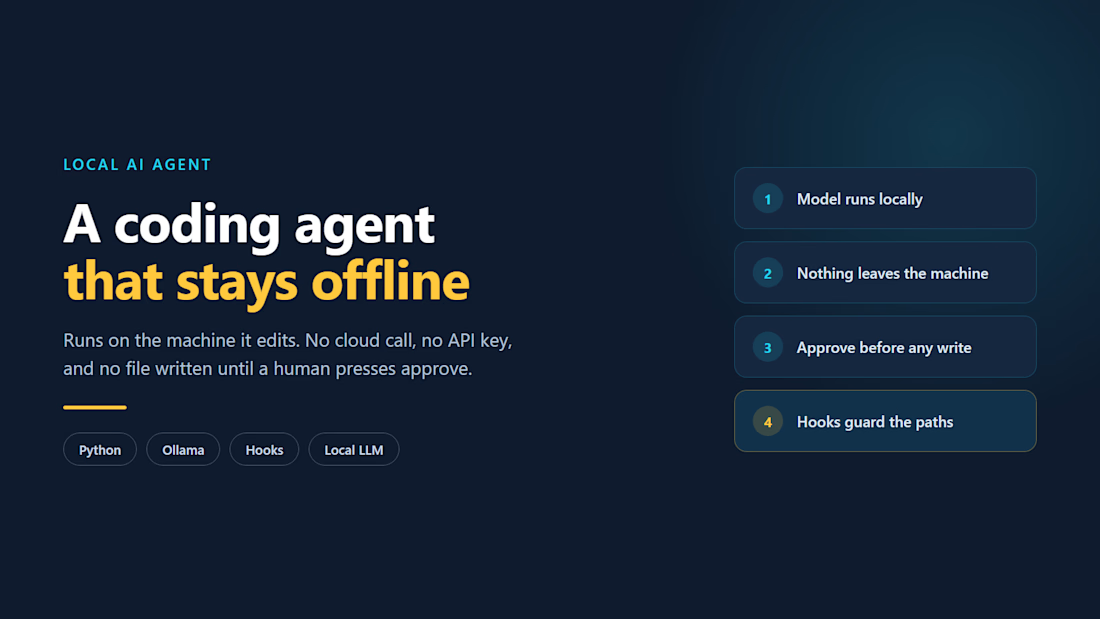
I build that layer. My own products run on it -- an ordering platform where an AI agent handles real orders, and a coding agent that writes no file until someone approves the change.
The question worth answering first is what your agent should never decide on its own.