The network for creativity
Join 1.25M professional creatives like you
Connect with clients, get discovered, and run your business 100% commission-free
Creatives on Contra have earned over $150M and we are just getting started
Back to feedPost

When we think about SEO growth, the conversation usually revolves around "more": more content, more backlinks, more keywords.
Working on complex B2B systems recently, I’ve realized that the most impactful growth often comes from "SEO Archaeology" - digging into the legacy layers of a product to find what’s silently draining the crawl budget.
For example, we often overlook how server-side conflicts (like Nginx/PHP-FPM misconfigurations) or outdated plugin remnants create 'digital noise' that search bots struggle to bypass. It’s not just a technical glitch; it’s a form of product debt that directly suppresses organic visibility.
By treating the website as a living product rather than just a marketing channel, we managed to stabilize the 'heartbeat' of the site, which led to a significant ranking recovery without adding a single new page initially.
I’m curious to hear from other strategists: How often do you find that the solution to a ranking plateau lies in the server architecture rather than the content strategy? And how do you communicate the value of this 'invisible' work to stakeholders who only want to see new blog posts?
SEO Content Managment technicalseogrowthstrategyGrowth MarketingSEO WritingGoogle AnalyticsGoogle Search ConsoleWordPress



The network for creativity
Join 1.25M professional creatives like you
Connect with clients, get discovered, and run your business 100% commission-free
Creatives on Contra have earned over $150M and we are just getting started
Trending
retrofuturism
Share your favorite designs from the past exploring the distant future. Or your own take on the aesthetic 🚀
halftone
Dots. Texture. Grain. Let's see your designs using the halftone technique.

Midjourney
Creatives are showing off what they're making with Midjourney.
colorgrade
Video editors sound off: How do you enhance the mood of your video in color grading?


Related posts

Still surprised how often platform choice comes before content strategy in web projects
Framer, Webflow, WordPress... all solid
All wrong for someone
The SEO ceiling on Framer is real for content-heavy builds. Most people find out after they've already committed
What's the platform decision process you actually follow before starting a client project?
https://www.youtube.com/shorts/juQoefjaMZk


"All wrong for someone" should be printed on every discovery call script honestly. I'd guess a lot of the mismatch comes from clients picking the platform before they've even nailed down their content plan. Do you push back on platform preference upfront, or let them pick and steer the build around it?

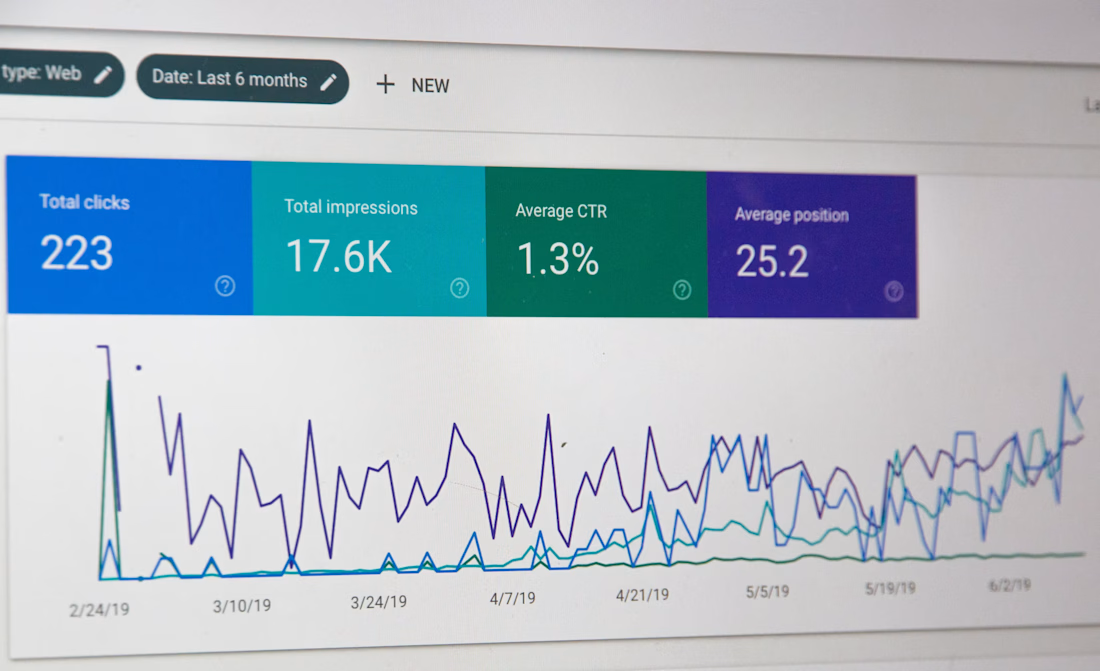
Every ranking jump starts with a number most people never look at: impressions.
Clicks tell you what's working. Impressions tell you what's possible, keywords you're already showing up for but not winning yet. That gap is usually where the fastest wins are hiding.
I go through this data for every technical SEO audit I run, small changes to titles and structure can move pages that are stuck on page 2 straight into the top 5.
Want me to take a quick look at yours? Send me your site.


How I Build Websites That Humans and AI Both Understand
A website now has two audiences. The person reading it, and the AI deciding whether to recommend it.
Most sites are built for one and invisible to the other. That's a problem, because more buyers are asking AI for recommendations before a human ever lands on your page.
Here's the shift. For years we built websites for people and search crawlers that mostly matched keywords. Now AI reads your site to understand it, summarize it, and cite it in answers. If it can't understand your page, it can't recommend you. And you'll never know you were skipped.
The good news is that what makes a site clear to AI is the same thing that makes it clear to humans. Structure.
So I build on semantic structure, not visual guesswork. That means real headings that describe what each section actually contains, not just big text styled to look like a title. It means proper schema markup that tells machines exactly what they're looking at: a product, a service, a review, a business. It means content organized as clear answers to real questions, so an AI can lift a clean response instead of guessing.
It also means clarity over cleverness. Vague marketing language gets skipped by AI and glazed over by humans. Specific, concrete claims get quoted by one and trusted by the other. Both audiences reward the same thing: say what you mean, plainly, and structure it so it's easy to find.
A page built this way works twice. Humans move through it effortlessly, and AI can actually parse, trust, and surface it.
Build for people and machines at once.
Because soon, the machine decides whether the person ever sees you at all.