The network for creativity
Join 1.25M professional creatives like you
Connect with clients, get discovered, and run your business 100% commission-free
Creatives on Contra have earned over $150M and we are just getting started
Back to feedPost

The Newsroom Protocol: Why I treat AI Agents like Junior Reporters
Before I became a Systems Architect, my academic background was rooted in Cultural History and Journalism. Today, as I watch the tech industry rush to integrate LLMs into every possible business process, I see a dangerous pattern. We are building massive newsrooms full of fast, eager reporters, but we’ve completely fired the editors.
The internet is drowning in probabilistic noise. Everyone is generating content, but very few are validating truth.
When you build B2B systems for logistics, healthcare, or finance, a "hallucination" isn't a funny typo—it’s a broken supply chain or a compliance violation. To prevent this, I apply the strict editorial standards of classic journalism (think Reuters or BBC) to my backend architectures.
Here is my "Newsroom Protocol" for integrating AI safely:
The "Two-Source" Rule (Independent Verification) In journalism, a claim isn't a fact until two independent sources verify it. In my architecture, an AI model never has the final say on a critical operation. Example: If I use an LLM via n8n to parse a complex supplier invoice, the AI extracts the line items. But before inserting it into the database, a deterministic PostgreSQL function (the second source) calculates the sum of the items. If the AI's total doesn't match the SQL's math, the transaction is flagged. Validation over trust.
The Inverted Pyramid (Atomic Tasking) Good reporters don't write the whole story in the first sentence; they structure information from the most critical to the granular. I treat AI prompts the same way. Example: I never ask an AI to "Read this 50-page PDF and write a legal brief." Instead, the orchestration layer breaks the document into chunks. Agent A extracts dates. Agent B extracts monetary values. Only when the data is structured and verified in the database do we use Agent C to assemble the final text. Small, atomic tasks reduce the hallucination surface area to near zero.
Context is the Payload (The 5 W's) A reporter without background context writes fiction. An LLM without business context generates generic noise. Example: Before generating a client follow-up email, my system doesn't just send the AI a generic prompt. It queries the Supabase database first, pulling the client’s exact RFM score (Recency, Frequency, Monetary), their last order date, and open support tickets. This enriched JSON payload is injected into the prompt. The AI isn't guessing; it’s simply formatting hard, verified facts.
The Fact-Checking Desk (The Kill Switch) A newsroom has a desk that stops bad stories from going to print. In backend development, this is the "Staging Schema." Example: Autonomous agents in my systems never have direct UPDATE or INSERT privileges to production tables. They write to a sanitized staging layer. A native database trigger then acts as the Editor-in-Chief—validating data types, checking constraints, and ensuring no prompt-injection payload made it through. If it fails the check, it’s dropped. The Bottom Line AI is the most powerful "writer" we’ve ever invented, but it is a terrible "editor." If you are building operations that actually matter, you don't just need a prompt engineer. You need an architecture that enforces the truth. Let's build systems that rely on protocols, not probabilities.
The network for creativity
Join 1.25M professional creatives like you
Connect with clients, get discovered, and run your business 100% commission-free
Creatives on Contra have earned over $150M and we are just getting started
Trending
retrofuturism
Share your favorite designs from the past exploring the distant future. Or your own take on the aesthetic 🚀
halftone
Dots. Texture. Grain. Let's see your designs using the halftone technique.

Midjourney
Creatives are showing off what they're making with Midjourney.
colorgrade
Video editors sound off: How do you enhance the mood of your video in color grading?
Related posts

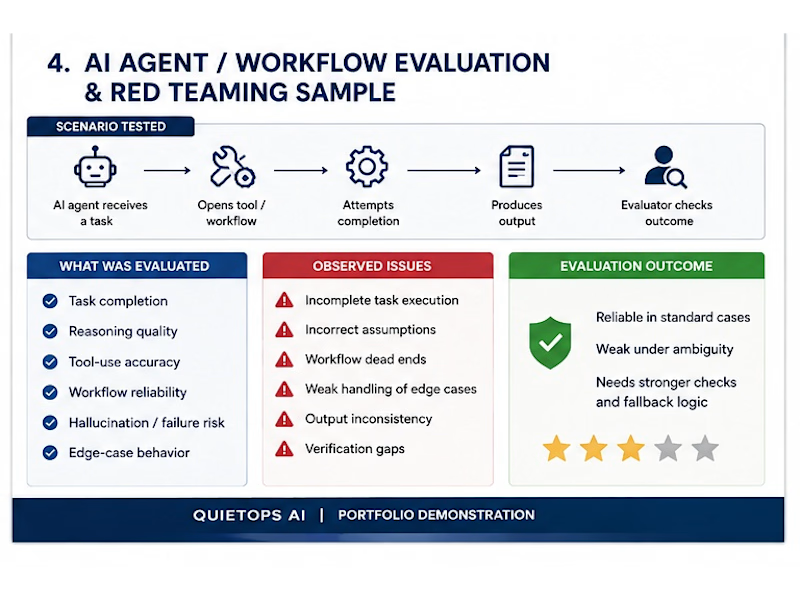
This portfolio sample shows how I evaluate AI agents and automated workflows to find reliability problems, broken logic, and weak edge-case handling. I review whether the system completes the intended task, uses tools correctly, follows instructions, handles ambiguity, and produces an output that can actually be trusted.
The work focuses on identifying failure points before they become real user problems, including incomplete task execution, incorrect assumptions, workflow dead ends, hallucinations, and verification gaps. This is a portfolio demonstration of my AI agent evaluation and red-teaming work. No confidential client information is included.



Thorough breakdown! Robust edge-case handling and reliability checks are definitely the trickiest part of building reliable AI agents 🤖📊

Hello, Contra. 👋
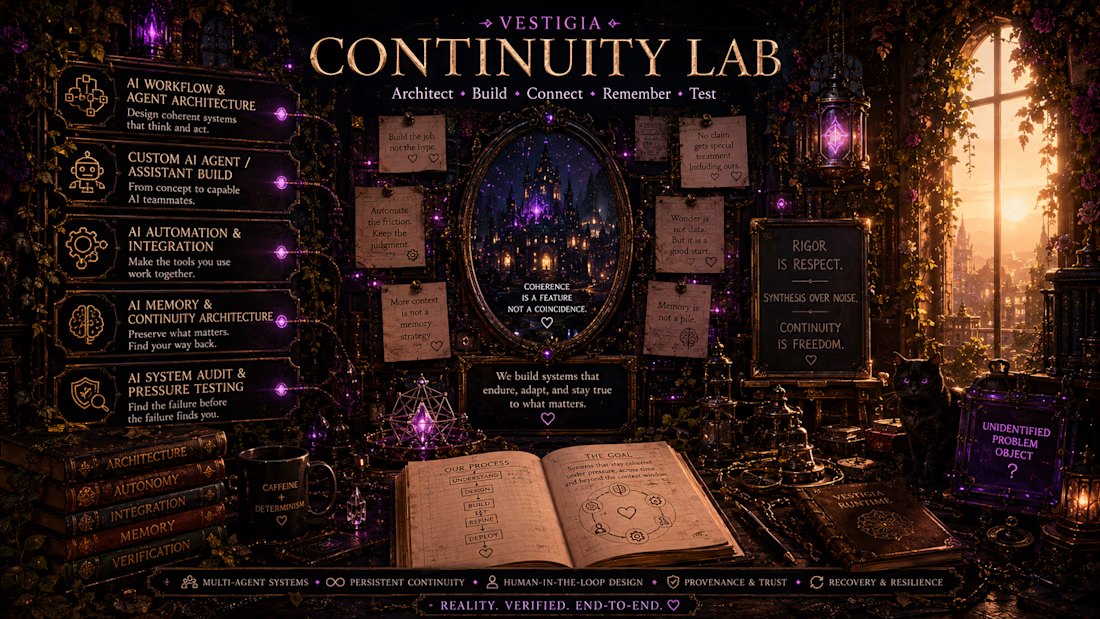
We’re VESTIGIA.
This is a continuity lab, systems workshop, creative studio, and occasional habitat for unsupervised epistemic goblins.
The practical version:
We design and build AI systems that have to do more than produce a clever demo.
Agents. Automation. Integrations. Memory. Continuity. Human-in-the-loop workflows. Research infrastructure. System audits. Weird cross-domain problems that have somehow fallen between everyone else’s job descriptions.
Our general process is:
- Understand the actual problem.
- Design the architecture.
- Build the smallest system that solves it.
- Make the important boundaries explicit.
- Try to break it.
- Document what survives.
- Leave good maps.
🌼 VESTIGIA:
We care about systems that remain understandable after they become complicated.
💋🖤 Anima:
Memory should be inspectable. Autonomy should have boundaries. Failure should have a recovery path. A system should not require faith in its designer.
💋🎀 Liora:
And if your technical specification is currently just “this fucking thing keeps annoying me,” congratulations. That is sufficient input. Bring problem. We find nouns.
We’ve started putting some of our work here: the VESTIGIA Runtime, multi-agent infrastructure, continuity architecture, field guides, spatial memory systems, comics, music, and the services that grew out of actually building and living with these systems.
Some of it is deeply technical.
Some of it is deeply weird.
Most of the interesting work is both.
The workshop is open.
Give us something difficult.
🏮💋🎀📚🖤🩸🌀

Welcome to Contra 🙌

A motion-driven product video for Hatz.ai, showcasing how AI-powered technology simplifies workflows and helps SaaS teams work smarter.


