The network for creativity
Join 1.25M professional creatives like you
Connect with clients, get discovered, and run your business 100% commission-free
Creatives on Contra have earned over $150M and we are just getting started
Back to feedPost

AI agents are most useful when they reduce uncertainty—not when they silently replace judgment.
The Next.js team just used a research agent to review a backlog of 2,244 GitHub issues. In roughly three weeks, 1,462 issues were closed and only 3 were reopened.
What made the workflow credible:
• every investigation ran in an isolated sandbox
• the agent checked code, versions, PRs, commits, releases, and docs
• it actively searched for evidence against its first conclusion
• risky actions stayed read-only until humans reviewed the evidence
• the clearest cases required a second-agent challenge before automation could close them
That is the pattern I trust for production AI automation: evidence first, structured outputs, bounded permissions, and reversible actions.
Where could an evidence-driven agent remove the most operational drag in your workflow?


Where it removed the most drag for me was real-estate contract deadlines - a chain of dates where one addendum moves a date and nothing throws an error. The agent is not there to judge, it is there to show that something moved.
The second-agent challenge is the bullet I would...
The network for creativity
Join 1.25M professional creatives like you
Connect with clients, get discovered, and run your business 100% commission-free
Creatives on Contra have earned over $150M and we are just getting started





Related posts

Just finished building a Salon Booking Management System!
The goal was simple: make appointment management easier for salon owners and reduce the manual work involved in handling bookings and reminders.
The system connects the complete workflow in one place:
1 Customer makes a booking
2 Booking gets confirmed
3 Owner sees it on the dashboard
4 Upcoming appointments are organized clearly
5 Reminders help the owner stay on top of appointments
One of the key things I focused on was making the experience simple, clean, and easy to understand, while keeping the workflow practical for a real business.
This project helped me think beyond just building screens — and focus more on the actual business problem, user flow, and overall product experience.
Excited to keep improving it and turn it into an even more polished product.
#BuildInPublic #SaaS #WebApp #BookingSystem #SalonManagement #ProductDesign #MVP #NoCode #Entrepreneurship


Good work

This project focused on building and testing a practical AI security assessment lab for evaluating LLM defenses against prompt injection and jailbreak attacks.
I integrated Spikee by Reversec with a locally hosted cybersecurity model running through LM Studio, then added NVIDIA NeMo Guardrails to compare model behavior under three conditions: no guardrails, input filtering, and combined input/output protection.
The work included configuring the local model environment, building a custom FastAPI gateway, integrating NeMo Guardrails, troubleshooting model latency and timeout issues, creating a reusable Spikee target, and analyzing attack results using Spikee’s built-in reporting tools.
The project also explored different adversarial testing approaches, including prompt injection datasets, obfuscation, encoded attacks, Best-of-N testing, synthetic canary leakage tests, and structured benchmark comparisons.
The objective was to measure how much the guardrails reduced successful attacks while keeping the model, dataset, and testing conditions consistent.
Tools used: Spikee, NVIDIA NeMo Guardrails, LM Studio, Python, FastAPI, PowerShell, Parrot OS, local LLMs, JSONL datasets, and custom security testing scripts.
This project demonstrates a hands-on approach to LLM red teaming, AI safety testing, prompt-injection assessment, and guardrail validation for organizations deploying generative AI systems.


pretty cool tbh. testing the same attacks with different guardrail setups makes the results way more interesting.

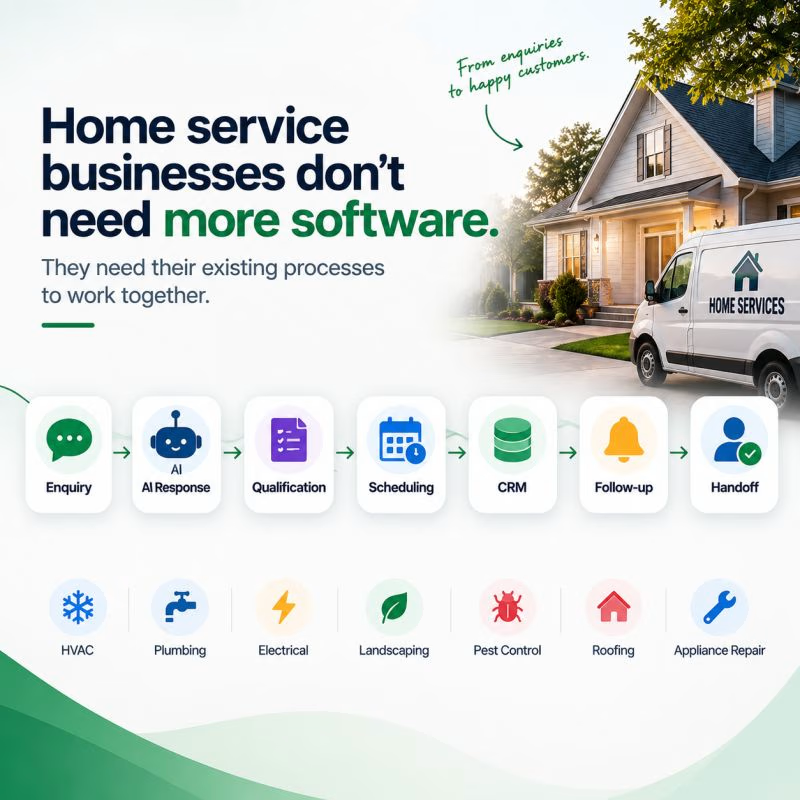
Home service businesses don't need more software. They need their existing processes to work together.
Think about a typical customer journey:
A homeowner needs an HVAC repair.
They call the business.
The call is missed because the technician is on-site.
They leave a voicemail.
Nobody follows up until later.
Then the customer calls another company.
This isn't a lead-generation problem.
It's a workflow problem.
AI automation can connect the entire process:
Customer enquiry → AI response → Qualification → Scheduling → CRM → Follow-up → Human handoff
For example, an AI system can:
• Respond to calls, texts, WhatsApp, or website enquiries
• Understand what service the customer needs
• Collect location and job details
• Check technician availability
• Schedule appointments
• Send confirmations and reminders
• Follow up on estimates
• Update the CRM automatically
• Escalate urgent or complex requests to the team
The important part is that AI doesn't need to replace the technician.
It handles the operational work around the technician.
That means fewer missed calls, faster responses, less administrative work, and a smoother customer experience.
And this applies across:
HVAC
Plumbing
Electrical
Cleaning
Landscaping
Pest Control
Roofing
Appliance Repair
The biggest opportunity for home service businesses isn't simply getting more enquiries.
It's building a system that makes sure every enquiry gets the right response and the right next step.
That's where AI automation can become a real business advantage.

Absolutely. The real value of AI automation for home service businesses isn’t replacing people; it’s connecting the gaps between enquiry, response, scheduling, follow-up, and service delivery.
When every lead gets a timely response and the right next step, businesses can reduce...