The network for creativity
Join 1.25M professional creatives like you
Connect with clients, get discovered, and run your business 100% commission-free
Creatives on Contra have earned over $150M and we are just getting started
Back to feedPost

The Future of Artificial Intelligence according to my opinion and analysis.
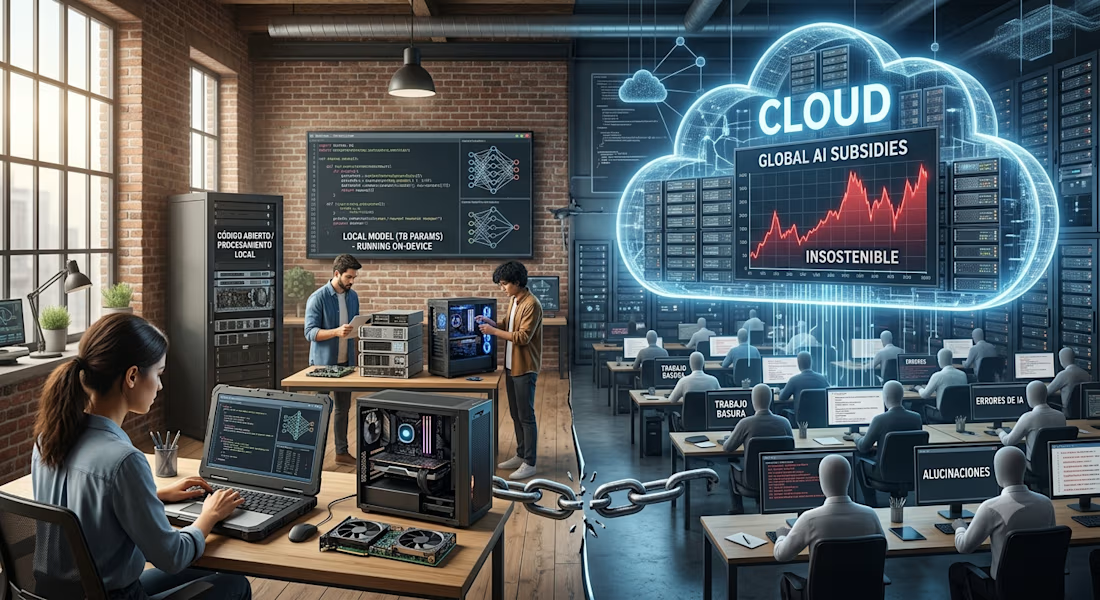
Artificial Intelligence (AI) as a technological advancement is here to stay and will not disappear. However, there is a profound disconnect between the viability of the technology and the financial sustainability of those who provide it. The business model of the vast majority of current commercial AI companies is unsustainable in the long term; we are on the verge of a massive restructuring in which many corporations will go bankrupt or be forced to radically transform. This critical scenario is based on three key factors: false financial profitability, the physical limitations of the infrastructure, and the real redefinition of the labor market.
Today, access to large commercial AI platforms (such as ChatGPT or Claude) is perceived as inexpensive or accessible. However, this scenario is artificial: the services are heavily subsidized by venture capital investors and tech giants that prioritize capturing market share over immediate profits.
Maintaining this infrastructure involves astronomical costs. Keeping servers running,
processing billions of prompts daily, and cooling advanced data centers requires
colossal budgets.
Frontier companies like OpenAI and Anthropic burn through billions of dollars more each year than they actually earn.
Data scientists and
financial investors warn that the current model of unlimited consumption through a flat subscription (the classic "all you can do for $20 a month" scheme) is not
economically viable when working with gigantic models of up to two trillion
parameters. Eventually, the market will be forced to make a drastic decision: either
subscription prices increase exponentially, or operating costs are cut aggressively
to prevent the commercial bubble from bursting.
The crisis of commercial AI is not just a problem of financial balance sheets; it is a challenge of
physics, natural resources, and material limits. The unchecked growth of cloud-based models is directly impacting the capacity of global power grids and the availability of water resources for cooling.
The situation has reached such a point of saturation that, in key regions of the United States and Europe, fully completed and equipped data centers are sitting idle because local cities and industries lack the energy capacity to power them. Faced with this physical constraint, the market is being forced to pivot toward a more efficient alternative: small, local AI models (optimized structures of 10 billion parameters or less).
These compact models represent the sustainable future of the technology. By running
natively on the user's hardware (whether on a mobile phone or a
desktop computer), they eliminate latency, guarantee data privacy, and
smoothly handle more than 80% of everyday computing tasks such as summarizing
texts, drafting documents, or assisting with code writing. Most importantly, they
operate without consuming cloud energy or generating infrastructure costs for a third party.
On the other hand, alarmist narratives claiming that AI arrived with the sole purpose of
massively destroying jobs have been greatly exaggerated by
marketing strategies and sensationalism. Contemporary AI is not a conscious or autonomous entity; it is
a highly advanced statistical tool.
Instead of an automated replacement of human personnel, the current corporate landscape
is experiencing the phenomenon known as "worklop." This occurs
when employees use generative AI tools without proper supervision or technical expertise,
producing a massive volume of texts, reports, or code of mediocre quality or
riddled with structural errors. Far from dispensing with professionals, companies are
being forced to hire or reassign specialized humans with the sole function
of auditing, hunting down, and correcting the "hallucinations" and inconsistencies of the machines.
AI will not destroy jobs across the board, but rather redefine the nature of
professional roles. Those under real threat of disappearing are those
agencies or companies whose business model depends exclusively on charging for
mechanical, repetitive, and low-value-added tasks that a language model can structure and
solve in a matter of seconds.
In the medium term, we will witness a thorough cleansing and purging of the technology ecosystem. Hundreds of applications, secondary tools, and startups that currently operate simply as a "cosmetic layer" or wrapper built on top of third-party APIs will go bankrupt when large infrastructure companies cut subsidies and adjust prices to the true cost of computing. The market will gravitate toward the permanence of two main trends: on the one hand, AI seamlessly and natively integrated into the software that is already part of everyday workflows (operating systems, development environments, and database engines); on the other hand, and with increasing force, open-source and local architecture models. These local solutions will allow users, professionals, and developers to maintain complete control over their data and run advanced processes on their own hardware, achieving true technological sovereignty without relying on a credit card or a monthly cloud subscription.
What do you think?
The network for creativity
Join 1.25M professional creatives like you
Connect with clients, get discovered, and run your business 100% commission-free
Creatives on Contra have earned over $150M and we are just getting started
Related posts


ONE MORNING. FIFTEEN SECONDS. NO SECOND CHANCES.
There is something quietly devastating about watching someone hold their entire life together with nothing but sheer willpower and a transit card.
No dramatic music. No slow motion. No cinematic luxury.
Just a woman, a clock, and seventeen things that need to happen before the door closes.
This project was an exercise in precision — how much human truth can be compressed into 15 seconds before it stops feeling like content and starts feeling like memory?
Every shot was engineered with intention. Lens choice, sound design, wardrobe continuity, color logic — nothing was accidental. Every cut lands on a beat. Every breath is placed. Every frame earns its place in the sequence.
Because the most cinematic thing in the world is not an explosion or a chase scene.
It is a woman lacing her shoes at full speed and still making it out the door.
🎧 Turn the volume up.
The sound design is doing half the work.
Concept · Direction · Cinematic Design
Engineered through Advanced AI Prompting


Very nicely done

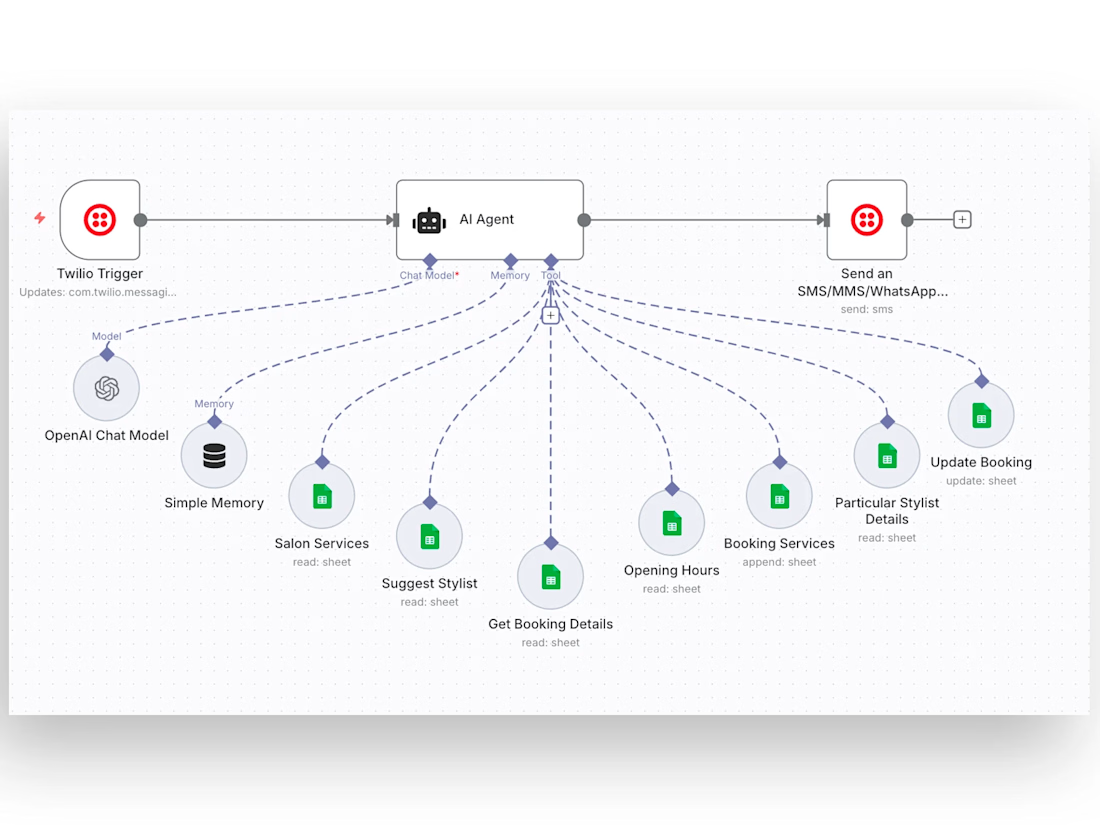
Salon Appointment Booking Automation
This automation workflow makes the entire client scheduling journey using n8n, OpenAI, and Google Sheets. The process begins when a client interacts with the salon’s chat interface, where an AI Agent leverages simple memory to recognise returning customers and provide personalised service recommendations.




Nova AI is a futuristic project consisting of premium UI DESIGNS,Image heavy layouts,responsive design for a user friendly website

















Trending

Claude
Claude has entered the design space. How are you using Claude Design?

Contra University
Learn from expert creatives how to earn more using next-gen AI tools.

MagicPath
The canvas is infinite, and exploration is becoming the workflow. How are you using MagicPath?
creativeaiflow
Creative AI workflows are evolving. What tools do you use, and what are their strengths and weaknesses?
freelancerlife
Freelancer life is wins, pivots, and everything in between. What’s yours right now?