The network for creativity
Join 1.25M professional creatives like you
Connect with clients, get discovered, and run your business 100% commission-free
Creatives on Contra have earned over $150M and we are just getting started
Back to feedPost


Six months ago, I invested 1 crore PKR into a retail pharmacy venture with the hope of building something stable for the future.
This wasn’t just a financial loss.
It was an experience that changed the way I look at business, partnerships, and risk.
I wrote the full story in detail — what went right, what went wrong, where we made mistakes, and what I learned after meeting people who had been in this industry for years.
If you are thinking about starting a business, investing in a franchise, or working with partners, this might save you from making the same mistakes.

open.substack.com
One Crore, Six Months, and a Lesson Worth 55 Lac PKR
We Invested One Crore, Worked 19 Hours a Day, and Still Had to Shut It Down
The network for creativity
Join 1.25M professional creatives like you
Connect with clients, get discovered, and run your business 100% commission-free
Creatives on Contra have earned over $150M and we are just getting started





Related posts

Post 1 — Problem awareness
Topic: You’re posting, but are people understanding your offer?
You can post consistently and still struggle to attract the right clients.
Not because you’re bad at what you do.
Sometimes, people simply don’t understand what you do well enough to see why they need you.
They visit your page.
They read your posts.
They might even like your content.
But when it comes to hiring you, they’re unsure.
Start by making three things clear:
Who do you help?
What problem do you help them solve?
What changes when they work with you?
Your content shouldn’t just keep you visible.
It should help the right person understand why your work matters.
CTA: Which of these three things is hardest for you to communicate?
Post 2 — Educational content
Topic: A simple way to make your offer clearer
Try completing this sentence:
“I help [specific audience] achieve [specific outcome] by [how you help them].”
For example:
“I help early stage service providers clarify their offers so potential clients can understand their value and take the next step.”
Is this sentence your entire marketing strategy? No.
But it’s a useful starting point.
When you can explain your offer clearly, you have a stronger foundation for your bio, website, social media content, and sales conversations.
Before creating another post, check whether your audience can understand what you’re actually offering.
Clarity gives your content somewhere to lead.
CTA: Try writing your own version.
Post 3 — Myth busting
Topic: More content isn’t always the answer
When engagement or enquiries are low, it’s tempting to post more.
Another carousel.
Another tip.
Another motivational caption.
But more content won’t automatically fix a message that people don’t understand.
Before increasing your posting frequency, ask:
Does my content speak to a problem my audience actually has?
Is my offer clear?
Can people see why my service is relevant to them?
Do they know what to do next?
Sometimes, the best improvement isn’t publishing more.
It’s making what you already say more useful and specific.
CTA: Save these questions for your next content review.
Post 4 — Trust building
Topic: Your audience needs more than a list of services
Imagine two business profiles.
The first says:
“I offer coaching, strategy, and consulting.”
The second explains who the service is for, what problem it addresses, and what the customer can expect from working with the coach.
Which one helps you make a more informed decision?
The second.
Your audience doesn’t just need to know what you sell.
They need enough context to understand whether it’s relevant to them.
Explain your process.
Address common concerns.
Show how you think about the problems you solve.
Help people understand what working with you involves.
Trust grows when your communication makes decisions easier.
CTA: What question do potential clients frequently ask you before working with you?
Post 5 — Service focused content
Topic: Is your offer clear enough to sell?
Your service might be valuable.
But if potential clients can’t understand what it does, who it’s for, or why it matters, they may struggle to see its value.
That is why offer clarity matters.
When reviewing your offer, check:
The audience: Who is this specifically for?
The problem: What are they struggling with?
The outcome: What are they working towards?
The next step: What should an interested person do?
You don’t need exaggerated promises or complicated language.
You need to communicate the value of your service in a way your audience can understand.
If your offer has become difficult to explain, start by simplifying the message.
CTA: If you’re a service provider, which part of your offer needs more clarity?
Contra Project Description:
Project overview
This speculative project explores how a business coach could use social media content to communicate their offer more clearly and connect with early stage service providers.
Objective
Develop a five post content package covering problem awareness, education, myth busting, trust building, and service focused messaging.
Approach
Each post addresses a different stage of audience understanding, from recognizing a problem to evaluating a service. The content uses practical explanations, relatable examples, and relevant calls to action rather than relying on generic motivational messaging.
Deliverables:
— Five social media post drafts.
— Five content angles.
— Calls to action tailored to each post.
— Content suitable for adaptation to Instagram and LinkedIn.
Project note
This is a speculative practice project created to demonstrate my social media copywriting and content strategy approach. The business is fictional, and no client performance results are being claimed.



Your shareholder account could be quietly costing you. 👀
Most founders I meet don’t know their shareholder current account balance.
Then year-end arrives, and the accountant asks:
“Why does the company owe you money?”
or worse,
“Why do you owe the company?”
Here’s the simple version 👇
Shareholder current account = the running tab between you and your company.
✅ Positive balance: the company owes YOU.
You paid a company bill from your own pocket or lent the business money. You can take it back as a repayment.
⚠️ Negative balance: YOU owe the company.
You took out more than you were entitled to. It’s treated like a loan, which can mean tax consequences, audit questions, and messy books when you want funding or a sale.
Quick example:
You put in 10,000 → company owes you 10,000 ✅
You withdraw 15,000 for personal use → you now owe 5,000 ⚠️
Most founders don’t have a money problem here. They have a record-keeping problem.
That’s where I come in.
At Counting Crux, we help startups and small businesses in the UAE and UK with:
📌 Monthly bookkeeping and clean reconciliations
📌 Shareholder/director account tracking
📌 VAT and Corporate Tax support
📌 Month-end and year-end reporting
📌 Work in QuickBooks, Zoho Books, Xero, and Excel
No jargon. No surprises at year-end. Just books you can trust. ✨
🎯 Want me to check your shareholder account for free?
Comment “CHECK” or DM me, and I’ll tell you where you stand.
♻️ Repost if you know a founder who mixes personal and business money.
#Accounting #Bookkeeping #Founders #Startups #SmallBusiness #UAE #UK #CorporateTax #VAT #Xero #QuickBooks


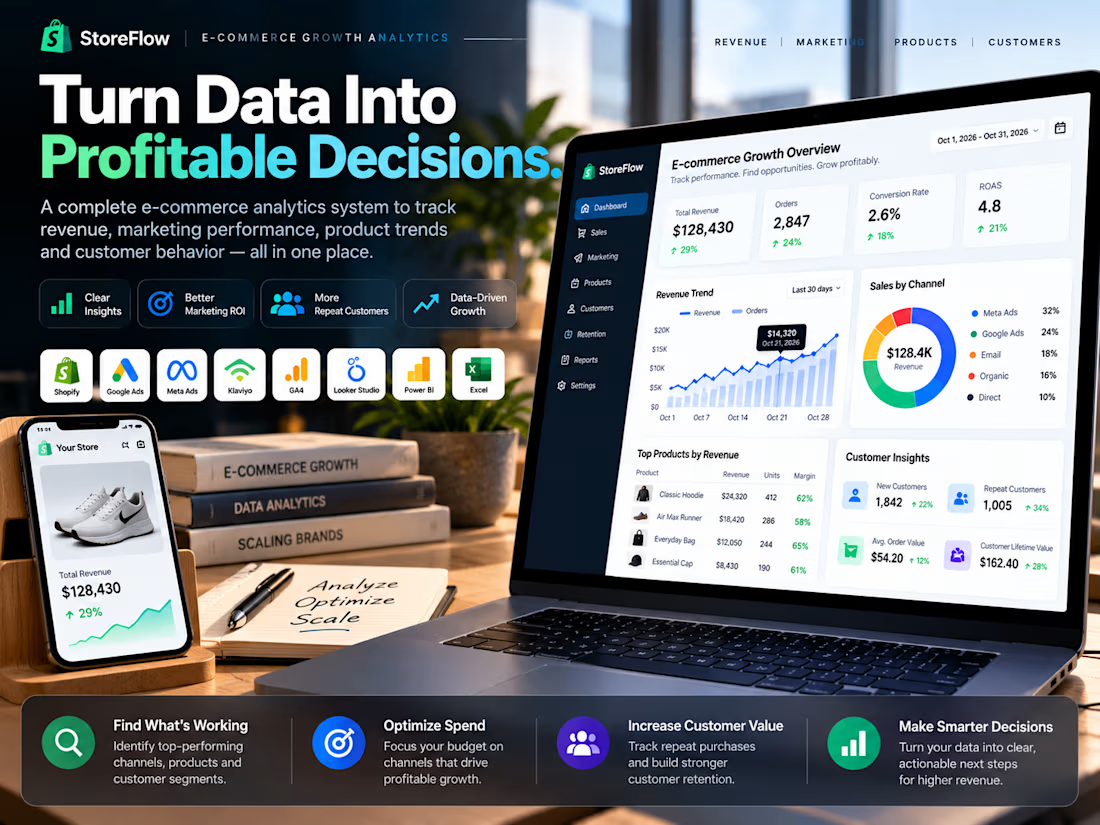
See exactly what’s driving revenue, where growth is leaking, and which products, channels, and customers deserve more investment.
I developed an e-commerce growth intelligence system around one question:
Where should the business invest next?
Most stores already have plenty of data. The harder problem is understanding what that data means for revenue, marketing spend, products, and customer growth.
So instead of building another dashboard full of charts, I’m structuring the system around decisions.
It brings together signals such as revenue, ROAS, CAC, conversion, product performance, repeat purchases, and retention to identify things like:
which channels deserve more budget, where acquisition is becoming inefficient, which products attract traffic but fail to convert, and where repeat customers are creating stronger value.
The goal isn’t just to answer:
“What happened?”
It’s to answer:
“What should we do next?”
Because the most useful analytics system isn’t the one with the most charts.
It’s the one that makes the next business decision clearer.
Tags: E-Commerce · Marketing Analytics · Data Analytics · Power BI · E-commerce Management
Marketing AnalyticsData AnalysisecommerceeCommerce ManagementMicrosoft ExcelMicrosoft Power BIShopify



Exactly. Analytics becomes much more valuable when it helps businesses make smarter decisions, not just track numbers.