The network for creativity
Join 1.25M professional creatives like you
Connect with clients, get discovered, and run your business 100% commission-free
Creatives on Contra have earned over $150M and we are just getting started
Back to feedPost

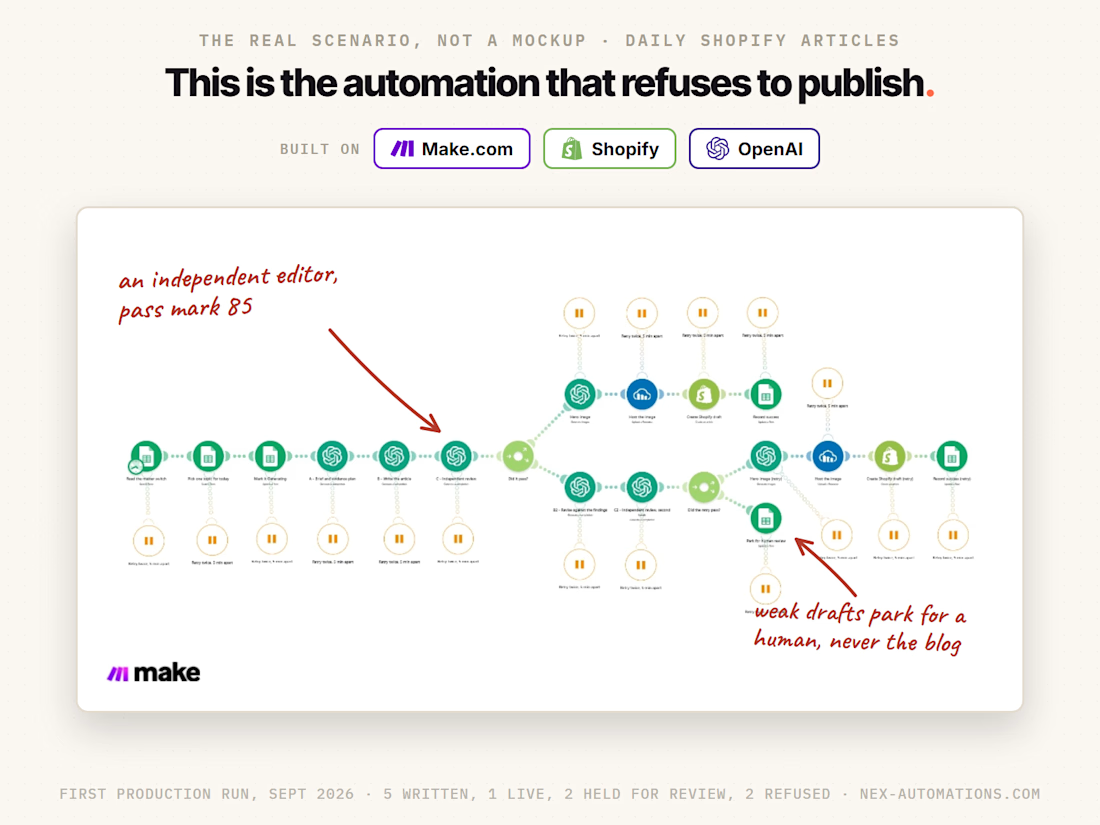
What does it take for an AI-written article to read like an editor produced it? A process, not a prompt. Below is the one we run in production, the picture is the actual Make.com scenario behind it, and this is who it is for.
Who should read this: store owners and marketing leads who publish weekly and are tired of content that sounds like everyone else's AI, agencies delivering articles for clients who can tell the difference, and founders writing their own blog at midnight because they do not trust anyone else with their voice.
The process, step by step:
1. Voice before content. We build a voice profile from 3 to 5 pieces of your real writing: on-voice and off-voice examples, your terminology, your closing line. "Friendly and professional" is not a voice. Your actual sentences are.
2. Memory before topics. Everything you already published gets indexed by search intent, and every new topic is checked against it. Two differently titled articles that answer the same search are the same article, and search engines punish you for both.
3. A brief before a draft. Each topic becomes a plan first: the reader's real question, a direct answer for the top of the piece, question-shaped sections that mirror what people actually type, and a list of facts that are safe to assert versus claims to avoid. This structure is also what earns citations in AI answers, which is the GEO and AEO half of the job.
4. Realism enforced in both directions. Inventing facts fails. So does the cowardly opposite, an article that explains how to choose without ever choosing. A guide that names nothing has not answered its question, and our editorial pass blocks both failure modes.
5. An independent editor, then a human. Every draft is graded by a separate AI step with its own prompt across 8 quality dimensions, pass mark 85, before I review it myself. You only ever see drafts that cleared both. In its first production month the editor blocked drafts rather than lower the bar, which is exactly what you want it to do.
6. Links with a job. Internal links placed early, middle and end, pointing at pages that survive (collections and guides, not products that sell out), tagged so clicks can be traced to what they earn.
The length is yours to set, with an 800-word floor so nothing thin ever ships. Blogs, newsletters, LinkedIn articles and help-centre pages all run through the same desk.
This now exists as a service on my profile: Brand-Voice Articles, $50 an hour with the honest math printed in the listing (most articles take 2 to 3 hours end to end). The system build behind it is there too for anyone who wants it running unattended in their own accounts.
If you publish weekly: which of these six steps is missing from your current process? That answer is usually where the quality leaks.


The network for creativity
Join 1.25M professional creatives like you
Connect with clients, get discovered, and run your business 100% commission-free
Creatives on Contra have earned over $150M and we are just getting started







Related posts

Members from our studio re-imagined a video from ottilie into a short film teaser, we wanted it to convey the message of her video in a short but intriguing & impactful manner, we would like to hear your opinions and suggestion about what we can improve further.


I created this ad almost entirely using AI, from the initial concept and script to the visuals, video generation, and final editing.
What I liked most about this workflow is how quickly an idea can go from a simple concept to a polished, ready-to-use ad without needing a traditional production setup.
AI isn’t just about generating content. The real value comes from knowing what to generate, how to direct it, and how to bring everything together into a story that feels intentional.
This is one of the AI ad workflows I’ve been experimenting with recently, and the results have been pretty exciting.
If you’re looking to build AI-powered ads for your brand, let’s connect. I’d be happy to explore what we can create.
#ai #videoads #aivideoads
Sharing the final video here 👇


EDGGY: THE YEMITRIUM
The story follows Edward “Edggy” Graves, a sarcastic young egg from Crackside, Las Veggas, who secretly sells Yemitrium—rare purple crystals produced by his sick little sister Clarita—to fund a possible cure.
For the 120-second pilot, I built the entire universe from scratch in Cantina, including characters, locations, props, dialogue, and story. The world combines playful egg-inspired references with darker cinematic storytelling, mixing drama, dark comedy, action, and internet culture.
The project is designed to expand through future episodes, side stories, crossovers, community-created clips, and interactive Cantina characters.
Created in 9:16 using Cantina’s Viral style, with a focus on pacing, sound, transitions, character consistency, and cinematic storytelling.
Edggy (Character)
Pilot Episode
— Braulio Cardenas


Edggy IS a good brother!