The network for creativity
Join 1.25M professional creatives like you
Connect with clients, get discovered, and run your business 100% commission-free
Creatives on Contra have earned over $150M and we are just getting started
Back to feedPost

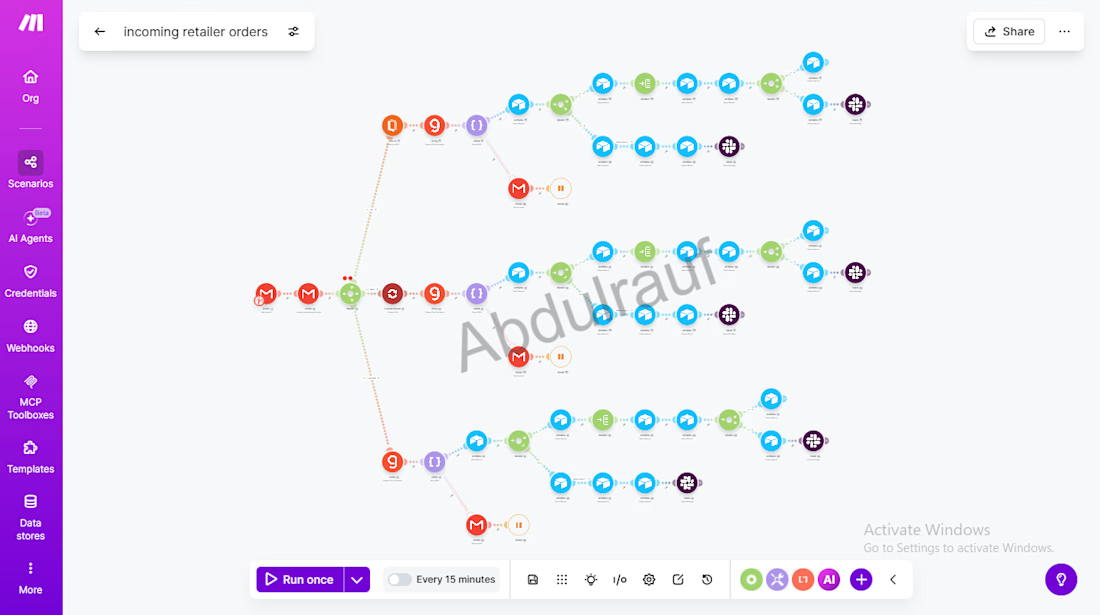
Currently working on a multi-channel order intake system for a beauty brand using Airtable, Make.com, and Groq AI.
The workflow monitors a Gmail inbox for retailer orders coming in as PDFs, Excel files, and plain emails.
Then Groq AI extracts the order data automatically before the system maps retailer SKU codes to the company’s internal SKUs inside Airtable.
The goal is to centralize multi-channel B2B orders into a single Airtable system with human approval before stock confirmation.
I’ll share more of the workflow as I continue building.
#Automation #AI #Airtable #Makecom #WorkflowAutomation


The network for creativity
Join 1.25M professional creatives like you
Connect with clients, get discovered, and run your business 100% commission-free
Creatives on Contra have earned over $150M and we are just getting started

Challenges
View all


Related posts

Experimented a bit today with Krea and image generation for a case study I’m putting together around AI EarPods connected to OpenAI.
The focus has been on creating fashion-forward product imagery and art directing a world that feels specific to the identity, rather than just generating nice-looking AI images.
The trickiest part has been product consistency. Especially getting the EarPods to actually sit snug in the ear. If you’ve worked through this process, you probably know the struggle 😅
Simply telling AI to “make it fit more snug or in the ear” doesn’t always work. It loves to reinterpret the product every time.
Still experimenting, but getting closer. If anyone has found a good workflow for keeping products consistent across AI-generated shoots, I’d love to hear it!


TOP!

Most people don’t avoid automation because they lack ideas.
They avoid it because turning “when this happens, do that” into a working system can swallow an afternoon.
n8n has just introduced an assistant that can take a plain-English request, build the workflow, run it, and help fix what breaks.
That makes the first step easier. But there’s still one thing the tool can’t decide for you: what should happen when reality doesn’t follow the happy path.
Before automating a task, write down:
What starts it?
What should happen?
When should a person step in?
If you could automate one annoying task this week, what would it be?


Recently worked on a GoHighLevel setup focused on building a more automated lead management system.
The workflow covered funnel and landing page setup, CRM pipelines, lead capture forms, triggers, automated follow-ups, appointment workflows, and integrations.
The goal was to connect the entire journey, from the first lead interaction to follow-up and conversion, without relying on manual processes.
GHL becomes much more powerful when the CRM, workflows, funnels, and automations are designed to work as one system.


