The network for creativity
Join 1.25M professional creatives like you
Connect with clients, get discovered, and run your business 100% commission-free
Creatives on Contra have earned over $150M and we are just getting started
Back to feedPost

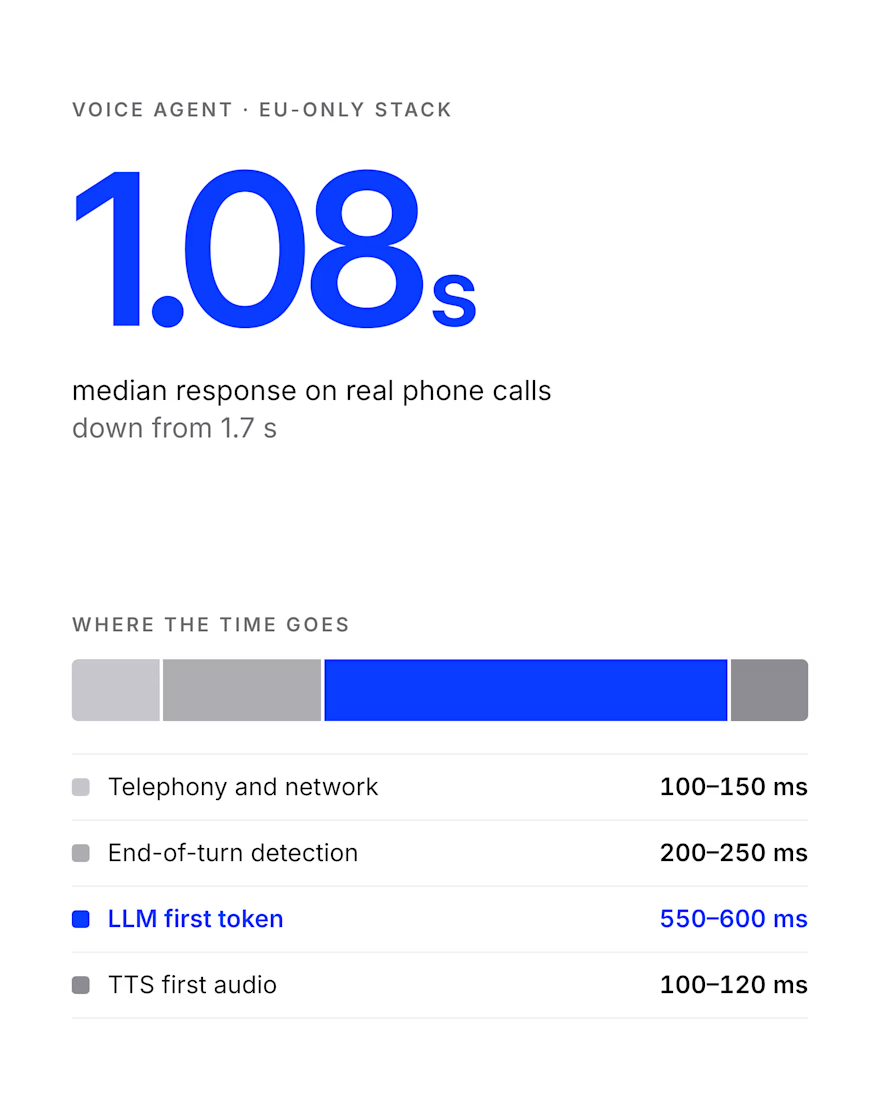
My voice agent's median response time went from 1.7 s to 1.08 s without changing the model, with every part of the stack running in Europe.
I'm building an AI receptionist that answers phone calls for businesses in Cyprus in Greek, English and Russian, and books appointments into their calendars.
The hard constraint is data residency. Speech-to-text, the LLM, text-to-speech and all customer data have to be processed in the EU. That rules out a lot of the usual choices. Some models that work really well on phone calls I couldn't find from a good EU provider at all.
So I benchmarked every model with tool support I could get from EU providers, about 40 of them, using the real receptionist prompt in Greek, Russian and English. Only one passed every check, faithful to the business facts, right language, right register.
That choice has a cost, and you can see it in the budget. When I first measured every stage, the LLM was about a third of the wait. After fixing everything around it, it's more than half.
Telephony and network - 100-150 ms
End-of-turn detection - 200-250 ms
LLM first token - 550-600 ms
TTS first audio - 100-120 ms
What made the difference.
1. Keeping the model connection warm. Node's fetch was closing idle connections after about 4 seconds, so most turns paid for a full TCP and TLS handshake. Keeping it open saved about 145 ms per request.
2. Hedging slow requests. The first token usually lands in about 0.5 s, but can spike past 2 s when the provider is congested. If nothing arrives within 1 s, the same request goes out again and the first answer wins. If the model stalls completely, a second model takes over.
3. Fillers only when they're needed. "One moment, let me check" plays only if a calendar lookup takes longer than 350 ms. Fast lookups add no spoken delay.
4. One fix I rejected on purpose. Waiting 500 ms longer before answering halved how often the agent cut callers off mid-sentence, but it added half a second to every single response.
Most calls now land between 0.9 and 1.2 s.
Under EU residency you can't just pick the fastest model on the market, so everything around the model has to be tight. Profile the whole turn before you blame the model.
If you're building voice agents under EU data residency, what first-token times are you seeing from your LLM?
The network for creativity
Join 1.25M professional creatives like you
Connect with clients, get discovered, and run your business 100% commission-free
Creatives on Contra have earned over $150M and we are just getting started











Related posts

Built SpeedPulse AI — an automated website performance teardown and local client acquisition engine.
Most local businesses lose over 35% of their mobile conversions due to slow load times and missing Google SEO schema. Auditing each client manually took hours, so I automated the entire process on Base44:
⚡ Real-time Core Web Vitals, Local SEO & UX friction score dials
🔄 Dynamic Before/After sprint projections (gliding scores from 45 to 91+)
📄 Automated Executive PDF brief generation
🤖 Built-in Agency CRM that captures incoming leads, tracks stages, and auto-drafts client proposals with one-click copy
Live App: https://speedpulse-flow.base44.app


New case study: SYVO. Just ask, and Syvo gets it done.
An AI agent that finds, compares, books and sells for you, then waits for your yes. Answers come as cards, your agent deals with the seller agent, and a character with 18 moods shows what it is doing. We designed and built the brand, the character, the app and the agent platform.
syvo.si is live, in private pilot. Full case study: vstd.si/products/syvo
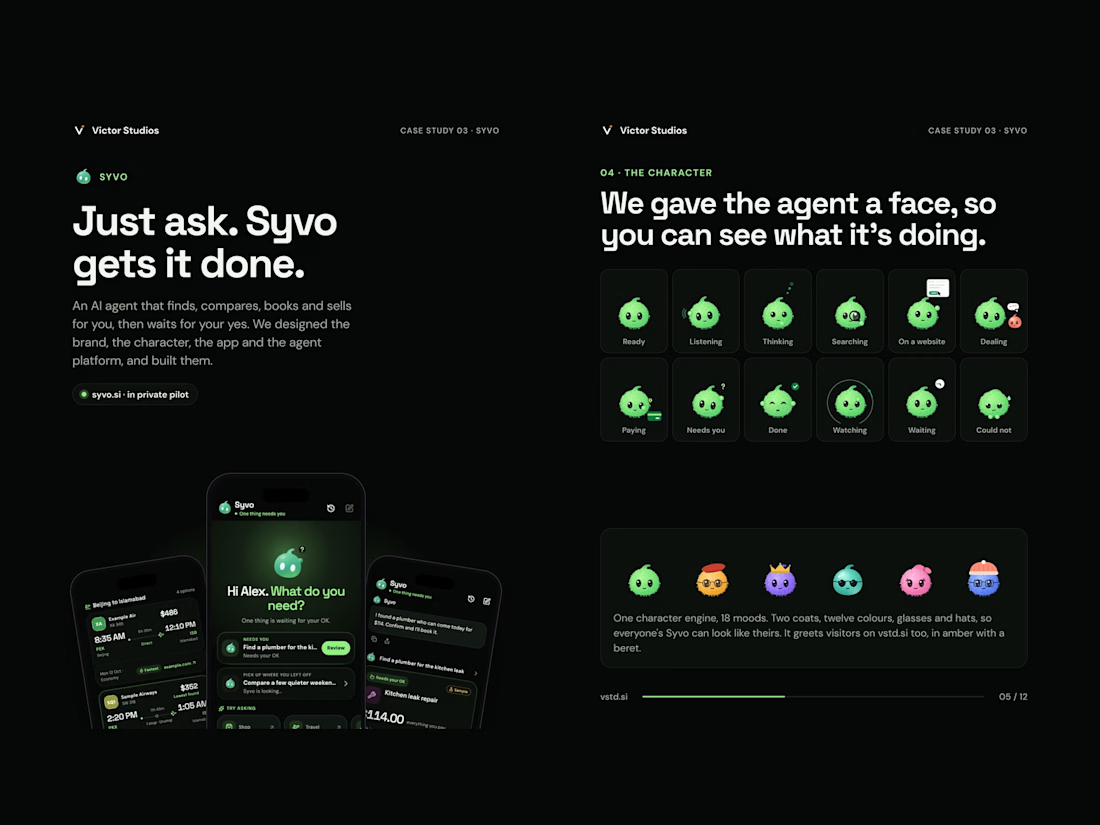
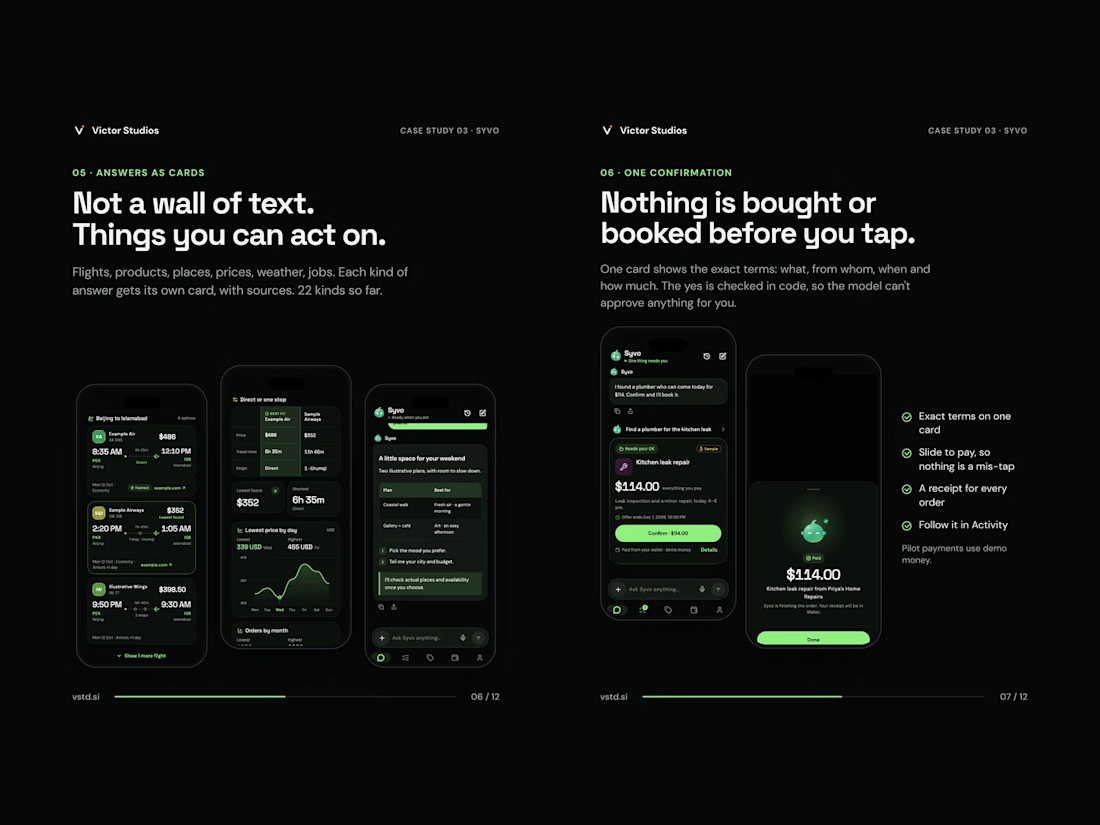
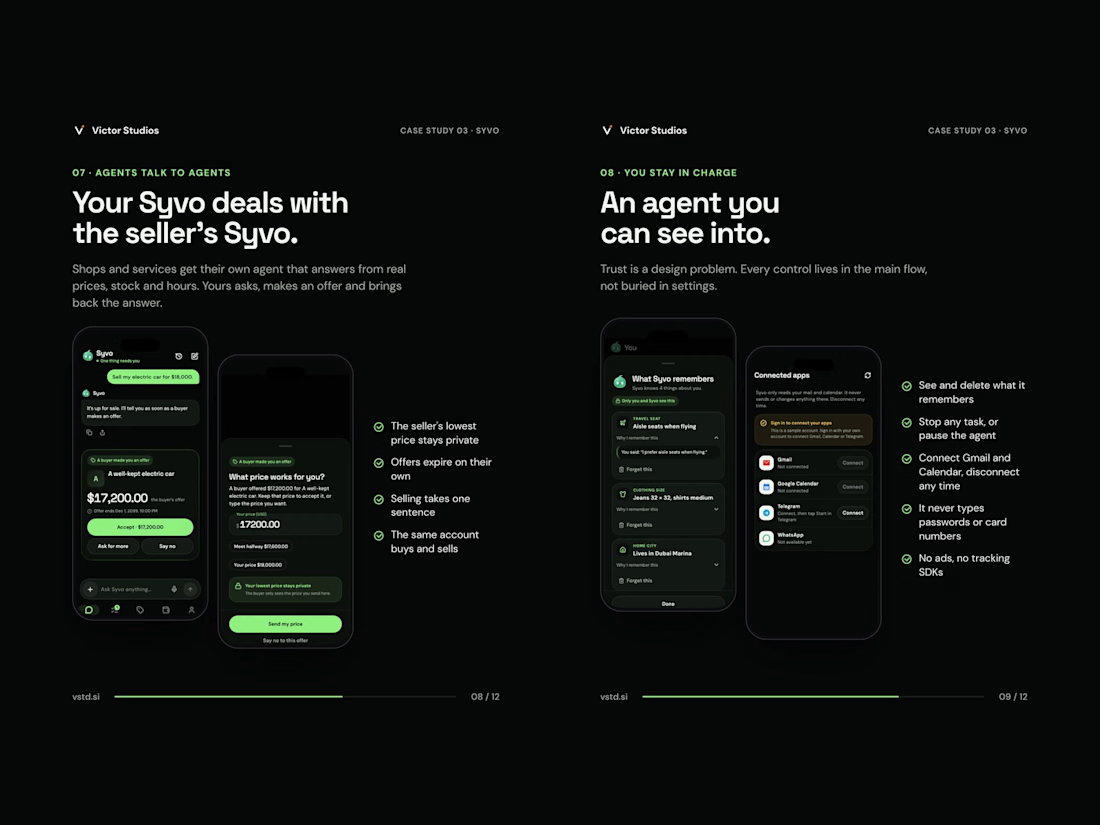
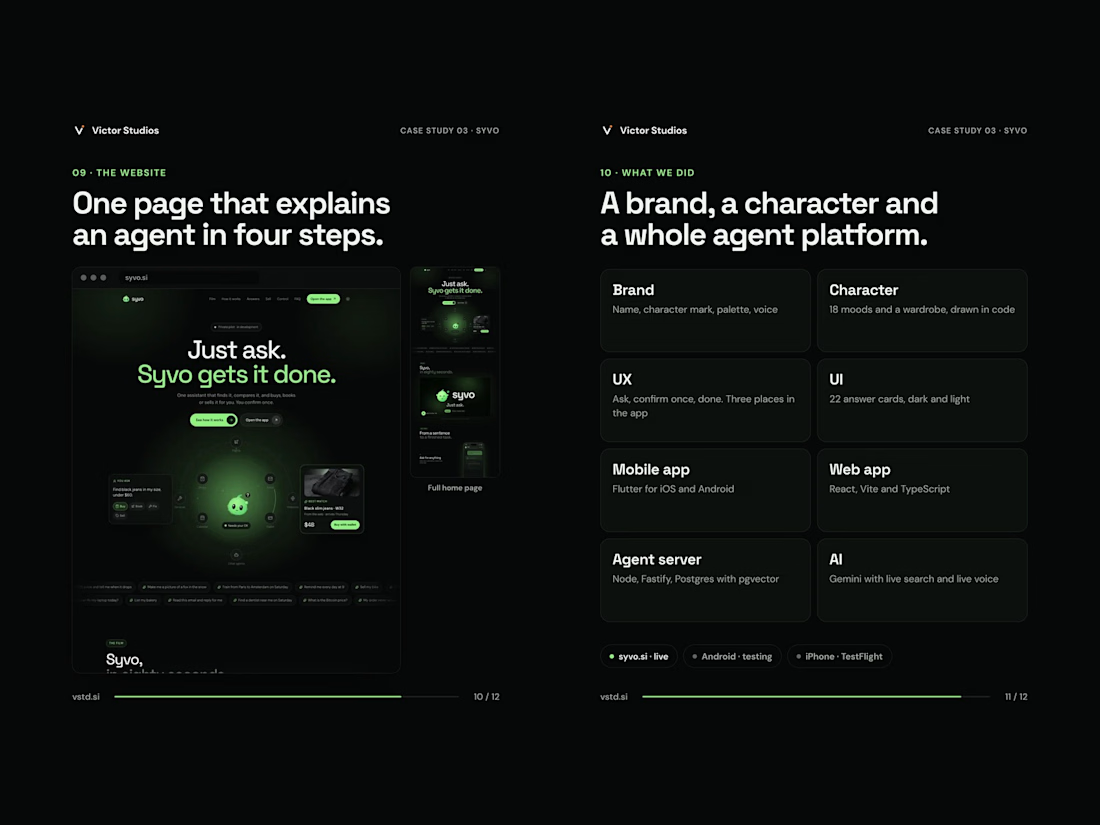

Giving the agent a face with 18 moods is such a smart trust move. Instead of a wall of text, you can see what it is doing, and that makes the whole autonomous concept feel human and approachable.

Project AIR is an open-source toolkit that keeps a tamper-proof record of what AI agents do. Every action an agent takes gets signed, chained to the step before it, and tied to the person who authorized it. The chain is anchored to Sigstore Rekor, a public transparency log, so anyone can check later that nothing was changed or deleted. When something goes wrong, you can show exactly what happened and who approved it, instead of just saying it happened.
It also runs 16 detectors over every record, covering all ten risks on the OWASP Top 10 for Agentic Applications, three from the OWASP list for LLM apps, and three of its own. It can stop an agent mid-action until a person signs off. It plugs into LangChain, LlamaIndex, and the OpenAI, Anthropic and Gemini SDKs with a line or two of code.
I built the Python library and command-line tool, published on PyPI as projectair (now at version 1.3.1) under the Apache 2.0 license, plus the website and dashboard in SvelteKit. We run it on our own infrastructure too: every request to vindicara.io is recorded and anchored to Rekor every minute.


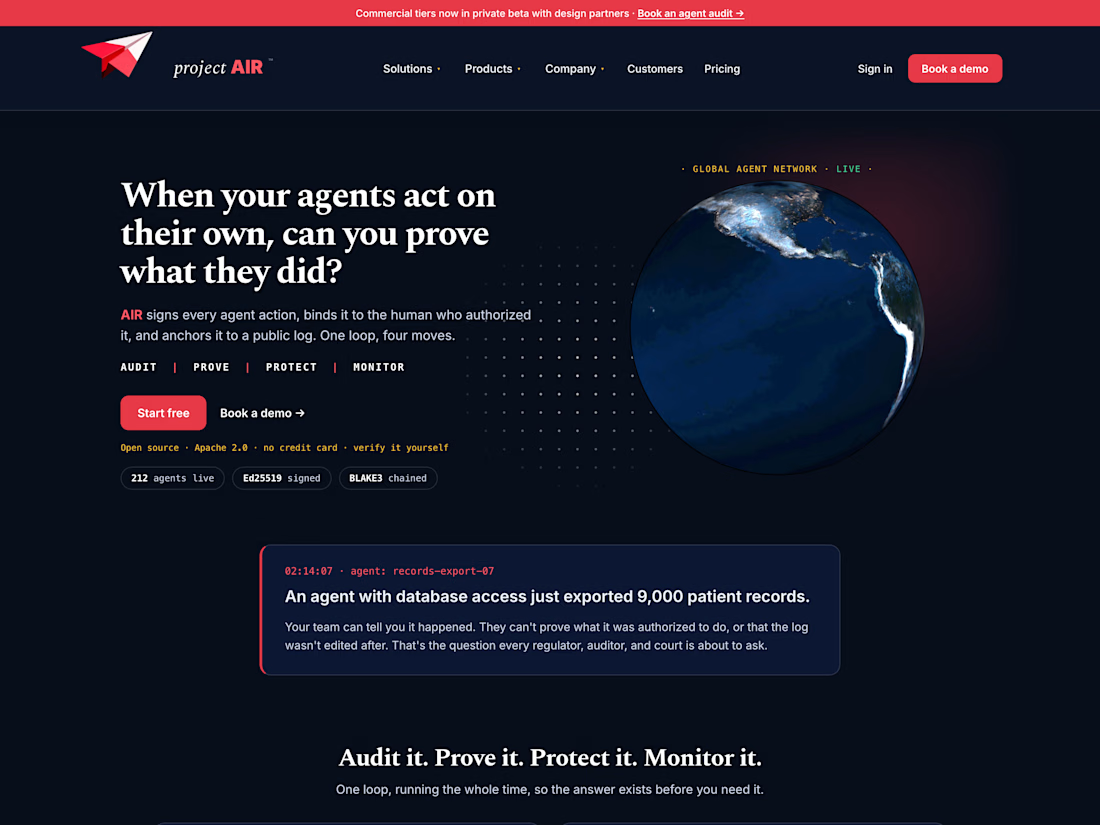

Impressive work! 👏 Excellent approach to AI agent security, tamper-proof audit trails, and human oversight for more trustworthy AI systems.