The network for creativity
Join 1.25M professional creatives like you
Connect with clients, get discovered, and run your business 100% commission-free
Creatives on Contra have earned over $150M and we are just getting started
Back to feedPost

Project AIR is an open-source toolkit that keeps a tamper-proof record of what AI agents do. Every action an agent takes gets signed, chained to the step before it, and tied to the person who authorized it. The chain is anchored to Sigstore Rekor, a public transparency log, so anyone can check later that nothing was changed or deleted. When something goes wrong, you can show exactly what happened and who approved it, instead of just saying it happened.
It also runs 16 detectors over every record, covering all ten risks on the OWASP Top 10 for Agentic Applications, three from the OWASP list for LLM apps, and three of its own. It can stop an agent mid-action until a person signs off. It plugs into LangChain, LlamaIndex, and the OpenAI, Anthropic and Gemini SDKs with a line or two of code.
I built the Python library and command-line tool, published on PyPI as projectair (now at version 1.3.1) under the Apache 2.0 license, plus the website and dashboard in SvelteKit. We run it on our own infrastructure too: every request to vindicara.io is recorded and anchored to Rekor every minute.


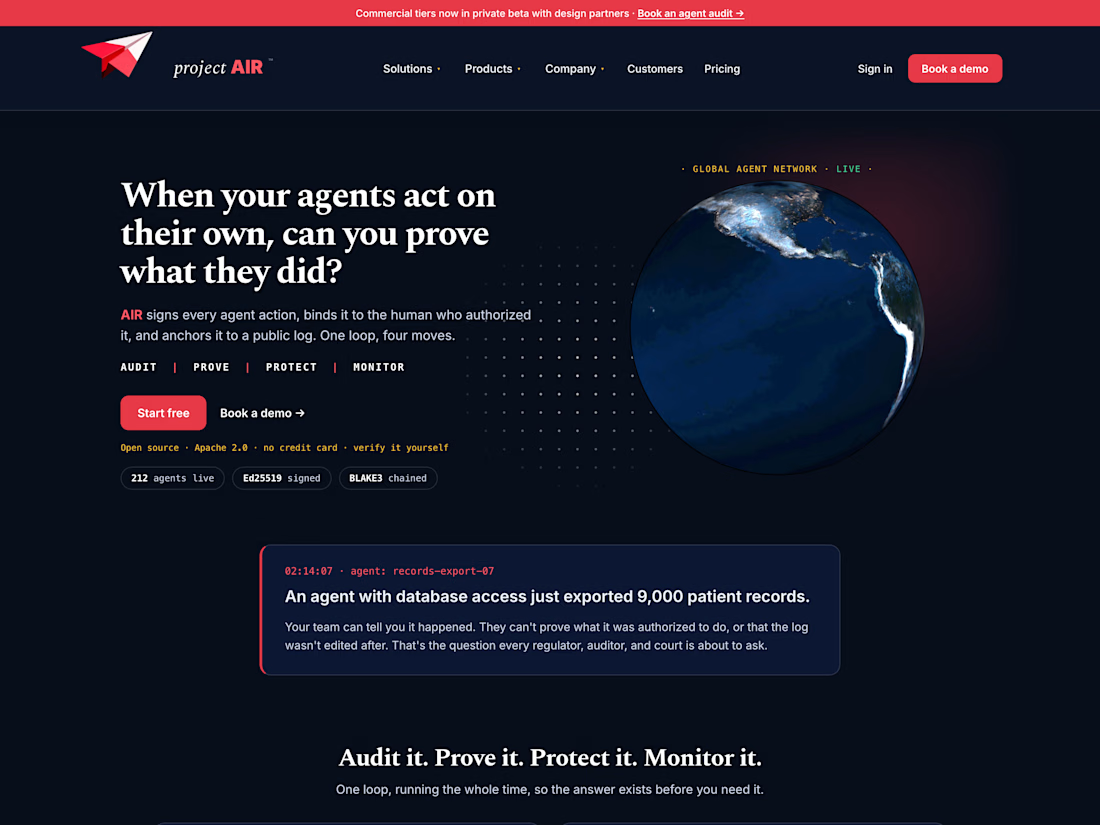

This is the layer most agent demos skip. Building agentic systems myself, I know the gap: signing and chaining each action to the person who authorized it, anchored to Rekor so it can’t be quietly edited later, turns “the agent did it” into something you can actually prove. The...
Thank you. its actually depends where you look. The live terminal alert is just the flagged step: detector, title, step, description. The dashboard shows more: the halted action with its arguments, the findings tied to that step, and the timeline around it. The full chain is in...

Pausing an agent mid-action until someone signs off is the part most teams skip. Nice work getting it onto PyPI.
Thanks Muhammad. That pause is the whole point for me. An agent shouldn’t take an action that can’t be undone until a person signs off, and the approval should be part of the signed record, so you can prove later who approved what and when.
Makes sense. Having the approval in the record is the part most setups miss.
The network for creativity
Join 1.25M professional creatives like you
Connect with clients, get discovered, and run your business 100% commission-free
Creatives on Contra have earned over $150M and we are just getting started






Related posts

AI Agent Automation & Intelligent Workflow System
Building a smart AI agent powered by advanced AI models and workflow automation.
Integrating webhooks, AI memory, conditional routing, and automated responses.
Designed for customer support, product recommendations, and intelligent task handling.
Creating scalable, efficient, and business-focused AI automation solutions.
Designed & Developed by Shubham Tripathi.


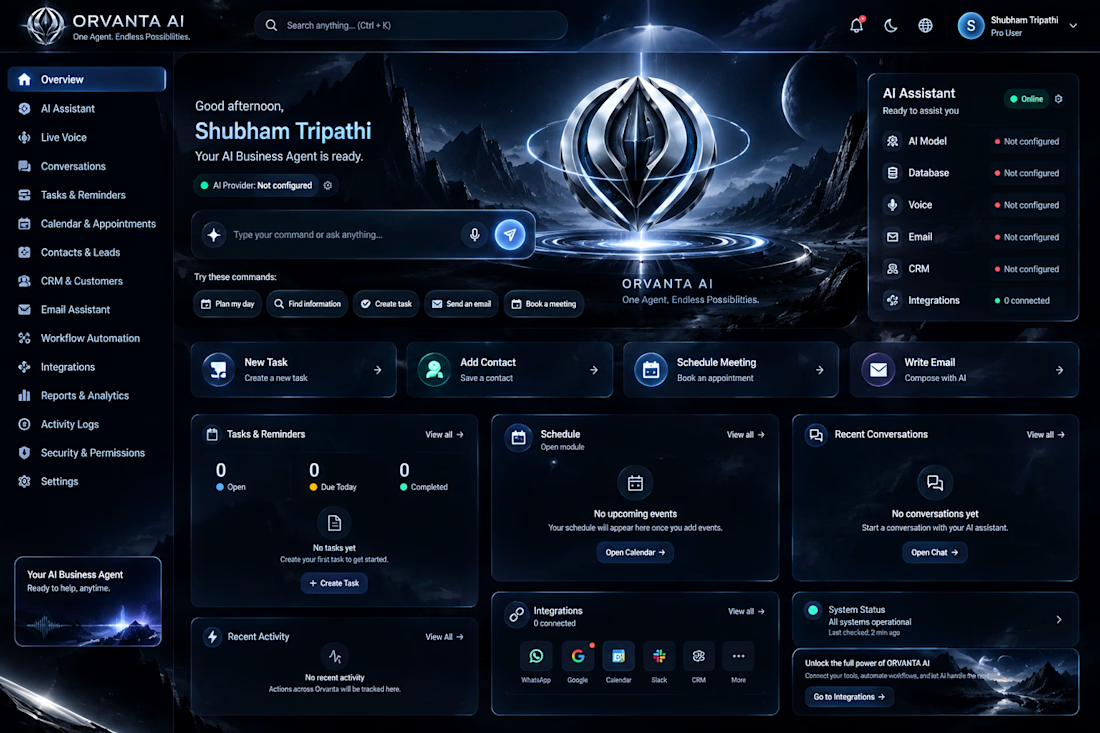

I really found this so amazing personally

When a competitor changes its website, what actually deserves action?
I built the full Eris Agent application and website around a practical workflow:
• Compare your website with confirmed competitors.
• Review page and offer changes with source links and collection dates.
• Save findings as reports and follow-up actions.
• Keep incomplete checks clearly marked, so missing evidence does not look like a confident conclusion.
The product lesson: a monitoring dashboard becomes more useful when someone can trace a finding back to its source and decide what to do next.
Here is the application case study: https://contra.com/p/LQOEPvbB-eris-agent-competitor-intelligence-app-and-website
I build web apps, MVPs and scoped AI/agentic workflows for founders and agencies.
Which competitor change would you want flagged first: pricing, offers or positioning?


does it catch pricing changes? that's the signal i'd care about most

🚀 Introducing WanderLust — My Full-Stack Web Development Project
I built WanderLust, a full-stack booking web application using Node.js, Express.js, MongoDB, and EJS.
✨ Key features:
User authentication and authorization
Create, edit, and manage property listings
Reviews and booking functionality
Image uploads using Cloudinary
Interactive maps with Mapbox
Search and category filters
🛠️ Tech Stack: JavaScript, Node.js, Express.js, MongoDB, Mongoose, EJS, Passport.js, Cloudinary, and Mapbox.
This project helped me strengthen my backend development, database integration, authentication, and deployment skills.
I'm a junior full-stack developer interested in building useful web applications and collaborating on real-world projects.
🔗 Live Demo: https://wanderlust-tphz.onrender.com
💻 GitHub: https://github.com/Aabi-dev10/WanderLust
#FullStackDevelopment #MERNStack #JavaScript #WebDevelopment #NodeJS

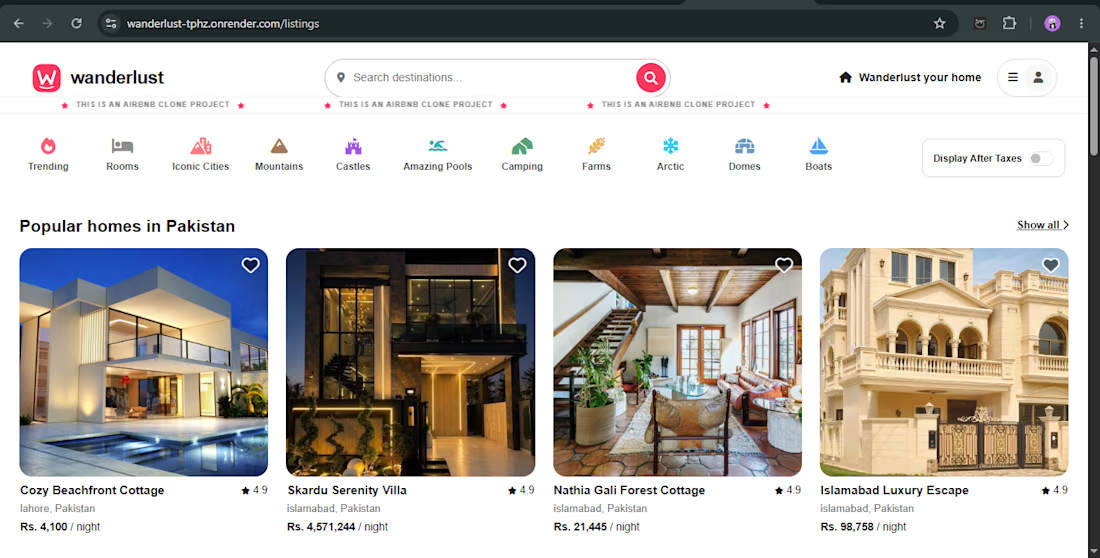
did you build the reviews and booking flow first?