The network for creativity
Join 1.25M professional creatives like you
Connect with clients, get discovered, and run your business 100% commission-free
Creatives on Contra have earned over $150M and we are just getting started
Back to feedPost

What Does Your Next.js Test Actually Prove? A passing test is useful when its name tells you exactly what it checked.
In my latest Next.js Notes article, I start with a small Pages Router example: render a page component with React Testing Library and find its heading by accessible role and name.
That proves the component renders the expected heading in the test DOM. It doesn’t request a URL, check Next.js routing, or prove someone can navigate there in a running app.
Before adding more assertions, separate three questions:
Does the component render the expected content?
Can a browser load the route?
Can someone reach it through the app’s navigation? Those need different checks. A green component test shouldn’t quietly become evidence for all three.
I’ve included the Vitest, jsdom and React Testing Library setup, plus the first test, in the full walkthrough. It’s specifically for the Pages Router, not a blanket recipe for async App Router components.



The network for creativity
Join 1.25M professional creatives like you
Connect with clients, get discovered, and run your business 100% commission-free
Creatives on Contra have earned over $150M and we are just getting started
Related posts


All looks so clean!

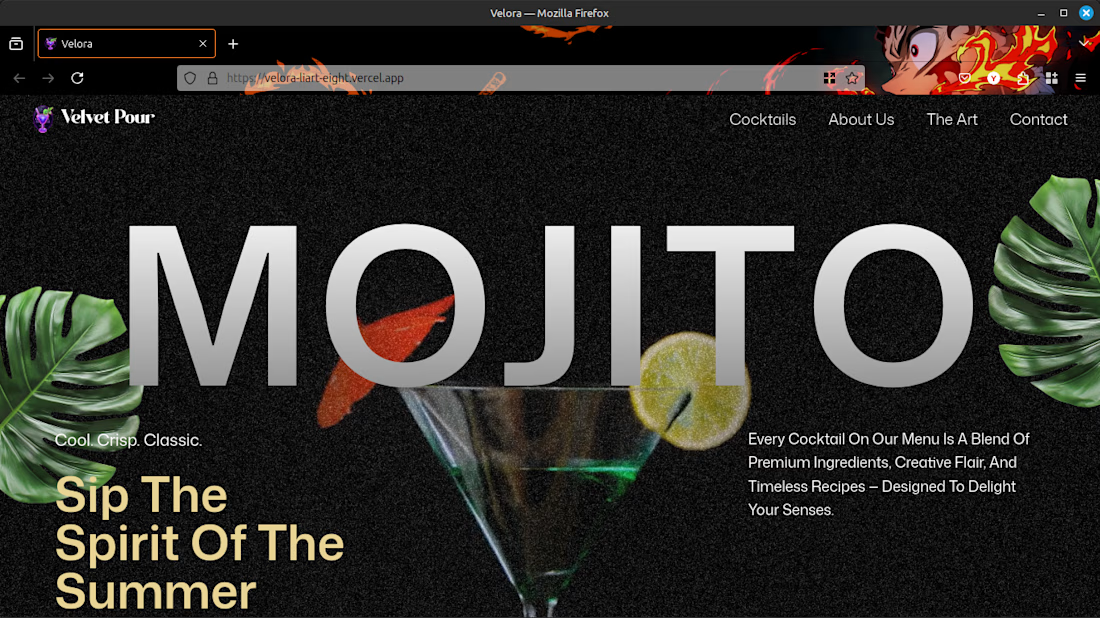
Created an immersive cocktail website focused on modern visual design, smooth animations, and interactive storytelling.
Developed an engaging landing page with visually rich content sections.
Implemented scroll-triggered animations and transitions using GSAP and ScrollTrigger.
Focused on responsive layouts, typography, and polished user interactions.
Applied modern frontend development practices to create an engaging browsing experience.
Tech stack: React.js, JavaScript, GSAP, ScrollTrigger, CSS.
Project links:
GitHub: https://github.com/TrainedDev/Velora
Live demo: https://velora-liart-eight.vercel.app/



Want an online store that looks like a luxury brand and actually turns visitors into buyers? I design and build complete, fully responsive e-commerce websites, from the first page to the final checkout.
Every store is custom-made for your brand. My sample project, Atelier Vane, a luxury leather goods store, shows the level of detail you can expect.
WHAT'S INCLUDED
Custom design with your logo, colors, and fonts
Product pages with image galleries, prices, and details
Working cart and smooth checkout flow
Fully responsive on mobile, tablet and desktop
Content upload and design customization
ADVANCED FEATURES (higher packages)
Search, wishlist and quick view
Product customizer (monogram, color, hardware)
Customer account area, reviews and order tracking
Booking system for consultations
HOW IT WORKS
You share your brand and products
I plan the design and layout
I build and test on all devices
I deliver on time, revisions included
Need more pages, products, faster delivery, or extra revisions? Add-ons are available. Message me first, and I will recommend the best package for you.
ecommercewebdesignresponsivedesigneCommerce ManagementFigma MakeReactTailwind CSSResponsive DesignWeb Design
