The network for creativity
Join 1.25M professional creatives like you
Connect with clients, get discovered, and run your business 100% commission-free
Creatives on Contra have earned over $150M and we are just getting started
Back to feedPost

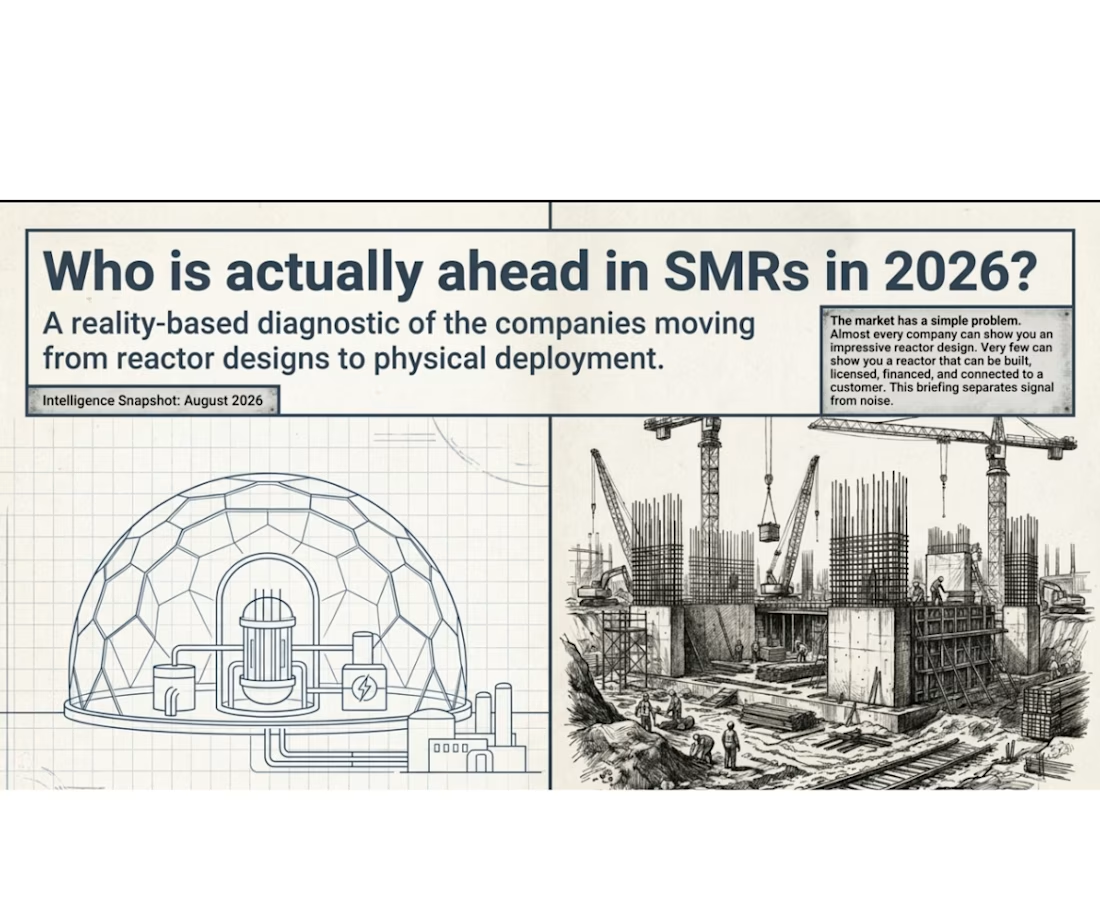
Who Is Actually Ahead in SMRs in 2026?
A reality-based diagnostic of the companies moving from reactor designs to physical deployment.
The small modular reactor industry is full of impressive reactor designs, ambitious timelines and billion-dollar announcements.
But there is a much harder question:
Who is actually ahead?
This research project examines the leading SMR developers through a different lens: verified progress toward physical deployment, not company claims or design maturity alone.
I built a reality-based comparison of companies moving through the difficult chain from reactor concept to an operating commercial plant:
Design → licensing → construction → financing → supply chain → grid connection → deployment.
The result is a competitive diagnostic designed to separate what companies say they will build from what they have actually demonstrated.
What the research examines
Reactor design maturity
Regulatory progress
Construction status
Financing and project backing
Manufacturing and supply-chain readiness
Customer commitments
Expected deployment timelines
Grid and site development
Commercial readiness
Evidence behind each major company's claim
Rather than treating every announced project equally, the analysis gives greater weight to physical and regulatory milestones that are independently verifiable.
The central finding
The SMR market does not have a shortage of reactor designs.
There is a shortage of companies that can demonstrate the complete path from design to a licensed, financed, constructed, and connected reactor.
That distinction changes the leaderboard.
A company with a technically advanced reactor but no construction project should not automatically rank above a developer that has already moved steel, concrete, and regulatory approvals into the real world.
The solution: an evidence-based deployment framework
I developed a practical comparison framework that evaluates companies across the deployment chain rather than relying on a single headline milestone.
The framework asks:
Can it be licensed?
Can it actually be built?
Is someone financing it?
Is there a credible customer or site?
Is the supply chain developing?
Is construction physically underway?
Is there a realistic path to grid connection?
This creates a more useful distinction between technology potential and deployment reality.
What I produced
Competitive SMR leaderboard
Company-by-company evidence analysis
Verified milestone comparison
Claim-versus-evidence assessment
Regulatory and construction-status analysis
Deployment-readiness framework
Data-centre suitability comparison
100 MW and 500 MW application analysis
Visual comparison tables and charts
Evidence hierarchy and source register
My role
Researcher • Investigative Writer • Analyst • Information Designer
I researched and structured the evidence, challenged the company's claims against verifiable milestones, built the comparative framework, and translated a technically complex nuclear energy market into a clear decision document.
The objective was not to predict who would win the SMR market.
It was to answer a more useful question:
Who has actually moved furthest from reactor design toward deployment?
Read the comprehensive research 👇


The network for creativity
Join 1.25M professional creatives like you
Connect with clients, get discovered, and run your business 100% commission-free
Creatives on Contra have earned over $150M and we are just getting started





Related posts




Love the cute concept! The logo icon and mockups feel so cozy and welcoming ☕✨

I'm a creative Graphic Designer with expertise in YouTube thumbnails, branding, and modern website graphics. I deliver clean, professional, high-quality designs fast.


Cadence: Coffee Subscription App Concept
A self initiated mobile app concept for a specialty coffee subscription, built around one idea: the customer controls the rhythm. Most subscriptions make skipping a delivery harder than signing up. Cadence makes it two taps.
The project covers one core flow and the states around it:
Onboarding: setting a delivery rhythm
Home: next bag, delivery progress, and coffee left
Delay or skip, with the new date shown up front
Confirmation with undo
Error and paused states, so the flow holds up beyond the happy path