The network for creativity
Join 1.25M professional creatives like you
Connect with clients, get discovered, and run your business 100% commission-free
Creatives on Contra have earned over $150M and we are just getting started
Back to feedPost

How I Turn Complex SOPs Into Dynamic Workflows
I built a walkthrough of the method I use to transform complex operational procedures into structured, dynamic SOP workflows.
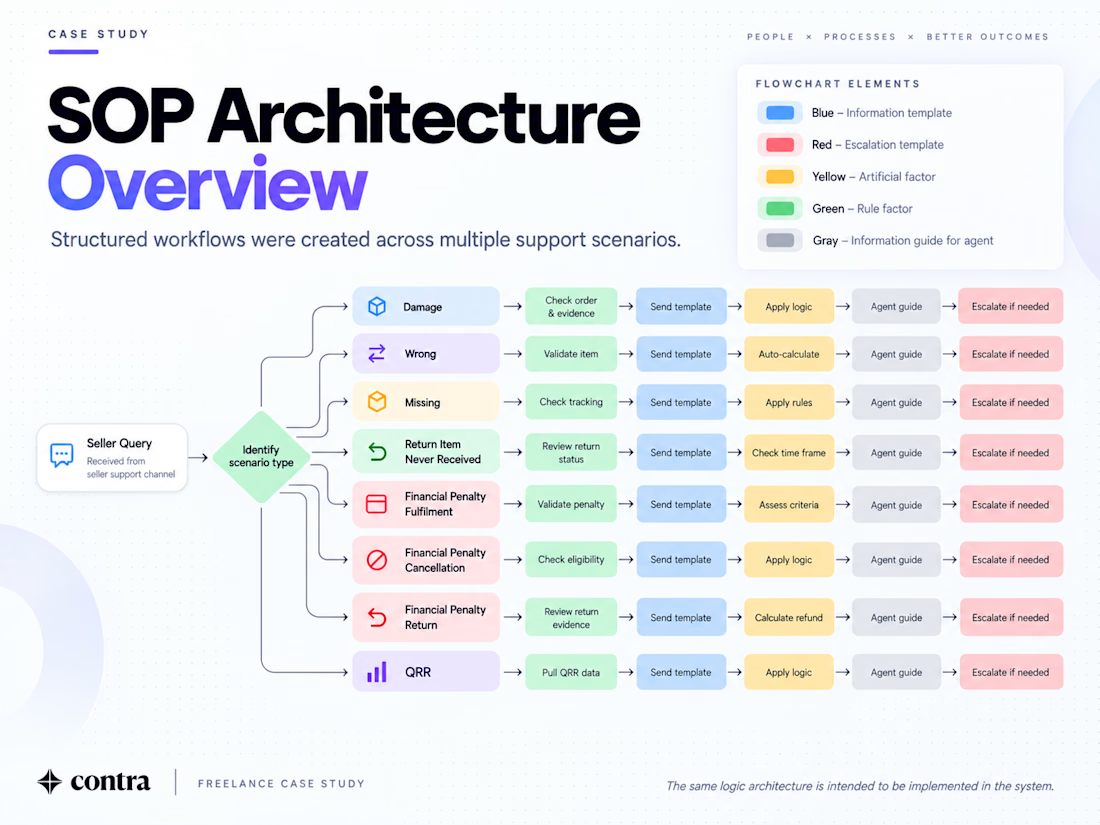
The process starts before anything is built in the system. First, I map the existing process in the correct operational order and break each scenario into decision points, rules, required information, resolutions, and escalation paths. The mapped flow is then reviewed with the relevant stakeholders so that the logic reflects the approved business process rather than an individual interpretation.
Once the process is approved, I convert each mapped path into structured SOP content. Different node types are used for different purposes—for example, rule factors, system-generated or artificial factors, FCR resolutions, NFCR resolutions, sub-SOPs, contact reasons, and information nodes. This makes a large procedure easier to understand, maintain, and eventually configure inside the operational system.
The final architecture is then recreated in the workstation platform. Instead of asking an agent to search through long documents and interpret the next step manually, the system can guide the agent through the relevant factors and dynamically return the correct status, action, guidance, or message.
Searchability is also part of the architecture. SOPs can be triggered using either the SOP name or relevant keywords. For example, an account-related issue could be found through terms such as “password reset,” “login issue,” or “account issue.” Frequently used SOPs can also be saved as favourites to reduce repeated search time.
After configuration, the workflow goes through UAT. Issues in logic, wording, routing, system behaviour, or user experience are identified, corrected, and retested before go-live.
The lesson I wanted to share is that a useful SOP is not simply a document. When the process is mapped correctly, approved by stakeholders, structured into reusable decision components, and implemented dynamically, it becomes part of the agent’s workflow.
The approach was developed in an e-commerce support environment, but the same method can be applied to operations in finance, logistics, onboarding, customer service, account management, product support, HR, healthcare administration, and other process-driven environments.
The goal is simple: reduce unnecessary interpretation and screen switching, improve consistency and compliance, shorten handling time, and make it easier for people to reach the correct resolution.
This video focuses on the process and thinking behind the architecture rather than the confidential business content itself. Certain examples, terminology, and details have been anonymized or recreated for demonstration.


Hi there! Please make sure your submission meets all requirements and resubmit to be considered for the prize
The network for creativity
Join 1.25M professional creatives like you
Connect with clients, get discovered, and run your business 100% commission-free
Creatives on Contra have earned over $150M and we are just getting started
Trending
retrofuturism
Share your favorite designs from the past exploring the distant future. Or your own take on the aesthetic 🚀
halftone
Dots. Texture. Grain. Let's see your designs using the halftone technique.

Midjourney
Creatives are showing off what they're making with Midjourney.
colorgrade
Video editors sound off: How do you enhance the mood of your video in color grading?
Related posts


Nice work


I will build a short educational video that uses AI-generated visuals, narration, and storytelling to explain an everyday subject in a simple and engaging way. My goal is to turn a basic topic into something visually interesting and easy to understand.
I chose this project because I believe learning becomes more powerful when information is presented through a combination of visuals, voice, and storytelling. I also want to explore how Descript and AI tools can transform a simple idea into a complete piece of content from concept to final video.

I built a simple workflow for creating consistent AI characters while saving time, money, and generations.
Watch the finished video:
View the final video
I start by creating a character in Midjourney, then refine it in Nano Banana and create a character sheet with different poses and angles.
The key step is using that character sheet together with the visual style and environment from my original Midjourney image. Instead of generating each shot individually, I ask Nano Banana to build a 3x3 grid containing nine different shots of the same character within the same environment. With a detailed prompt, I can define the framing, composition, and action for all nine shots in a single generation.
I can then extract the individual frames from the grid simply by asking Nano Banana to separate them. Finally, I use the most suitable frames as starting frames in tools like Kling or Veo to animate the shots and build the final sequence.
The idea is simple: instead of generating 150 images and throwing most of them away, I create a visual system first and generate multiple usable shots at once. It saves generations, reduces costs, and gives me much more consistency and control over the final video.