The network for creativity
Join 1.25M professional creatives like you
Connect with clients, get discovered, and run your business 100% commission-free
Creatives on Contra have earned over $150M and we are just getting started
Back to feedPost
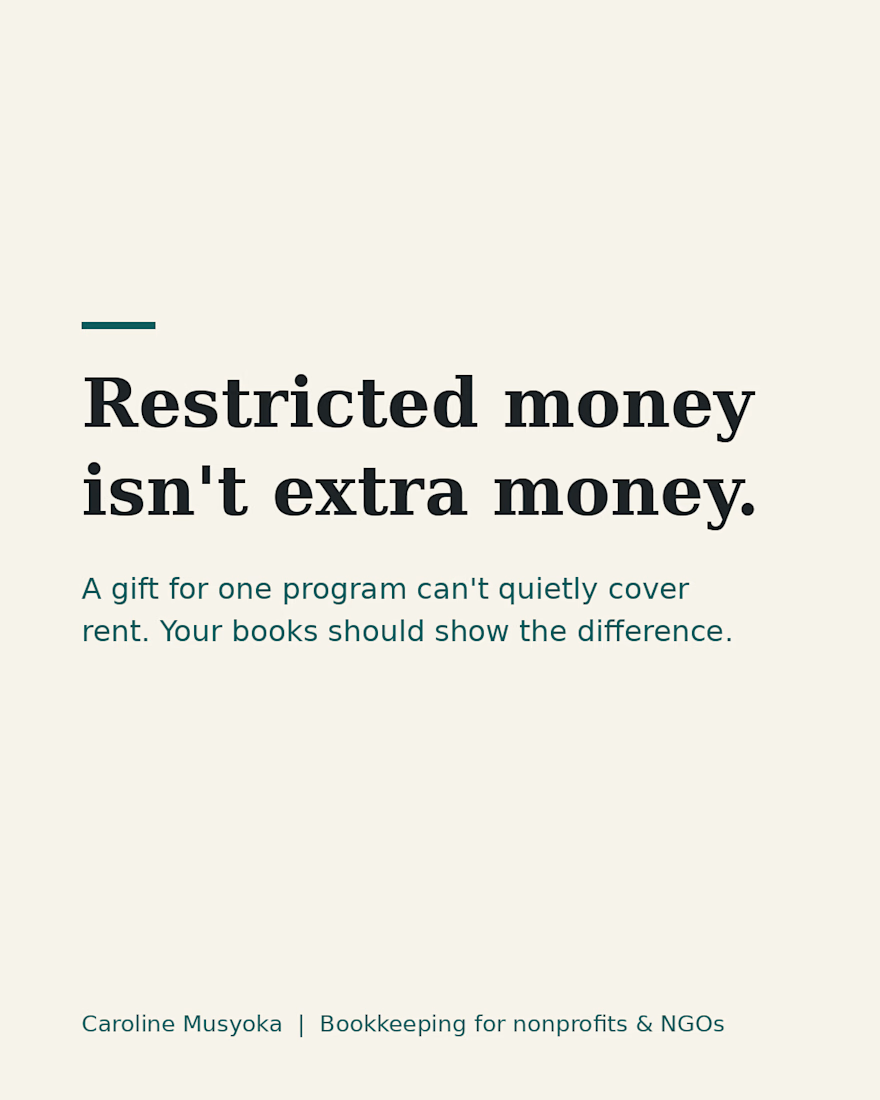
Restricted money isn't extra money.
When a donor gives $20,000 for a youth program, that money can't quietly cover the rent or a salary somewhere else. It has to be spent on what it was given for, and your books need to show that clearly.
When restricted and unrestricted funds get mixed together, the problem usually surfaces months later, when a funder asks where their gift went. Keeping them separate from day one makes that a two-minute answer.

Such an important point! Keeping funds separate from the start saves a lot of confusion later and makes reporting so much easier.

Thank you, Fatima! The confusion usually shows up at the worst time too, right when a funder is asking for a report.

Absolutely! Proper fund tracking is essential for maintaining donor trust and financial transparency. Separating restricted and unrestricted funds from the start helps prevent reporting issues and ensures every contribution is used as intended.
Well said. Donor trust is really the heart of it. Do you find most organizations set this up correctly from the start, or is it something you usually end up fixing after the fact?
The network for creativity
Join 1.25M professional creatives like you
Connect with clients, get discovered, and run your business 100% commission-free
Creatives on Contra have earned over $150M and we are just getting started



Related posts

Landing page design for Lumo — banking for freelance life
Banks sell control — dashboards, charts, a card floating at fifteen degrees. Freelancers don't want control over their money. They want to stop thinking about it in the gap between sending an invoice and the money landing.
That gap is what the page is built on. The product sits in a meadow instead of on a dark grid, because the promise isn't "manage your finances better" — it's "we handle the part that keeps you up." And the strongest line on the page isn't a feature: no waiting for Monday. Freelancers don't lose weekends to fees. They lose them to timing.
The proof follows the same rule. One freelancer, one number — 4% lost on every international payment. A percentage someone can check against their own account beats any adjective.


great visuals 🙌

This is a freestyle Ai edit I did for Ramadan celebration trying to tell a story of giving since the celebration was about giving


A lead who doesn't buy today isn't necessarily a lost opportunity. 🏡
Imagine someone inquires about a property but tells you they're not ready to buy yet.
What do you do?
Do you move on to the next lead and forget about them?
Or do you keep the relationship alive?
Here’s an important lesson about lead nurturing:
Not every lead is ready to buy at the same time.
Some people need to save more money. Others are still comparing properties or waiting for the right opportunity.
As a real estate professional, you can:
→ Understand what the person needs.
→ Share relevant information when appropriate.
→ Follow up at a suitable time.
→ Keep accurate notes so you remember the conversation.
A CRM can help you organize these interactions and remind you when it's time to reconnect.
The goal isn't to pressure people into buying.
It's to be helpful and stay connected until they're ready to take the next step.
Question: How do you stay in touch with potential buyers who aren't ready to purchase yet?
#RealEstate #LeadNurturing #CRM #HubSpot #LeadManagement