The network for creativity
Join 1.25M professional creatives like you
Connect with clients, get discovered, and run your business 100% commission-free
Creatives on Contra have earned over $150M and we are just getting started
Back to feedPost


Kodsinc CRM: AI-First Revenue Intelligence and Sales Management Platform
I designed Kodsinc CRM as an AI-first revenue operating system for modern B2B sales teams. Rather than treating AI as a chatbot added on top of a conventional CRM, the entire product is designed around intelligent agents that continuously understand customers, monitor opportunities, interpret buying signals, prioritize work, assist sales representatives, forecast revenue, automate repetitive activity, and connect every interaction back to measurable commercial outcomes.
Traditional CRMs are primarily systems of record. Sales representatives enter contacts, update stages, create tasks, and managers review reports after the activity has already happened. Kodsinc CRM is designed to operate differently. It functions simultaneously as a system of record, system of intelligence, and system of action.
The CRM records what has happened, AI analyzes what it means, and specialized agents help determine what should happen next.
This creates a connected operating environment covering the complete revenue lifecycle: lead generation, account intelligence, prospect engagement, sales conversations, deal management, forecasting, invoicing, attribution, website intelligence, SEO performance, AI-search visibility, management reporting, and operational administration.
AI Agent Operating Layer
At the centre of Kodsinc CRM is an agentic intelligence layer that continuously works across the CRM rather than waiting for users to manually request assistance.
The agents share access to approved CRM context including accounts, contacts, deals, emails, activities, website behaviour, buying signals, invoices, campaigns, marketing attribution, AI citations, historical performance, and user-defined business rules.
This allows multiple specialized AI agents to work together.
The Revenue Intelligence Agent continuously watches the overall business. It monitors pipeline creation, deal movement, forecast categories, quota attainment, revenue velocity, lead sources, invoice status, marketing contribution, and AI-influenced pipeline. It surfaces important changes to leadership instead of requiring them to search through multiple dashboards.
The Deal Agent monitors every opportunity individually. It understands the deal stage, stakeholders, communication history, website visits, competitor involvement, days in stage, engagement levels, next steps, and close date. It can identify stalled opportunities, missing decision makers, declining engagement, overdue actions, or unusual risk patterns and recommend the most appropriate next action.
For example, rather than simply showing that a deal is worth $48,000 and currently in Proposal, the agent can identify that the economic buyer has not been engaged recently and recommend arranging a CFO review before the expected close date.
The Account Intelligence Agent maintains a living view of every customer and prospect account. It combines firmographic information, people, open opportunities, invoices, engagement history, website visits, sales activity, technology information, acquisition channels, and relationship strength into one account profile. Sales representatives therefore enter a customer conversation already understanding what that company has been researching and how engaged it has become.
The Conversation Agent assists inside the Inbox. It understands previous messages, the associated account, active opportunity, recent activity, and next steps before producing a response suggestion. The user can review, edit, or send the response, preserving human control while dramatically reducing time spent drafting repetitive communication.
The Outreach Agent supports structured multi-step prospecting sequences across channels such as email, LinkedIn and calls. Rather than evaluating outreach only through sending volume, it watches opens, replies, meetings, step-level conversion and sequence performance. Over time it helps identify which message, channel, audience and sequence structure actually produces qualified conversations.
The Forecasting Agent analyzes the probability of revenue landing during the quarter. It combines closed revenue, Commit, Best Case and Pipeline opportunities with individual deal behaviour and recent movement. Instead of merely adding CRM probabilities together, it produces an AI-predicted landing range and explains the factors that are pushing the forecast upward or downward.
The Growth Intelligence Agent connects sales with digital demand generation. It understands how prospects discovered the company through traditional search, AI answer engines, campaigns, referrals, paid traffic and outbound activities. This means management can move beyond asking, “Where did this lead come from?” and begin asking, “Which source, page, AI citation, campaign or search journey actually influenced this revenue?”
The AI Visibility Agent monitors how the company appears inside ChatGPT, Perplexity, Google AI Overviews, Gemini, Copilot and other AI-driven discovery environments. It tracks citations, brand visibility, citation position, sentiment, factual inaccuracies, unanswered high-intent prompts and AI-influenced pipeline.
The Revenue Operations Agent acts as the operational layer across the CRM. It can surface incomplete data, overdue tasks, stale opportunities, missing fields, unassigned records, unusual pipeline behaviour and integration problems. This reduces the administrative burden normally placed on RevOps teams.
Finally, the Finance and Collections Agent connects sales outcomes with invoicing. Once an opportunity becomes revenue, its financial lifecycle remains visible inside the same system. Paid, due, overdue and awaiting invoices can therefore be connected back to the account and opportunity that generated them.
Together these agents transform Kodsinc CRM from a database users maintain into a platform that actively helps operate the revenue function.
Command Center
The Command Center acts as the executive cockpit of Kodsinc CRM.
It immediately presents closed-won revenue, open pipeline, quota attainment, revenue versus target, pipeline distribution, invoice status, AI-search visibility, recent activity and deals expected to close during the current quarter.
Instead of forcing managers to move through several reporting applications, the screen combines commercial performance, pipeline health, cash status and growth intelligence in one view.
The system is designed around exception management. Management does not need to inspect every opportunity manually. AI highlights meaningful changes such as a high-value deal losing momentum, an invoice becoming overdue, an important prospect reopening a proposal, an AI citation suddenly improving, or pipeline coverage falling below acceptable levels.
Every metric is also actionable. Pipeline numbers lead directly into opportunities, forecast values lead into revenue intelligence, invoice metrics lead into billing, and AI visibility metrics lead into the growth intelligence module.
The result is not simply a dashboard showing what happened. It is a control centre for deciding where the team needs to act next.
Intelligent Sales Pipeline
The Pipeline workspace manages every active opportunity visually across stages such as Discovery, Qualified, Demo, Proposal and Negotiation.
Each deal card communicates more than an opportunity name and monetary value. It includes account context, expected close date, time spent in the current stage, forecast category, health score and acquisition source.
This allows managers to understand both the financial value and underlying quality of the pipeline.
Deals can be moved between stages through drag-and-drop interaction. When an opportunity changes stage, associated probability, forecast contribution and pipeline totals can update automatically.
The deeper intelligence comes from AI monitoring the movement itself.
The system can identify:
opportunities spending unusually long periods in a stage;
high-value deals without recent contact;
close dates repeatedly being moved;
missing economic buyers;
falling engagement;
unusually strong intent signals;
opportunities whose stated stage does not match observed behaviour;
deals that should potentially move into Commit or out of the current forecast.
Instead of forcing managers to run weekly pipeline-cleaning exercises manually, Kodsinc CRM makes pipeline hygiene part of the operating system.
Deal Intelligence and Deal 360
Opening an opportunity moves the user into Deal 360.
This screen becomes the complete operating environment for that commercial opportunity.
The CRM displays the stage, amount, probability, forecast category, close date, opportunity type, acquisition source, first-touch source, last-touch influence, time in stage, health indicators, competitors and account owner.
More importantly, it combines traditionally disconnected events into a single chronological activity timeline.
Emails, calls, meetings, notes and stage changes can appear alongside website visits, proposal engagement and AI-search citations.
For example, a representative could see that a prospect:
first discovered the company through Google,
attended a webinar,
visited the pricing page three times,
opened a proposal,
appeared through a Perplexity citation,
and later replied to the sales representative.
That sequence gives the seller a far more complete understanding of buying behaviour than an ordinary CRM activity log.
The Deal Agent continuously analyzes this information and can recommend a next-best action.
A deal health score becomes explainable rather than decorative. The system can show which behaviours are strengthening or weakening the opportunity so representatives understand why the AI considers something risky.
Accounts and Contacts
The Accounts and Contacts workspace provides the master customer database.
Accounts include information such as company size, industry, geography, owner, annual recurring revenue, health, active opportunities, acquisition channel and recent activity.
Contacts contain relationship-level information including title, account, deal role, qualification score, source, engagement state and last interaction.
Contacts can be classified as Champions, Decision Makers, Influencers, Blockers or Users, giving sales teams visibility into the political structure of an opportunity.
AI scoring can prioritize people and accounts using explicit evidence rather than opaque numerical scoring.
For example, a high prospect score could be explained through factors such as seniority, company size, webinar attendance, repeated pricing-page visits or direct email engagement.
This allows sellers to understand why someone is important rather than simply being told that a lead has a score of 91.
Account 360
Account 360 combines every relevant commercial signal for a company.
Sales representatives can see annual revenue contribution, account health, open pipeline, lifetime value, company characteristics, technology stack, contacts, opportunities, invoices and recent engagement.
An Engagement view connects CRM activity with web behaviour.
Instead of website analytics remaining anonymous inside a marketing product, known-account behaviour can be attached to the customer record.
The account team might therefore see that a company has recently visited the pricing page fourteen times, viewed a forecasting product page nine times and visited a competitor comparison page six times.
These behaviours become valuable buying signals.
The Account Intelligence Agent can then summarize what is happening across the account and surface meaningful changes before a seller begins their next conversation.
Unified Inbox and Activity Management
The Inbox combines customer conversations and sales work in one place.
Email, LinkedIn-compatible messages and other supported communication channels can appear in a unified conversation view.
Users can see unread messages, tasks due today, overdue activities and conversations connected to specific accounts or opportunities.
Opening a conversation simultaneously displays the message thread and CRM context.
Instead of switching from email to CRM to account records to opportunity notes, the seller can immediately see who the person is, which company they belong to, what opportunity is active and what the next step should be.
The AI Conversation Agent can draft replies using that complete context.
Crucially, AI-generated responses are treated as recommendations rather than autonomous truth. Users can review and modify the generated content before sending it.
Task management is also integrated into the same workflow. Completing a task updates activity records and reduces outstanding workload immediately.
This creates a daily workspace in which sellers can operate without repeatedly moving between CRM, email, task management and prospecting applications.
AI-Assisted Outreach
The Outreach workspace manages multi-step sales sequences.
Teams can create structured cadences containing combinations of email, waiting periods, LinkedIn activity and calls.
Each sequence tracks enrolment, open rates, response rates, meetings booked and performance at individual steps.
This makes the system useful for both SDR execution and management optimization.
The Outreach Agent can analyze which steps produce engagement and which steps cause prospects to disappear from the sequence.
Templates can then be evaluated using actual downstream outcomes instead of only open rates.
The objective is not simply “send more messages.” The objective is to continuously improve which people are contacted, what is communicated, when communication occurs and which channel is most appropriate.
Over time, the platform can use this information to recommend sequence structures and messaging based on prospect segment, seniority, industry, previous engagement and buying signals.
Revenue Forecasting
The Forecast workspace turns pipeline data into a forward-looking revenue model.
Management can see Closed Won, Commit, Best Case, Pipeline and projected quarter-end revenue compared with quota.
A traditional CRM forecast often depends heavily on seller-selected probabilities.
Kodsinc CRM adds a behavioural intelligence layer.
The Forecasting Agent can consider opportunity movement, engagement patterns, close-date changes, stakeholder coverage, historical conversion, opportunity health and recent events before producing an expected landing range.
The output therefore includes both a prediction and confidence interval.
More importantly, the system explains why the prediction changed.
Management might see positive drivers such as three opportunities moving into Commit, alongside negative drivers such as a major deal slipping four days.
Forecasting therefore becomes a management conversation supported by evidence rather than a single unexplained number.
Individual sales representatives can also be expanded to inspect the opportunities contributing to their forecast, making the model auditable.
Billing, Invoicing and Deal-to-Cash Management
Kodsinc CRM continues tracking a customer after the opportunity closes.
The Invoices and Billing workspace displays paid revenue, amounts due, contracted balance, overdue invoices, invoice status, recent transactions and available payment methods.
Invoices remain linked to their original accounts and deals.
This provides a true deal-to-cash workflow.
A sales leader can therefore follow an opportunity from pipeline creation through close, invoice generation and eventual payment without losing context between CRM and finance systems.
New invoices can be generated directly from the CRM. Existing invoices can be previewed, reminders can be issued, and payment status changes can update financial metrics.
Overdue invoices can also become operational signals.
Instead of Finance discovering a problem separately, the account owner can immediately see that an important customer has an overdue balance and adjust the commercial conversation accordingly.
Web Analytics
The Web Analytics module brings acquisition behaviour directly into the revenue platform.
It tracks sessions, users, engagement time, bounce rate, conversion rates, traffic channels, landing pages, devices, geography and the complete marketing-to-revenue funnel.
A real-time visitor view provides current website activity, while historical visualizations explain longer-term trends.
The important difference is that web analytics are not isolated from CRM outcomes.
Traffic channels can be connected to leads, opportunities and closed-won revenue.
AI answer engines are specifically tracked as their own acquisition channel, allowing teams to compare traffic and conversion from services such as ChatGPT, Perplexity, Gemini and Copilot against traditional channels.
This helps answer a commercially important question:
Which digital discovery environments are actually creating customers?
SEO Intelligence
The SEO workspace monitors conventional search visibility.
It tracks organic traffic, impressions, CTR, average ranking position, domain strength, keyword movement, referring domains, backlinks, indexed pages and Core Web Vitals.
Keywords can be connected with landing pages and AI Overview presence.
Technical SEO issues are also surfaced directly in the CRM environment.
Instead of presenting technical problems without commercial context, AI can generate remediation guidance and help teams understand which issues may affect high-value pages or revenue-producing search journeys.
This connects the work of growth teams with the same commercial dataset used by Sales and RevOps.
AI Visibility: AEO, GEO and LLMO
AI Visibility is one of the defining capabilities of Kodsinc CRM.
As buyers increasingly ask AI systems for recommendations rather than relying entirely on traditional search engines, the platform monitors how the company appears inside those AI-generated answers.
The module covers three complementary disciplines.
AEO — Answer Engine Optimization measures visibility in answer-oriented search experiences such as featured snippets, People Also Ask results, structured answers and schema-driven results.
GEO — Generative Engine Optimization measures brand presence and citation position inside generative search environments such as Google AI Overviews, Perplexity, ChatGPT Search, Copilot and Gemini.
LLMO — Large Language Model Optimization measures how often a brand appears within LLM-generated answers, its share of model voice, citation frequency, sentiment and factual accuracy.
Kodsinc CRM can therefore track questions that prospective customers are asking AI systems and determine whether the company appears in the answer.
It can also compare visibility across different engines.
A GEO matrix can show which queries receive strong citations and which engines fail to mention the company.
The platform can identify high-intent prompt gaps where competitors appear but the company does not.
AI can then create a content brief designed to address the missing information.
The platform also detects factual errors.
For example, if an AI engine incorrectly describes pricing, lists an obsolete integration or attributes a competitor capability to the company, Kodsinc CRM creates an alert.
The AI Visibility Agent can draft a correction strategy, supporting content or structured-data recommendation for review.
This turns AI-search visibility into an operational business process rather than an experimental marketing metric.
Revenue Attribution
The Attribution workspace connects marketing investment with commercial results.
Users can analyze first-touch, last-touch, linear and time-decay attribution models.
Channels can be evaluated against spend, sessions, leads, pipeline generated, closed-won revenue, CAC and return on investment.
The platform also visualizes actual customer journeys.
A successful opportunity might follow a journey such as:
Organic Search → Pricing Page → Perplexity Citation → Demo → Closed Won.
This is extremely valuable because modern B2B buying journeys are rarely attributable to a single click.
Kodsinc CRM preserves that multi-touch context while still allowing management to understand which channels materially influence revenue.
AI answer engines therefore become measurable alongside outbound, paid advertising, events, referrals and conventional organic search.
Reporting and Revenue Analytics
The Reports workspace gives leadership and RevOps teams a configurable analysis environment.
Reports can combine Sales, Growth and Finance data because the underlying platform works from one connected revenue model.
Users can create reports around metrics such as AI-sourced pipeline, quarter performance, keyword movement, accounts receivable ageing, pipeline velocity or campaign ROI.
Metrics, dimensions, filters and visualization formats can be configured directly.
Reports can also be scheduled for recurring distribution.
Instead of rebuilding management packs manually every week, teams can create persistent reporting views that remain connected to live CRM data.
The AI layer can eventually extend this into narrative reporting by explaining material changes such as:
“Pipeline increased 11% this week, primarily due to three AI-sourced opportunities entering Proposal, while forecast risk increased because two enterprise opportunities moved their expected close dates into Q4.”
This changes reporting from static visualization into decision support.
Settings, Teams, Permissions and Integrations
The Settings area manages the operating environment behind the CRM.
Administrators can manage workspace configuration, users, roles, permissions, pipeline stages, custom fields, notifications, integrations, billing and API access.
Role-based access supports administrators, managers, account executives, SDRs and viewers.
The platform is designed to integrate with systems such as Gmail, Outlook, Slack, HubSpot, Stripe, Google Search Console, GA4, Ahrefs, Perplexity, OpenAI, Segment and Zapier.
These connections allow the CRM to become the intelligence layer across the broader revenue technology stack rather than replacing every specialized system.
The RevOps Agent can monitor these connections and identify issues such as missing data, failed synchronization or incomplete records.
Cross-Functional Automation
One of the strongest aspects of Kodsinc CRM is that features are not designed as isolated pages.
The application supports complete operational journeys.
An AI citation can generate referral traffic. That visitor can become a lead. The lead can be qualified, converted into an account and contact, and eventually become an opportunity. The opportunity can progress through the pipeline, contribute to the forecast, become closed revenue, generate an invoice and eventually appear in attribution reporting.
Likewise, an incorrect AI-generated claim can become a visibility alert. AI can draft a remediation strategy, create a task, assign it to the appropriate team, track the resulting SEO or AI visibility improvement and later connect recovered traffic with pipeline.
A sales opportunity can move into Negotiation, become Closed Won, automatically affect revenue reporting, produce an invoice and update forecast performance.
Quarterly management reviews can move seamlessly from executive KPIs into forecast inspection, individual seller performance, attribution analysis and board reporting.
This connected architecture is what makes Kodsinc CRM fundamentally different from a collection of dashboards.
Human-Controlled AI
Although AI is deeply embedded throughout the product, the system is designed around controlled automation.
Generated responses, recommendations, content corrections and actions remain visible to the user.
AI-generated material can be reviewed, accepted, modified or dismissed.
Important actions can be logged through an audit trail.
Role permissions, approval rules, sending limits and operational guardrails can govern what an agent is allowed to perform automatically.
The objective is not to remove people from the sales process.
The objective is to remove unnecessary administrative work so people can spend more time on judgment, relationships, negotiation and closing business.
AI-First CRM Architecture
The conceptual architecture can be understood as five connected layers.
At the bottom is the Revenue Data Layer, containing accounts, contacts, leads, deals, activities, communications, campaigns, invoices, website behaviour, search data, AI citations and revenue events.
Above it is the Intelligence Layer, where AI models analyze relationships, score opportunities, detect signals, summarize information, forecast outcomes and identify anomalies.
Above that sits the Agent Layer, containing specialized agents responsible for deals, accounts, outreach, conversations, forecasting, visibility, RevOps and revenue operations.
The fourth layer is the Action Layer, where agents can draft communication, recommend tasks, prepare reports, create briefs, update records, trigger workflows and surface notifications within defined permissions.
Finally, the Experience Layer exposes everything through the Command Center, Pipeline, Account 360, Inbox, Outreach, Forecast, Billing, Growth Intelligence, Reporting and Settings interfaces.
Because every layer operates on the same revenue graph, intelligence generated in one part of the product can immediately become useful somewhere else.
The Result
Kodsinc CRM is designed to move CRM software beyond data entry and pipeline administration.
It gives sales representatives a clearer understanding of every prospect and opportunity.
It gives managers continuous visibility into pipeline quality, seller performance and forecast risk.
It gives SDR teams intelligent outreach and prioritized conversations.
It gives RevOps a connected system for data quality, workflow management, automation and reporting.
It gives Growth teams visibility into SEO, AI discovery, attribution and digital behaviour.
It gives Finance a direct connection between deals, invoices and collected revenue.
And it gives leadership one environment for understanding where revenue came from, what is happening now, what is likely to happen next and where the organization should act.
The result is an AI-first CRM that does not merely store the history of the customer relationship, it continuously helps the revenue team decide and execute the next best action.


The network for creativity
Join 1.25M professional creatives like you
Connect with clients, get discovered, and run your business 100% commission-free
Creatives on Contra have earned over $150M and we are just getting started

Challenges
View all


Related posts



I Just Created HYDRUM VEIL 🔥
HYDRUM VEIL is a skincare brand built around a premium SPF 50+ sunscreen, developed as a complete brand identity, packaging design, and seasonal advertising campaign.
The project explores a question most seasonal beauty work gets wrong: how do you make a limited-edition campaign feel festive without making it feel cheap?
Instead of stacking decorative props, the campaign holds a strict visual system - vivid pumpkin orange, deep twilight violet, warm cream, and restrained black and lets a single product carry every frame.
Drop your replies in cmnts.....!!!!! 🙌
branddesignertastetestBrand DesignGraphic DesignPackaging DesignAdobe IllustratorAdobe PhotoshopClaude








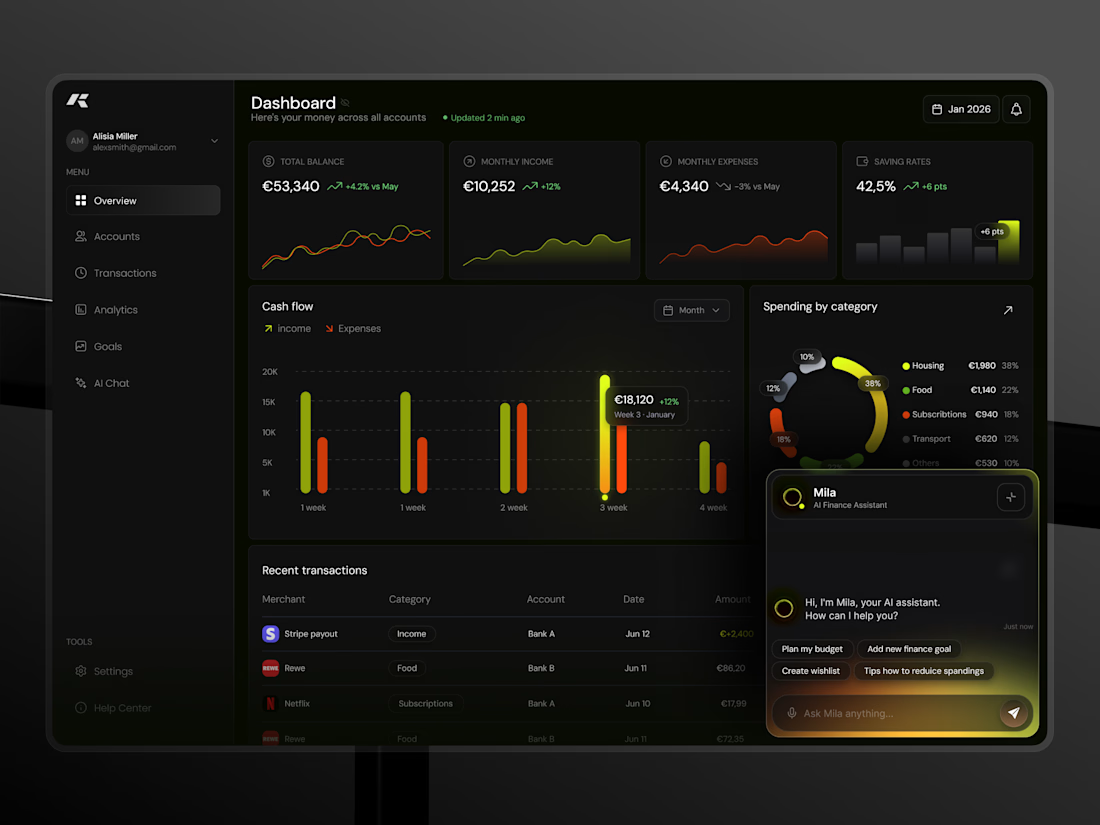
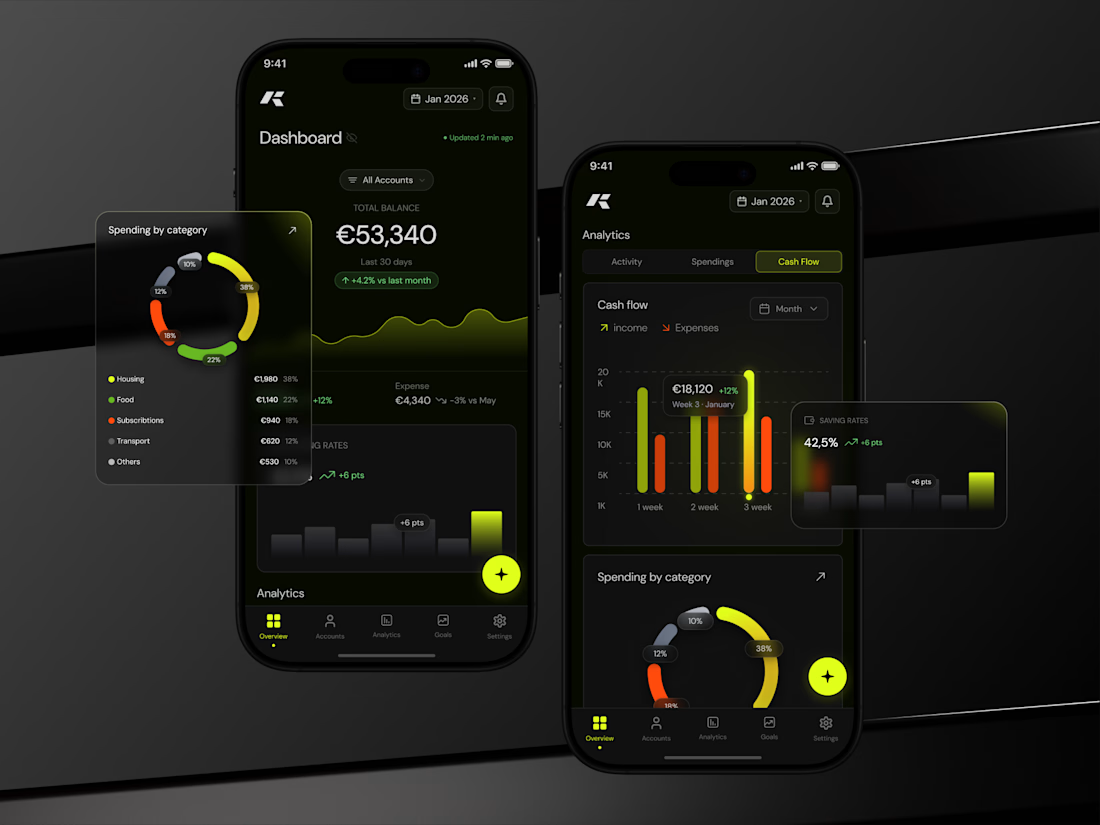
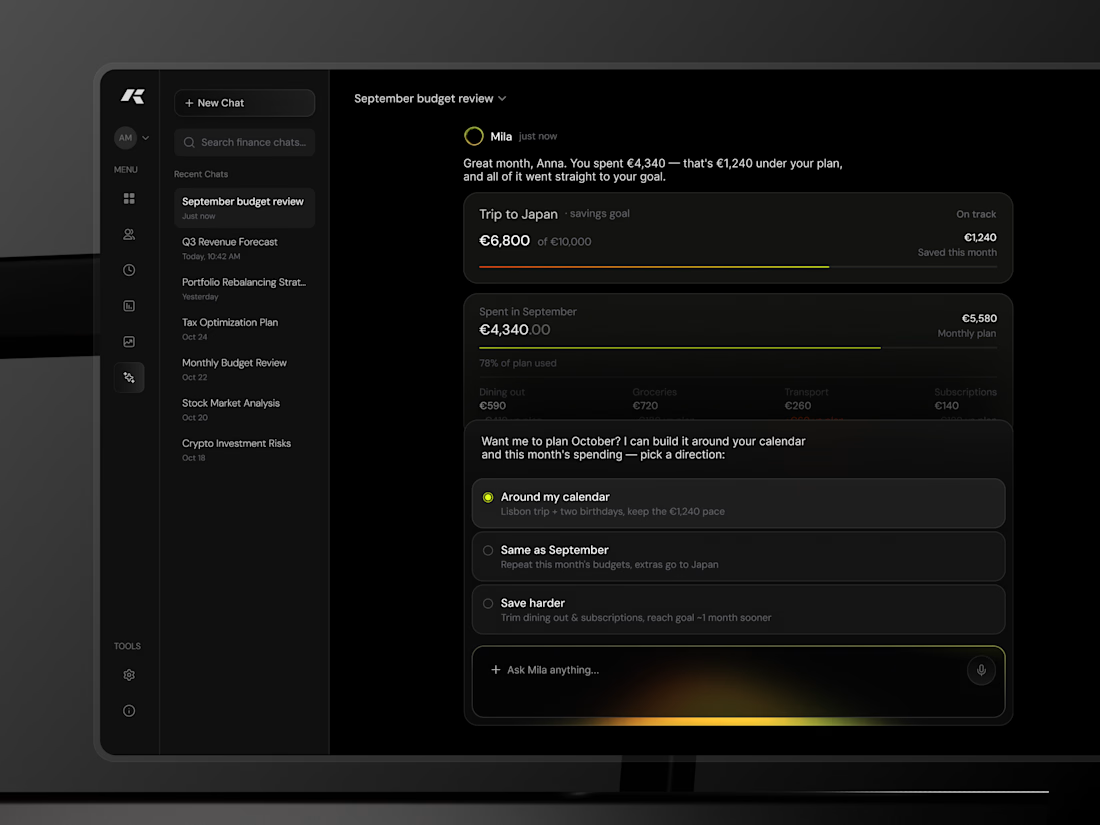
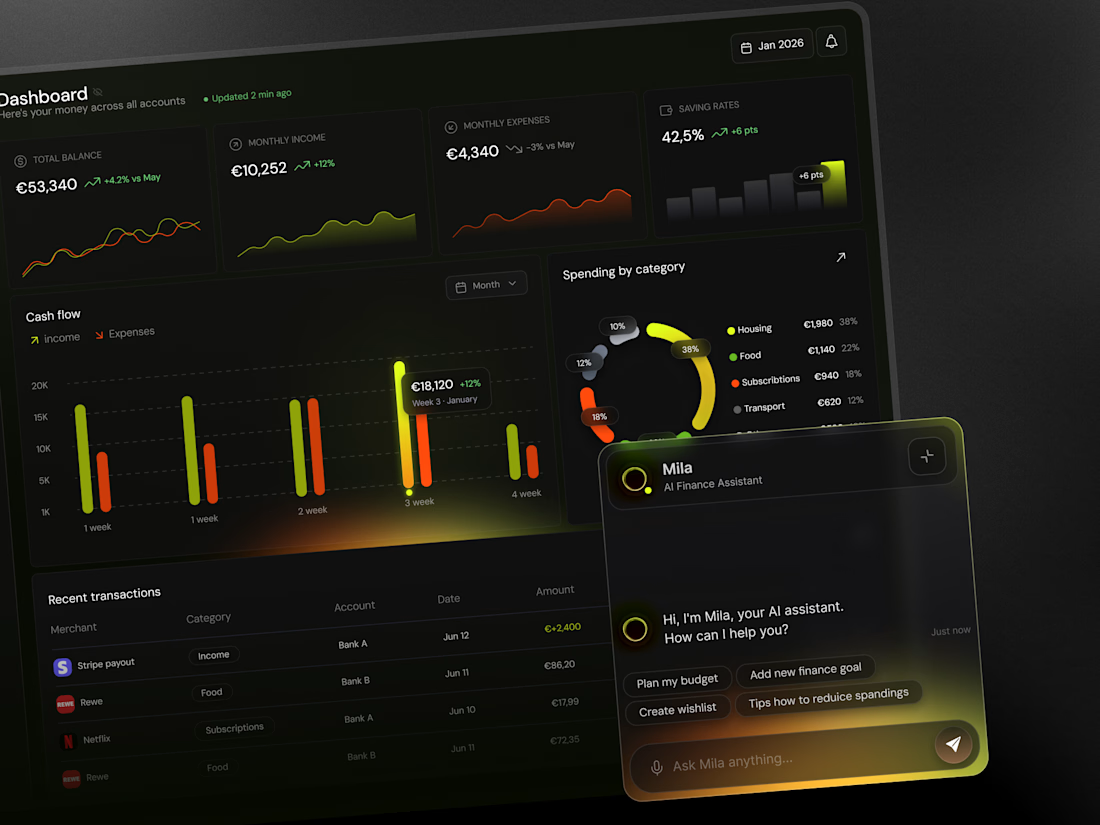
Konto — Personal finance planner, web dashboard and mobile app
Konto is a personal finance planner concept I designed for both desktop and mobile, sharing one data model and one visual language.
Web dashboard: four KPI cards (balance, income, expenses, saving rate) with mini-charts, a weekly cash-flow chart with income and expenses side by side, spending by category as a segmented ring with a legend, and a recent-transactions table. The AI assistant lives in a docked panel bottom-right.
Mobile: the dashboard leads with total balance and a 30-day trend, then cash flow, saving rate and categories in one scroll. Analytics gets its own tabbed view. A floating action button opens the assistant from anywhere.
The visual system is dark by default with two signal colours: lime for income and growth, orange for spending. Glows are used only on the active data point, so highlights mean something. Numbers use the same layout and spacing on both platforms, so switching devices doesn't require re-learning the app.