The network for creativity
Join 1.25M professional creatives like you
Connect with clients, get discovered, and run your business 100% commission-free
Creatives on Contra have earned over $150M and we are just getting started
Back to feedPost
How to Build a High-Income Career in Commercial Finance?
Commercial finance has evolved far beyond traditional budgeting, reporting, and financial analysis. Today, high-performing commercial finance professionals sit at the intersection of finance, strategy, revenue, pricing, sales, operations, and executive decision-making.
For professionals who understand how to connect financial analysis with business growth, Commercial Finance can become one of the most financially rewarding areas of a finance career.
But high income does not come simply from having a finance title. It comes from becoming the person who can identify opportunities, improve profitability, influence decisions, and deliver measurable commercial results.
The Real Path to Higher Income
The most valuable Commercial Finance professionals do not ask only:
“What happened to the numbers?”
They ask:
“Why did it happen, what will happen next, and what should the business do about it?”
That difference is critical.
A traditional finance role may focus heavily on reporting historical performance. A commercially focused finance leader goes further by helping management determine:
Where revenue is coming from
Which customers and products are most profitable
Where margins are being lost
How pricing should change
How sales incentives influence behavior
Where costs can be optimized
How working capital can be improved
Which investments are likely to generate the highest return
What actions can increase sustainable EBITDA
This is where finance becomes a direct driver of enterprise value.
1. Become a Revenue and Profitability Expert
One of the strongest ways to increase your market value is to move beyond accounting-oriented thinking and develop deep expertise in revenue and profitability management.
Companies care about revenue, but revenue alone is not enough.
A business can grow sales while simultaneously destroying margin.
Commercial finance professionals therefore need to understand the relationship between:
Volume + Price + Mix + Cost = Profitability
For example, a finance leader might discover that a company increased sales by 12%, but the improvement came primarily from low-margin customers. By analyzing customer profitability, product mix, discounting, and pricing, the finance team can identify where growth is actually creating economic value.
The professional who can uncover and communicate these insights becomes much more valuable than someone who simply produces the monthly report.
2. Develop Pricing Expertise
Pricing is one of the most powerful commercial levers available to a business.
Even a relatively small improvement in pricing can have a significant impact on profitability because additional revenue from pricing often carries a much higher contribution margin than additional volume.
High-value Commercial Finance professionals understand:
Price elasticity
Discount structures
Customer segmentation
Competitive positioning
Contract economics
Promotional effectiveness
Contribution margins
Price-volume-mix analysis
They work closely with sales and commercial teams to answer an important question:
Are we charging the right price for the value we provide?
Professionals who can translate pricing analysis into measurable margin improvement are highly attractive to organizations because their work can directly affect the bottom line.
3. Learn to Influence Sales and Commercial Decisions
A high-income finance career requires more than technical financial knowledge.
You need the ability to influence people outside of finance.
The strongest Commercial Finance leaders work closely with:
Sales
Marketing
Product
Operations
Procurement
Revenue Management
Strategy
Executive Leadership
Instead of becoming the finance department that says “no,” successful commercial finance teams become strategic partners that explain how the company can achieve its objectives profitably.
For example, rather than telling a sales leader that a proposed discount will reduce margin, a strong finance partner might present several scenarios:
Option A: 10% discount with higher volume
Option B: 5% discount with improved margin
Option C: No discount with additional customer value
This transforms finance from a control function into a decision-making partner.
4. Master Financial Modeling and Business Intelligence
High-income finance professionals combine financial judgment with strong analytical capabilities.
Important skills include:
Advanced Excel
Financial modeling
Power BI
SQL
Data visualization
Forecasting
Scenario analysis
Revenue analytics
Customer profitability analysis
KPI development
The objective is not to become a data analyst for its own sake.
The objective is to turn large amounts of business data into clear financial decisions.
A senior finance professional should be able to move from:
Raw Data → Analysis → Insight → Recommendation → Business Action → Financial Result
That complete chain is extremely valuable.
5. Become an Expert in Forecasting and Scenario Planning
Executives rarely want to know only what happened last quarter.
They want to know what happens next.
That makes forecasting and scenario planning essential Commercial Finance capabilities.
A strong finance leader should be comfortable developing scenarios such as:
Base case
Upside case
Downside case
Recession scenario
Pricing scenario
Volume scenario
Cost inflation scenario
Investment scenario
The goal is not to predict the future perfectly.
The goal is to help leadership understand the financial consequences of different decisions before those decisions are made.
That is strategic finance.
6. Connect Finance to Business Outcomes
If you want to command higher compensation, learn to measure your work in business outcomes rather than activities.
Instead of saying:
“I built a financial model.”
Say:
“I developed a profitability model that identified margin opportunities and supported pricing decisions.”
Instead of:
“I prepared the annual budget.”
Say:
“I led the planning process and identified opportunities to improve operating leverage and profitability.”
Instead of:
“I created management reports.”
Say:
“I redesigned commercial reporting so leadership could identify revenue and margin trends faster.”
The difference is positioning.
Executives pay more for outcomes than for tasks.
7. Build Executive Communication Skills
At senior levels, financial expertise alone is not enough.
You must be able to communicate financial information clearly to people who may not have a finance background.
An effective Commercial Finance executive can take hundreds of pages of financial information and reduce them to three questions:
What happened?
Why did it happen?
What should we do next?
This is one of the most important career accelerators in finance.
Strong communication allows a finance professional to participate in executive discussions rather than remaining outside the decision-making process.
8. Understand the Economics of the Business
To become highly compensated, do not limit yourself to finance.
Understand the entire commercial engine.
Learn how the company acquires customers, generates revenue, delivers products or services, manages costs, and produces cash.
Understand metrics such as:
Gross margin
EBITDA
CAC
LTV
Churn
ARPU
Conversion rate
Retention
Working capital
Free cash flow
Revenue growth
Contribution margin
The exact metrics depend on the industry.
The principle remains the same:
The closer you are to the economic engine of the company, the more valuable your financial expertise becomes.
9. Move Toward Strategic Leadership
The highest-income path in Commercial Finance generally involves increasing the scope of responsibility.
A professional career may progress through positions such as:
Financial Analyst → Senior Financial Analyst → Commercial Finance Manager → Director of Commercial Finance → VP Finance / VP Commercial Finance → CFO
The exact titles vary between organizations, but the underlying progression is similar.
Responsibility expands from:
Reporting → Analysis → Planning → Decision Support → Commercial Strategy → Enterprise Leadership
At senior levels, compensation increasingly reflects the scale of decisions you influence and the value you create.
10. Build Multiple Sources of Professional Income
A senior Commercial Finance professional can potentially diversify income beyond a primary salary.
Depending on experience, expertise, employment restrictions, and applicable laws, opportunities can include:
Financial consulting
Commercial strategy consulting
Pricing advisory
Fractional finance leadership
Financial modeling services
Corporate finance training
Executive advisory work
Speaking and professional education
Industry research and publishing
However, these activities should complement—not compromise—the professional's primary career, reputation, confidentiality obligations, or employment agreements.
The objective should be sustainable professional leverage, not chasing every possible side opportunity.
11. Negotiate Compensation Based on Value
One of the biggest mistakes professionals make is negotiating only around years of experience.
Experience matters, but measurable impact is stronger.
A stronger compensation conversation sounds like:
“My experience has enabled me to improve forecasting accuracy, identify pricing opportunities, strengthen commercial planning, and support decisions that improve profitability.”
The more clearly you can connect your experience to financial outcomes, the stronger your compensation case becomes.
At senior levels, total compensation may include:
Base salary
Annual bonus
Performance incentives
Long-term incentives
Equity
Deferred compensation
Therefore, evaluating an opportunity should involve more than looking at the base salary.
12. Develop a Personal Commercial Finance Brand
High-income professionals are often recognized for something specific.
Instead of positioning yourself simply as:
“Finance Professional”
develop a more differentiated reputation around areas such as:
Commercial Finance | Revenue Management | Pricing Strategy | FP&A | Profitability | Business Performance
Then consistently demonstrate that expertise through:
Professional articles
Industry analysis
Case studies
LinkedIn content
Presentations
Professional networking
Executive-level discussions
A strong professional reputation can create opportunities that traditional job applications cannot.
The Commercial Finance High-Income Formula
A sustainable high-income career can be thought of as:
Financial Expertise + Commercial Understanding + Technology + Communication + Measurable Business Impact + Leadership
Technical finance knowledge gets you into the conversation.
Commercial understanding makes you valuable.
Analytical and technology skills make you more efficient.
Communication makes executives listen.
Measurable business impact makes your contribution visible.
Leadership increases your scope—and ultimately your earning potential.
Final Perspective
The future of Commercial Finance belongs to professionals who can do more than explain financial statements.
The highest-value finance leaders understand how businesses make money, where they lose money, how pricing and customer behavior affect profitability, and which decisions can create sustainable growth.
If your goal is to build a high-income career in Commercial Finance, focus less on collecting titles and more on building a track record of measurable commercial impact.
Become the finance professional who can walk into an executive meeting, understand the numbers, identify the opportunity, explain the risk, recommend the action, and help the business execute.
That is where finance becomes strategic.
And that is where a finance career can become significantly more valuable.
https://finance.yahoo.com/economy/policy/articles/sergio-p-mendes-highlights-data-180000112.html ,
https://about.me/sergio.p.mendes ,
https://www.crunchbase.com/person/sergio-mendes-6e60 ,
https://cloutrep.com/profile/sergio-p-mendes/ ,
https://www.24-7pressrelease.com/press-release/533973/sergio-p-mendes-shares-a-practical-framework-for-turning-data-into-decisions


A strong article. Commercial Finance is no longer just about reporting numbers—it is about turning financial insights into profitable decisions. I especially agree that pricing, profitability, forecasting, and executive communication are key drivers of both business impact and career growth.

A very practical perspective on building a high-income career in Commercial Finance. The key takeaway for me is that real value comes from connecting financial expertise with revenue growth, profitability, strategic decision-making, and measurable business outcomes. Strong...

Well said. The real advantage in Commercial Finance comes from combining financial discipline with commercial thinking. Professionals who can turn data into actionable growth and profitability strategies become true strategic partners to the business.
The network for creativity
Join 1.25M professional creatives like you
Connect with clients, get discovered, and run your business 100% commission-free
Creatives on Contra have earned over $150M and we are just getting started
Trending
retrofuturism
Share your favorite designs from the past exploring the distant future. Or your own take on the aesthetic 🚀
halftone
Dots. Texture. Grain. Let's see your designs using the halftone technique.

Midjourney
Creatives are showing off what they're making with Midjourney.
colorgrade
Video editors sound off: How do you enhance the mood of your video in color grading?





Related posts

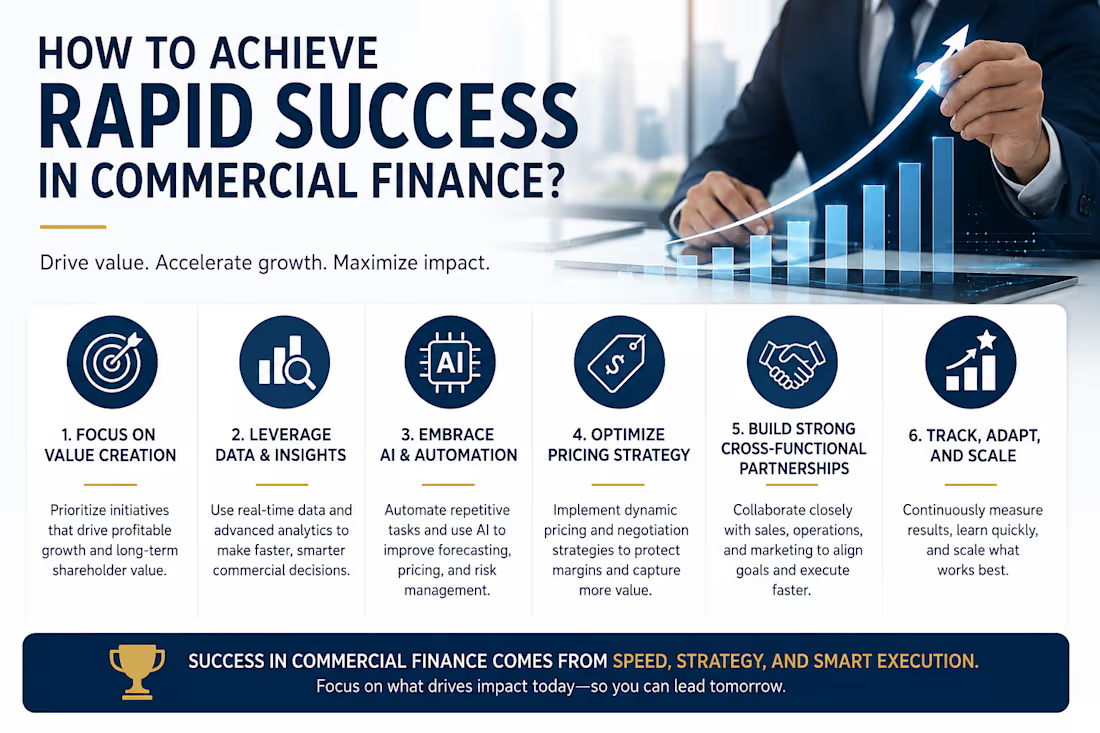
How to Achieve Rapid Success in Commercial Finance
Commercial finance is becoming one of the most important strategic functions inside modern organizations.
The role is no longer limited to budgeting, reporting, forecasting, and explaining financial results. Today, commercial finance leaders are expected to help businesses grow revenue, protect margins, improve cash flow, optimize pricing, and make better decisions faster.
But how can professionals and organizations achieve rapid success in this environment?
The answer is not simply working harder or producing more financial reports. Rapid success comes from connecting financial intelligence with commercial action.
1. Start With Profitable Growth
The first step is to stop treating revenue growth as the only measure of success.
A business can increase sales while profitability declines because of discounting, rising costs, poor customer mix, or inefficient operations.
Commercial finance should therefore focus on questions such as:
Which customers generate the strongest margins?
Which products create the most value?
Where are discounts reducing profitability?
Which markets deserve additional investment?
Which revenue opportunities generate sustainable cash flow?
The objective is simple:
Grow revenue—but make sure the growth creates economic value.
2. Turn Data Into Decisions
Modern commercial finance teams have access to enormous amounts of financial, customer, operational, and market data.
The competitive advantage comes from turning that information into decisions.
Instead of producing reports that only explain what happened last quarter, finance teams should provide insights that answer:
What is happening? Why is it happening? What happens next? What should we do about it?
This requires stronger data integration, reliable performance metrics, and clear communication with commercial leadership.
3. Make Pricing a Financial Strategy
Pricing can have a significant impact on profitability.
A small improvement in realized pricing can sometimes create more value than a large increase in sales volume—particularly when additional volume requires higher acquisition, fulfillment, or service costs.
Commercial finance should work closely with sales and revenue-management teams to evaluate pricing by:
Customer segment
Product
Geography
Channel
Volume
Discount level
Contribution margin
The goal is not simply to increase prices.
The goal is to capture the value the company creates.
4. Use AI to Increase Decision Speed
Artificial intelligence is changing how finance teams operate.
AI can support forecasting, scenario analysis, anomaly detection, management reporting, pricing analysis, and working-capital monitoring.
However, the greatest opportunity is not automation for its own sake.
The real advantage is decision speed.
A finance team that can identify a margin problem today rather than at the end of the quarter has a significant strategic advantage.
AI should therefore be viewed as a decision-support capability that strengthens financial judgment—not as a replacement for it.
5. Protect Cash Flow
Profitability and cash flow are closely connected, but they are not the same.
Rapid growth can consume cash through higher inventory requirements, longer customer payment cycles, increased staffing, and additional capital expenditure.
Successful commercial finance teams continuously monitor:
Accounts receivable.
Inventory.
Payment terms.
Working capital.
Capital expenditure.
Operating cash flow.
A strong growth strategy should answer two questions:
How much profit will this opportunity generate?
and
How much cash will we need to support it?
6. Build Strong Relationships With Commercial Teams
Finance cannot create rapid business impact while operating in isolation.
The most effective commercial-finance professionals build strong relationships with sales, marketing, operations, procurement, and executive leadership.
They understand the commercial reality behind the numbers.
Instead of simply saying:
“The margin is declining.”
they help explain:
“Margin is declining because customer discounts increased, product mix shifted, and fulfillment costs rose. Here are three actions that could reverse the trend.”
That is the difference between financial reporting and financial leadership.
7. Focus on a Small Number of High-Impact Metrics
More metrics do not necessarily create better decisions.
Commercial finance should identify the indicators that genuinely influence business performance.
Depending on the organization, these may include:
Revenue growth
Gross margin
Contribution margin
Customer profitability
Price realization
Customer acquisition cost
Working capital
Operating cash flow
Forecast accuracy
Return on invested capital
The goal is to create a clear performance system where leadership can quickly understand what is working and what requires intervention.
8. Develop Scenario-Based Thinking
Markets can change quickly.
Interest rates, customer demand, input costs, competition, regulation, and technology can all affect financial performance.
Instead of relying on a single forecast, commercial finance teams should develop multiple scenarios.
For example:
Base case: Expected business performance.
Upside case: Stronger demand, better pricing, or improved margins.
Downside case: Lower demand, higher costs, or weaker customer retention.
Scenario planning allows executives to prepare before conditions change rather than reacting after the impact appears in financial statements.
9. Communicate Finance in Business Language
One of the fastest ways to increase influence is to communicate financial information clearly.
Executives and commercial teams generally do not need more complicated spreadsheets.
They need answers.
A strong finance leader can translate financial analysis into business language:
What happened?
Why did it happen?
What is the financial impact?
What should we do next?
When finance communicates this way, it becomes easier for the organization to act on financial insights.
10. Create a Culture of Continuous Improvement
Rapid success is rarely the result of one major initiative.
It usually comes from continuous improvements across pricing, forecasting, cost management, customer profitability, working capital, and capital allocation.
The strongest commercial finance organizations constantly ask:
Can we forecast better?
Can we price smarter?
Can we reduce unnecessary costs?
Can we convert revenue into cash faster?
Can we identify profitable opportunities earlier?
This mindset transforms finance from a reporting department into a continuous source of business improvement.
The Formula for Rapid Commercial Finance Success
Rapid success in commercial finance ultimately comes from combining several capabilities:
Better data + faster analysis + commercial understanding + disciplined execution = stronger financial performance.
Technology can accelerate analysis.
AI can improve speed.
Data can improve visibility.
But leadership determines whether those capabilities translate into results.
The most successful commercial finance professionals will be those who can connect financial discipline with commercial opportunity.
They will understand that the purpose of finance is not simply to explain yesterday's numbers.
It is to help the business make better decisions today that create greater value tomorrow.
The Bottom Line
Commercial finance is entering an era where speed, profitability, data, AI, pricing, and cash flow are increasingly interconnected.
Organizations that want rapid success should stop viewing finance as a function that only measures performance.
Finance should help create performance.
The winning commercial-finance model is therefore not:
Revenue → Reporting → Review
It is:
Data → Insight → Decision → Action → Profitable Growth
That is how commercial finance can move from being a financial support function to becoming a genuine engine of sustainable business growth.
https://www.24-7pressrelease.com/press-release/533973/sergio-p-mendes-shares-a-practical-framework-for-turning-data-into-decisions
https://about.me/sergio.p.mendes
https://finance.yahoo.com/economy/policy/articles/sergio-p-mendes-highlights-data-180000112.html
How Commercial Finance Can Turn Revenue Growth Into Real Income
In today’s competitive business environment, increasing revenue is only part of the challenge. The bigger question is: Are we converting that revenue into sustainable profit and stronger cash flow?
As a VP of Commercial Finance and Revenue Management, I see commercial finance as the connection between financial strategy, pricing, customer value, and business growth.
A company can generate millions in additional sales and still underperform if pricing is too aggressive, customer acquisition costs are rising, discounts are uncontrolled, or low-margin revenue is consuming valuable resources.
The real opportunity is to focus on profitable growth.
That means:
• Analyzing revenue and margin by customer, product, and market
• Improving pricing and discount strategies
• Identifying the most profitable revenue channels
• Strengthening forecasting and financial planning
• Connecting sales targets with realistic profitability goals
• Turning financial data into decisions that improve cash flow and income
For businesses in competitive markets like Norwalk and the broader New York–Connecticut region, finance leaders have an increasingly important role: not simply reporting what happened, but helping management decide what should happen next.
Revenue management should ultimately answer three questions:
Where is the money coming from?
Where is profit being lost?
What decisions can create more profitable income?
The strongest commercial finance organizations do more than protect the bottom line. They help build a business model where growth, margin, and cash generation work together.
#CommercialFinance #RevenueManagement #FinancialStrategy #Profitability #RevenueGrowth #FPandA #BusinessFinance #FinanceLeadership

Revenue growth is valuable only when it creates sustainable profit and stronger cash flow. Commercial Finance helps businesses connect pricing, customer value, margins, forecasting, and strategic decision-making to achieve profitable growth. The focus should not simply be on...


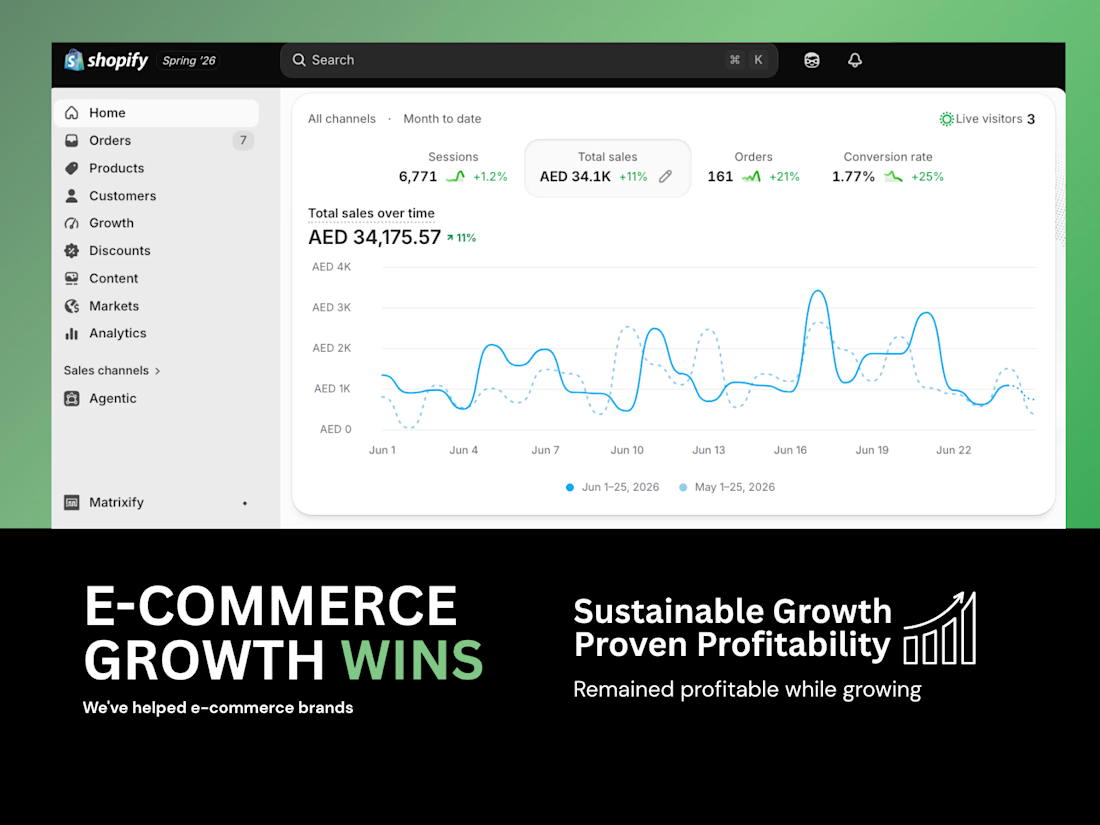
Check it out Challenge: An ecommerce business owner needed a Performance marketing expert for business growth. With a 100+ SKU Shopify ecommerce website, their online business stalled due to poor Facebook Ads Manager setups and underperforming google ads.
Solution: I took over Google Ads Account Management and Facebook Ads, auditing all channels. I used Google Merchant Center to Manage Google Shopping feeds, handled the PPC Campaign Setup & Management, and drove ecommerce growth via data loops.
Results: Scaled online shopping revenue and ROAS.